Clear Sky Science · en
Absolute configuration, improved synthesis and femtogram-level behavioral activity of the sex pheromone of the minute parasitoid wasp Trichogramma turkestanica
Tiny wasps with a big job
Many of us rely on pest control to protect crops, stored food, and even pantry shelves at home. One group of helpers is almost invisible: Trichogramma wasps, smaller than a grain of dust, that lay their eggs inside moth eggs and prevent caterpillars from hatching. This study explores how males and females of one such species, Trichogramma turkestanica, find each other using incredibly small amounts of sex scent, and shows how understanding this signal could sharpen an important tool in sustainable pest control.
How minute wasps help fight moth pests
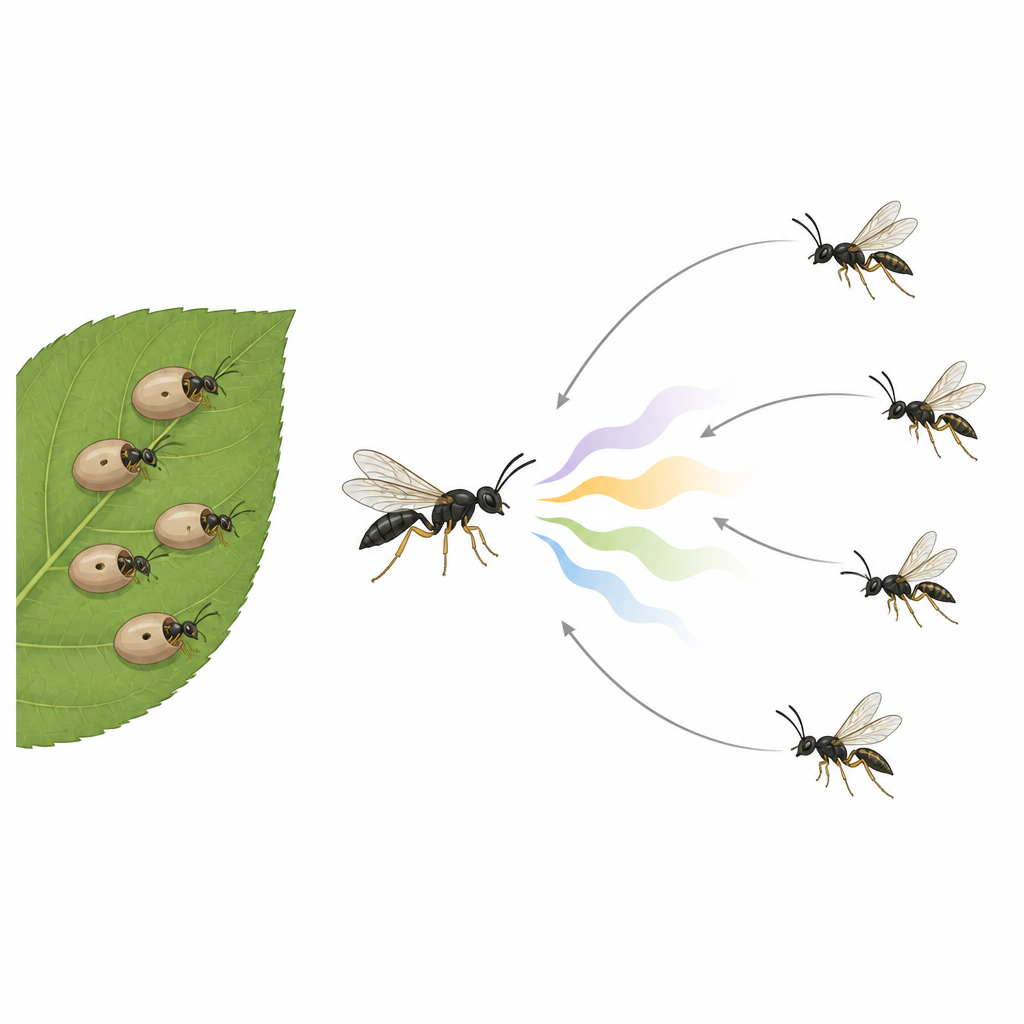
Trichogramma wasps are widely released in fields, greenhouses, warehouses, and private homes to keep moth populations down. Each female attacks the eggs of butterflies and moths, killing the developing embryos. Because the adult wasps are less than half a millimeter long and weigh around eight millionths of a gram, almost everything about them happens at a tiny scale. Males and females must still locate one another to mate, and their antennae are packed with smell-sensing hairs. Earlier work suggested that females release a special sex scent that only males can pick up, but the exact chemical nature of this pheromone and its full effect on behavior had not been pinned down.
Cracking the scent code molecule by molecule
Previous research had hinted at two related molecules produced only by virgin females: one hydrocarbon and one closely related alcohol. The catch was that females release such minute amounts that ordinary analytical methods struggled to identify the exact three-dimensional shapes of these compounds. In chemistry, the “handedness” of a molecule can greatly affect how well it fits into a biological receptor. The authors tackled this challenge by building the candidate molecules from scratch in a highly controlled way and then comparing them to the natural scent collected from live females. They used specialized gas chromatography on a chiral, or handed, column to separate mirror-image forms and showed that both natural compounds shared the same specific spatial arrangement at three key positions along their carbon chains.
Smarter chemistry for difficult natural scents
Armed with this information, the team designed a more efficient route to make the pheromone in the laboratory. Earlier attempts to synthesize one of the components required 16 steps and produced only tiny yields. The new pathway starts from a simple building block that is split asymmetrically by enzymes, then uses a series of carefully chosen reactions to add methyl branches and double bonds in the correct order. A key intermediate, already known from other natural products, serves as a hub from which both the hydrocarbon and the alcohol versions of the pheromone can be made. This streamlined synthesis produced much more material with fewer steps, opening the door to behavioral tests and practical applications.
Watching males respond to whisper-level signals
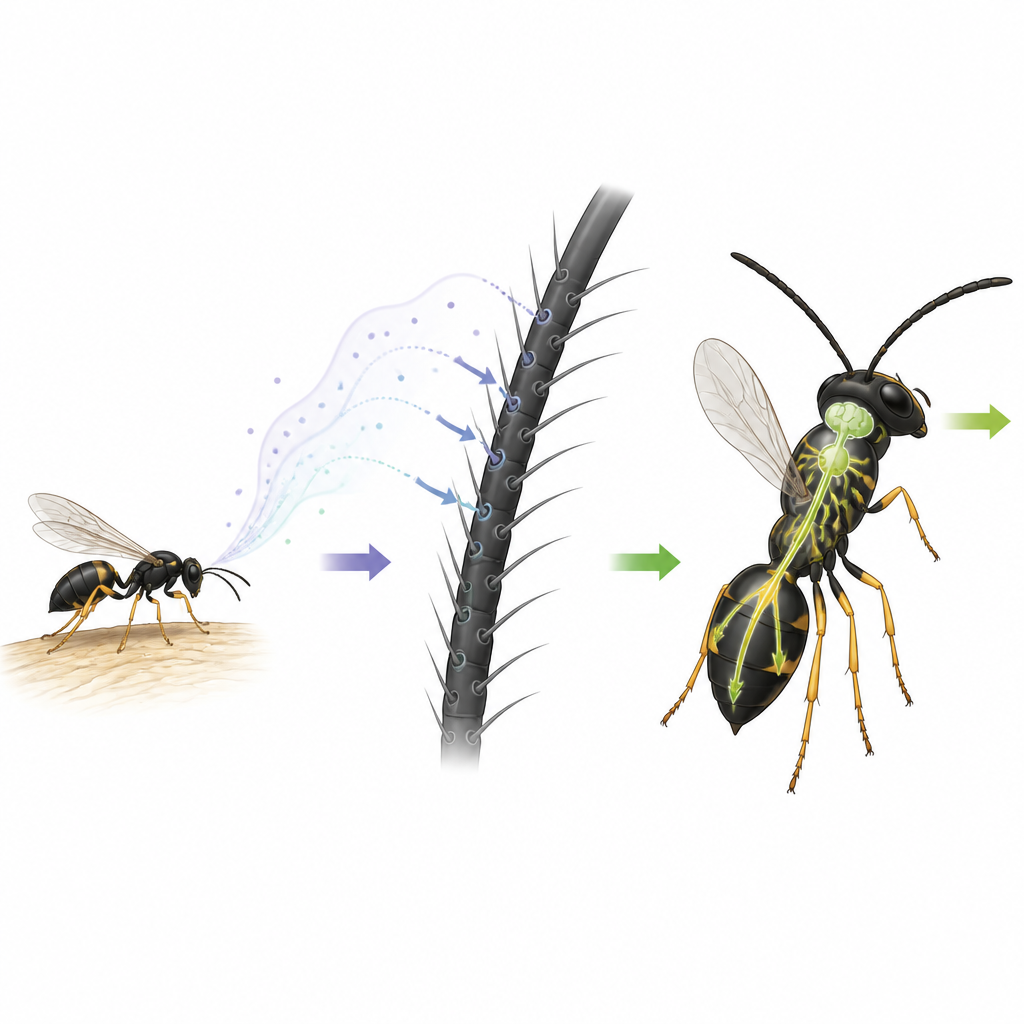
To see whether the synthetic scent truly acted as a sex pheromone, the researchers observed males in a tiny arena under a microscope. They coated dead, solvent-washed female bodies, used as scentless dummies, with known amounts of the lab-made compounds, either alone or in the natural 3-to-1 mixture of alcohol to hydrocarbon. Males were then released at the edge of the arena and watched for up to five minutes. Even when the total dose on each dummy was in the attogram range, far below what most people would consider measurable, males were more attracted, arrived sooner, stayed longer near the dummy, and showed a characteristic zigzagging “casting” pattern that marks the start of courtship. The alcohol component was more active on its own, while the hydrocarbon boosted the effect at low doses.
What this means for pest control and insect senses
The study shows that the sex pheromone of T. turkestanica consists of two closely related molecules with a precisely defined three-dimensional shape, and that males can detect and react to vanishingly small quantities. This makes the species one of the tiniest insects whose sex scent has been fully described. By providing both a clear chemical identity and a practical synthetic route, the work sets the stage for using these molecules in field traps to monitor wasp populations and improve biological control programs. It also highlights just how sensitive insect noses can be, responding reliably to amounts of scent that are hard to even imagine, let alone measure.
Citation: van Beek, T.A., Kaniraj, J.P., Dornbusch, A. et al. Absolute configuration, improved synthesis and femtogram-level behavioral activity of the sex pheromone of the minute parasitoid wasp Trichogramma turkestanica. Sci Rep 16, 15679 (2026). https://doi.org/10.1038/s41598-026-46414-z
Keywords: sex pheromone, Trichogramma wasp, biological control, insect behavior, chemical ecology