Clear Sky Science · en
Tunable colorless and transparent copoly(ester imide)s and nanocomposites derived from an optimized composition
Clear Plastics That Can Take the Heat
Modern gadgets, from foldable phones to solar cells, need plastic films that are both crystal clear and tough enough to survive high temperatures. Glass is clear but heavy and brittle; conventional high‑temperature plastics are strong but often dark amber and block light. This study explores a new family of see‑through plastics and their clay‑reinforced versions that aim to combine the best of both worlds: glass‑like clarity with the ruggedness needed for next‑generation flexible electronics.
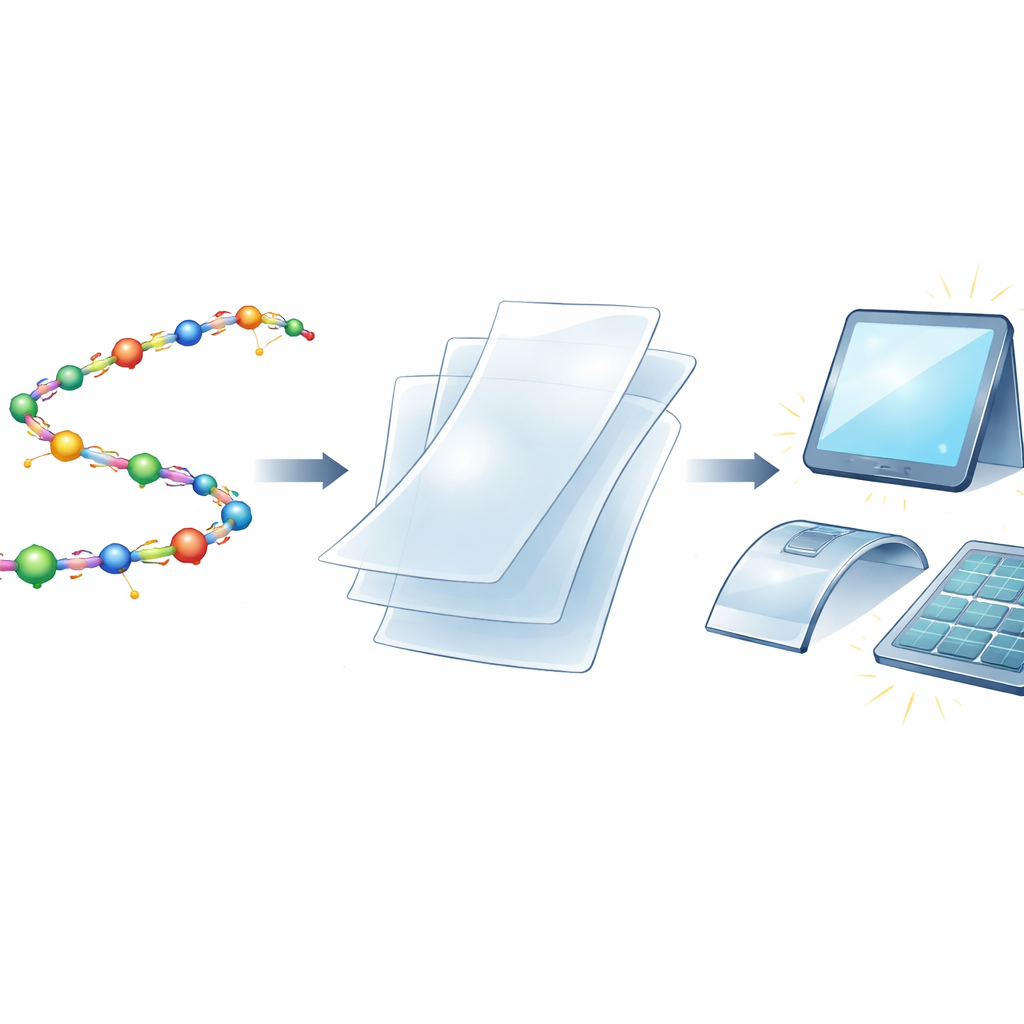
Why Regular High‑Tech Plastics Are Not Really Clear
Many of today’s most heat‑resistant plastics are built from rigid, ring‑shaped molecules that stack tightly together. This gives them excellent stability but also makes them absorb visible light, so they appear brownish instead of transparent. Engineers can "bend" or disrupt these stacks by tweaking the molecular shapes, which lightens the color but often weakens the material or lowers its heat tolerance. The challenge is to redesign the building blocks so that the chains no longer form light‑absorbing complexes, yet still lock together strongly enough to resist heat and mechanical stress.
Designing a New Clear and Tough Plastic
The researchers created a series of new plastics by combining three types of small molecular building blocks in different ratios. One ingredient provides flexible linkers that keep the material colorless and transparent, while two others are rigid units that stiffen the chains and improve heat and mechanical performance. By gradually shifting the balance between a bent, kinked rigid unit and a straighter, rod‑like one, they could tune how tightly the chains pack, how easily they move, and how light passes through the resulting films. All of the films remained clear and nearly colorless to the naked eye, but those with more of the straight unit showed higher softening temperatures and greater strength, at the cost of a slight drop in light transmission.
Adding Tiny Layers of Clay for Extra Strength
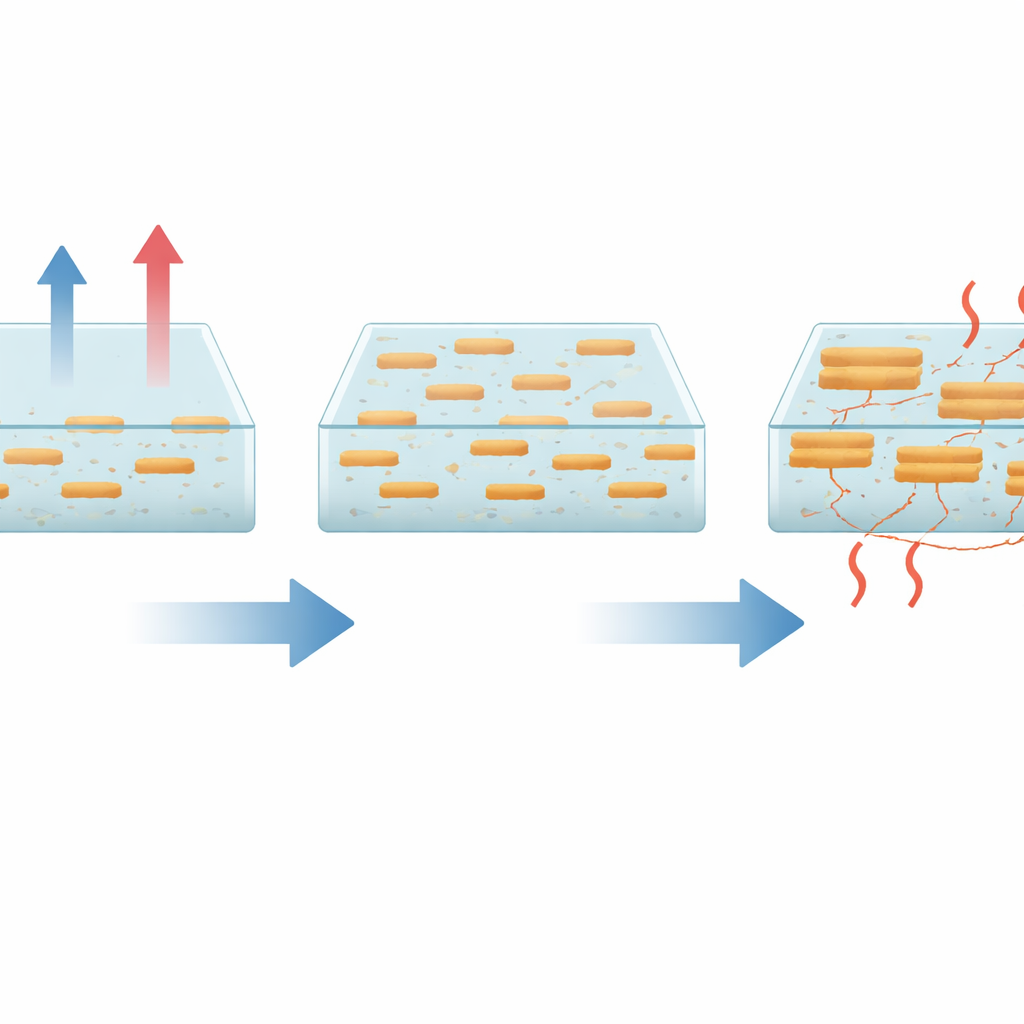
To push performance further, the team selected one particularly balanced plastic recipe and mixed in very thin platelets of a specially treated clay. These platelets are only a few nanometers thick—thousands of times thinner than a human hair—and can slip between the polymer chains. When a small amount of clay (up to about one‑tenth of the film’s weight) was added and spread evenly, the platelets acted like reinforcing rebar, restricting chain motion and making the film significantly stiffer and more heat‑resistant. Microscopy and X‑ray measurements showed that, in this range, the clay layers remained well dispersed, forming a true nanocomposite in which the polymer and inorganic sheets are intimately interwoven at the nanoscale.
When Too Much of a Good Thing Becomes Harmful
Once the clay content passed this critical level, the benefits reversed. Instead of remaining evenly distributed, the platelets began to clump together into larger stacks and particles. These aggregates created tiny defects and weak spots, lowering the material’s strength and making it more prone to thermal degradation. They also scattered light more strongly, causing the films to darken and lose transparency. In other words, there is an optimal clay loading where the material is maximally reinforced yet still looks like clear plastic; beyond that, added filler does more harm than good.
What This Means for Future Flexible Devices
By carefully choosing the molecular building blocks and fine‑tuning both their ratios and the amount of clay added, the authors show that it is possible to engineer plastic films that are thin, flexible, heat‑resistant, and nearly as transparent as window glass. These tunable materials could replace brittle glass in flexible displays, lightweight circuit boards, advanced sensors, and other devices that must endure heat and bending without clouding or yellowing. The work highlights a broader lesson: in advanced materials, performance depends not only on what ingredients are used, but also on how precisely they are arranged and how much of each is present.
Citation: Choi, Y.C., Shin, Y.S. & Chang, JH. Tunable colorless and transparent copoly(ester imide)s and nanocomposites derived from an optimized composition. Sci Rep 16, 11692 (2026). https://doi.org/10.1038/s41598-026-46406-z
Keywords: transparent polymer films, polyimide alternatives, nanocomposite clays, flexible electronics, high temperature plastics