Clear Sky Science · en
Correlation analysis between visual factors and academic performance in Chinese children
Why clear sight matters in the classroom
Parents and teachers often focus on homework, tutoring, and extra classes when children struggle at school, but everyday vision problems can quietly hold students back. This study from primary schools in Shandong Province, China, explores how different aspects of eyesight relate to test scores in Chinese language and mathematics. By looking beyond simple sharpness of sight, the researchers show that how well a child’s eyes focus and how fully short sightedness is corrected may make a measurable difference to learning.
Looking at many parts of vision
The researchers examined 1,766 children in grades 2 to 5, with an average age of about nine years. Each child received a detailed eye check that measured how clearly they could see with their usual glasses or without any correction, how much astigmatism they had, and how well their eyes could adjust focus when looking at near objects. Two key abilities were tested: how quickly the eyes can switch focus back and forth, and how much "focusing power" is available for close work such as reading and writing. At the same time, the team collected standardized exam scores in Chinese and mathematics, and they also measured each child’s nonverbal intelligence to separate general thinking skills from vision related effects.
Short sightedness and the problem of weak glasses
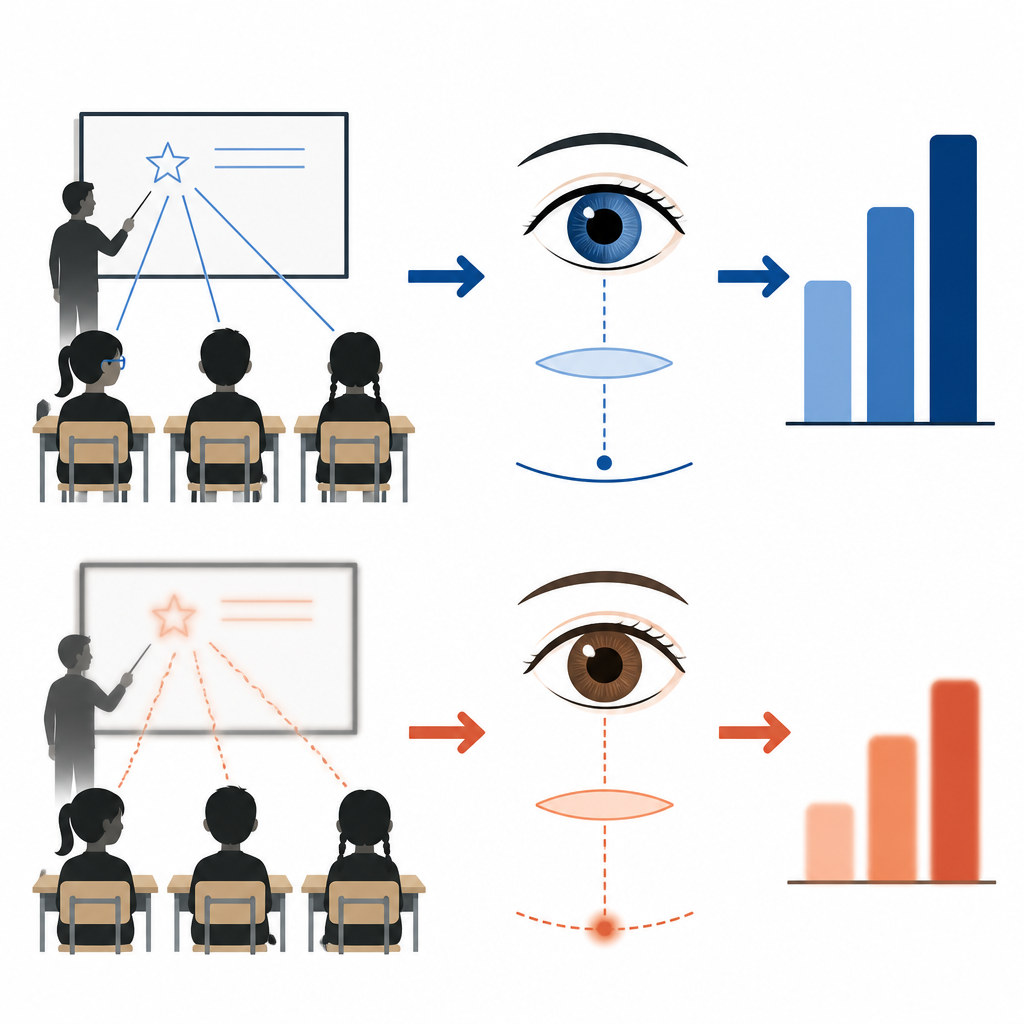
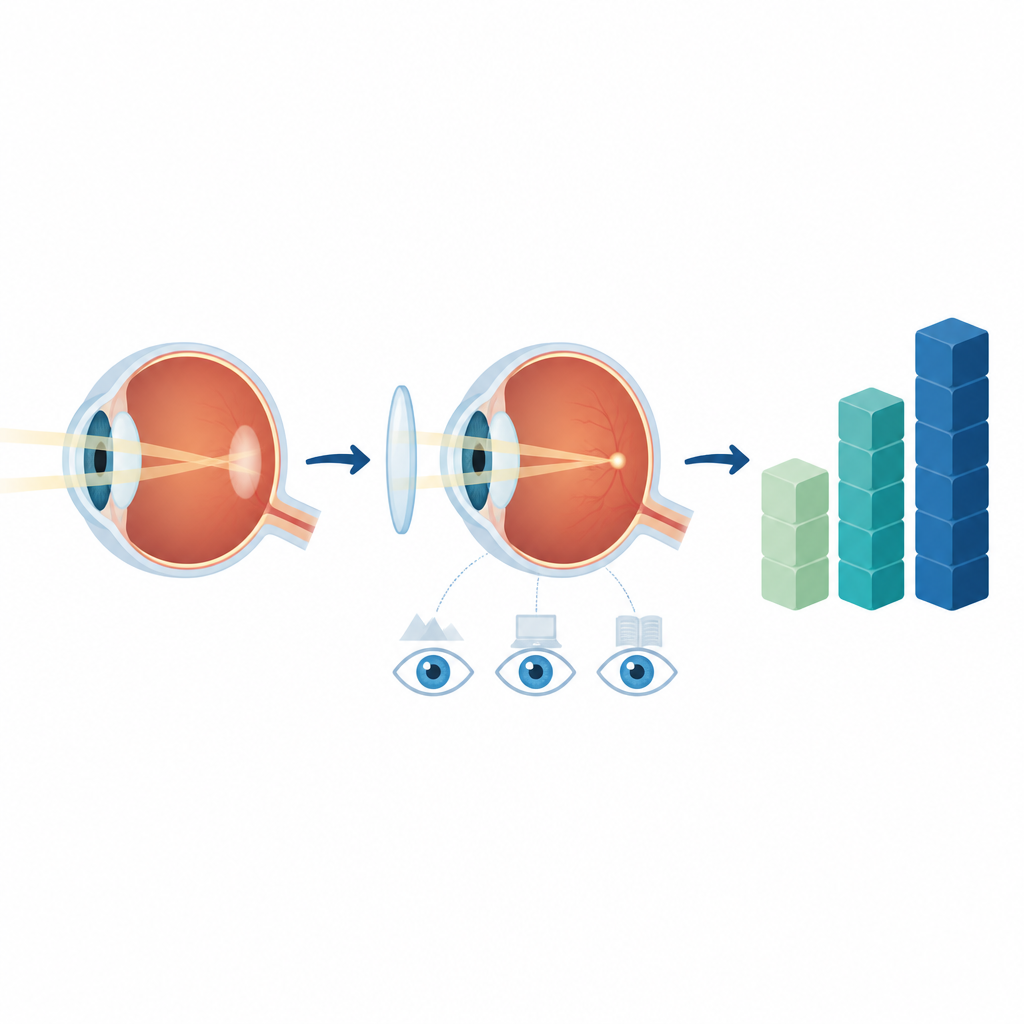
About one quarter of the children were short sighted. Strikingly, just over half of these myopic students were wearing glasses that did not fully correct their vision. The researchers defined this as undercorrection: even with their usual correction, the child’s sight at a standard distance was not as clear as it could be, but improved when stronger lenses were tried. When the team compared test results, children with undercorrected myopia scored lower in Chinese, in mathematics, and in the average of the two subjects than myopic children whose glasses fully corrected their vision. This difference remained even after taking into account gender, intelligence, and other eye measures, suggesting that wearing less than ideal glasses can be linked to lower school performance.
Blur, eye strain, and schoolwork
Beyond myopia itself, several specific visual factors were tied to how well children did in school. Poorer day to day clarity of sight was strongly associated with lower academic scores, which fits with the simple idea that it is harder to follow board work or projected material when the image is blurred. More severe astigmatism, a focusing error that distorts shapes in certain directions, was linked to lower scores as well. This type of blur can interfere with reading fluency and can cause eye strain. In contrast, children whose eyes could change focus more easily and had a larger reserve of focusing power for close work tended to have better exam results. Interestingly, the pattern hinted that language learning might rely more on sustained focusing ability, while mathematics might depend more on flexible switching of focus.
What the findings mean for families and schools
Although the study cannot prove that vision problems directly cause lower grades, it points to an important and practical message. Children with blurrier sight, more astigmatism, weaker near focusing, or undercorrected short sightedness were more likely to have lower exam scores, even after accounting for intelligence and other factors. The results support regular vision checks that include not only simple distance charts but also tests of how well the eyes work together at near ranges. For children who are short sighted, making sure their glasses are updated and fully correct their vision may help reduce visual barriers to learning. In short, paying attention to clear and comfortable sight in the classroom is a sensible step that parents, teachers, and health workers can take to support children’s learning.
Citation: Liu, G., Guo, B., Yu, J. et al. Correlation analysis between visual factors and academic performance in Chinese children. Sci Rep 16, 15424 (2026). https://doi.org/10.1038/s41598-026-46397-x
Keywords: children’s vision, myopia, astigmatism, school performance, eye exams