Clear Sky Science · en
Transcriptomic analysis of Rnq1 loss and prionization reveals alterations in translation pathways and energy metabolism
Why this yeast study matters
Proteins in our cells can sometimes flip into unusual shapes that spread from molecule to molecule, much like a biological chain reaction. These prion-like changes are linked to brain diseases in humans, but they also occur in simple organisms such as yeast, where they can be studied in detail. This paper asks a basic yet important question: when one such protein in yeast changes its shape or disappears, how does that ripple through the cell’s overall activity and energy use?
A shape-shifting protein under the microscope
The researchers focused on Rnq1, a yeast protein known for its ability to act in a prion-like way and to help other proteins clump together. Despite this central role in prion biology, its day-to-day job in healthy cells has been mysterious. To tease this apart, the team built three nearly identical yeast strains that differed only in the state of Rnq1: one with normal Rnq1, one in which Rnq1 had switched into a prion-like form, and one in which Rnq1 could no longer be made. Careful genetic engineering ensured that a neighboring gene needed for cell division was left untouched, avoiding a common source of confusion in earlier studies. 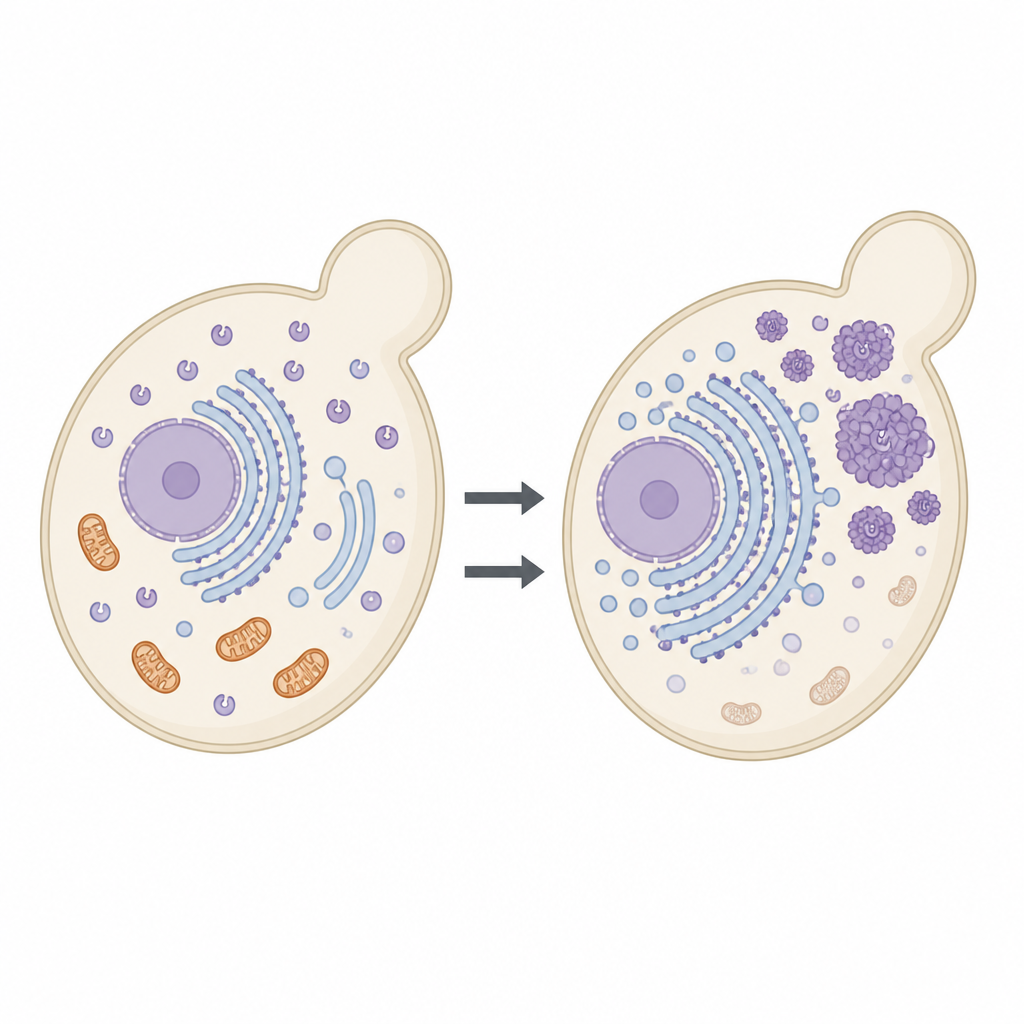
Listening in on the cell’s RNA messages
To see how cells responded to losing or prionizing Rnq1, the team used RNA sequencing, which measures the levels of thousands of RNA molecules at once. These RNAs act as messages that guide which proteins the cell makes. Surprisingly, both the loss of Rnq1 and its conversion into a prion altered roughly one in six of all yeast transcripts, and in both cases more messages went up in abundance than down. Many of the boosted RNAs were small helper RNAs, including tRNAs and snoRNAs, which are key players in reading the genetic code and modifying the cell’s protein factories, the ribosomes. In contrast, many of the transcripts that dropped were linked to energy production, especially in the cell’s power stations, the mitochondria.
Shifting resources from power to production
These sweeping changes paint a consistent picture: when Rnq1 is missing or trapped in prion-like clumps, the cell appears to tilt its resources toward making more proteins while dialing back energy generation. Genes involved in building and fine-tuning the translation machinery became more active, whereas genes that support the mitochondrial respiration chain and certain energy-producing pumps became less active. Measurements of total protein content confirmed that cells with altered Rnq1 actually contained more protein than normal cells, even as many mitochondrial genes were turned down. The prion form of Rnq1 often produced stronger versions of the same effects seen when the protein was absent, suggesting that aggregates of Rnq1 behave like an exaggerated loss of function. 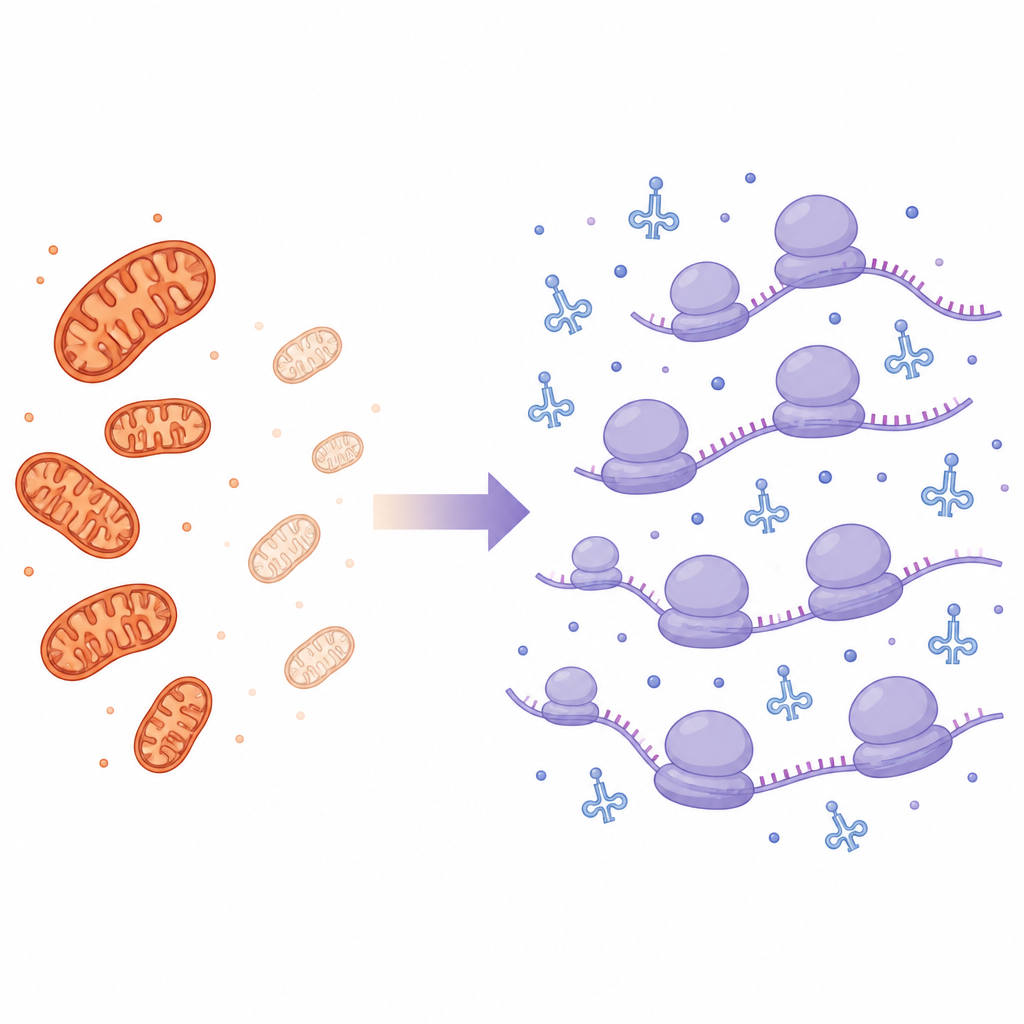
Networks of partners and feedback loops
Rnq1 does not seem to act as a classic gene switch itself; it is not a nuclear protein and is not predicted to bind DNA directly. Instead, the study points to Rnq1 as a hub in a web of partnering proteins involved in protein folding, RNA handling, and transport between cell compartments. Many known Rnq1 partners also showed altered RNA levels when Rnq1 was lost or prionized, especially chaperones that help other proteins fold and factors that move cargo in vesicles. The authors propose that when Rnq1’s normal interactions are disturbed, cells sense the imbalance and respond through feedback, adjusting the activity of RNA polymerases, transcription factors, and RNA-processing machines to restore some degree of balance.
What this means beyond yeast
In simple terms, this work suggests that a single shape-shifting protein can subtly retune how a cell divides its efforts between protein building and energy generation. In yeast, Rnq1 seems to help maintain this balance under normal conditions. When it is lost or locked into prion aggregates, cells compensate by boosting their protein-making toolkit and trimming back their power supply systems, while also rewiring networks of helper proteins and RNAs. Because prion-like behaviors and low-complexity protein regions are found across many species, these findings in yeast may offer clues to how similar proteins in more complex organisms, including humans, can influence cell health, stress responses, and possibly disease when their shapes and interactions go awry.
Citation: Du, Z., Alasady, M.J., Mendillo, M.L. et al. Transcriptomic analysis of Rnq1 loss and prionization reveals alterations in translation pathways and energy metabolism. Sci Rep 16, 15778 (2026). https://doi.org/10.1038/s41598-026-46386-0
Keywords: yeast prion, Rnq1, protein translation, mitochondrial metabolism, RNA sequencing