Clear Sky Science · en
Magnetically recoverable activated carbon/CMC–β-cyclodextrin composite sponge for high-performance Cr(VI) adsorption, reduction, and sustainable wastewater treatment
Cleaning Poison from Water
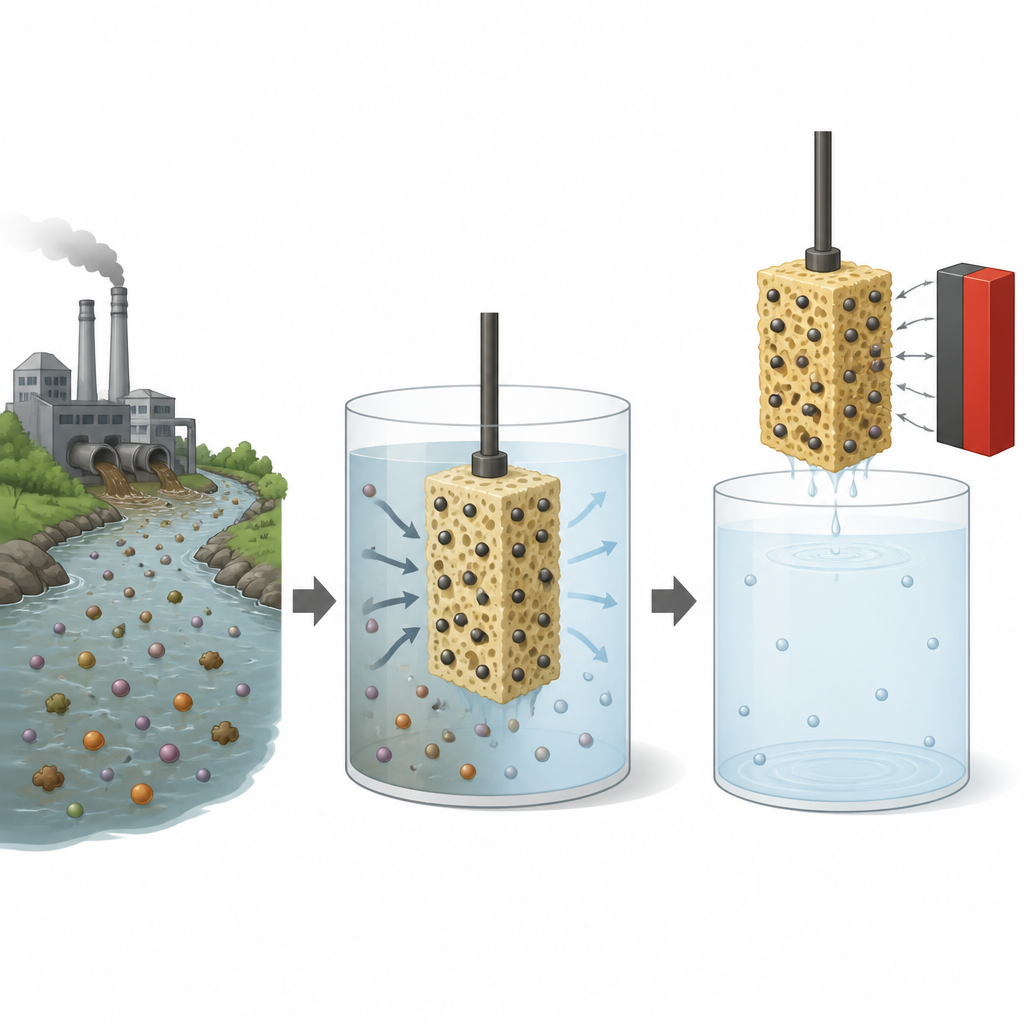
Many industries release wastewater that can contain hexavalent chromium, a highly toxic metal linked to cancer and organ damage. This study explores a new “magnetic sponge” made from low-cost, partly natural materials that can pull this dangerous form of chromium out of water, help convert it into a safer form, and then be quickly removed and reused using a simple magnet. The approach aims to make advanced water cleanup more practical and affordable for real-world use.
Why Hexavalent Chromium Is a Problem
Hexavalent chromium is a particularly harmful pollutant because it dissolves easily, travels far in water, and slips into living cells where it can damage DNA and organs. Even tiny amounts can cause serious health problems, from skin ulcers to liver, kidney, and lung disease. It also builds up in aquatic ecosystems, disturbing microbes and moving up the food chain. Conventional treatment methods often struggle to remove chromium when it is present at low levels, or they generate large volumes of sludge that are difficult to handle. This has driven the search for smarter materials that can selectively grab chromium, work efficiently at realistic concentrations, and be used many times.
Building a Magnetic Cleaning Sponge
The researchers created a composite material called MACC by combining three key ingredients. First, they produced activated carbon from waste pomegranate peels, turning agricultural leftovers into a highly porous substance full of tiny tunnels and reactive sites. Second, they grew very small iron oxide particles inside this carbon, giving the material a strong magnetic response so it can be pulled out of water with an external magnet. Third, they wrapped the magnetic carbon in a crosslinked gel made from two biopolymers, carboxymethyl cellulose and β-cyclodextrin. This soft framework adds many extra binding sites and helps keep the carbon and magnetic particles evenly spread in a sponge-like, water-friendly structure.
How the Sponge Catches and Tames Chromium
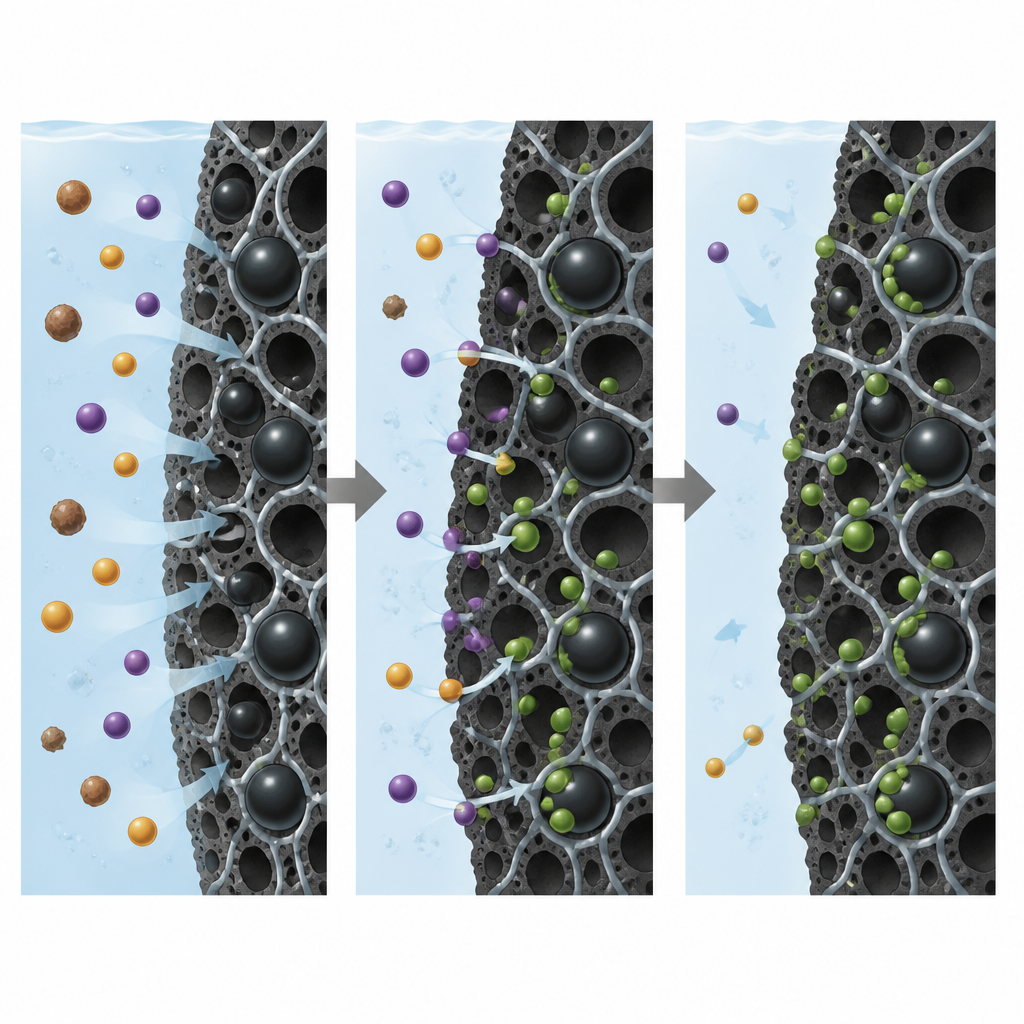
When the MACC sponge is placed in chromium-contaminated water, several helpful processes run at the same time. The sponge surface carries many chemical groups that attract the negatively charged chromium species, so chromium ions are drawn into the pores and held there like burrs on fabric. Inside the sponge, some of these groups, together with iron in the magnetic particles, can donate electrons to hexavalent chromium, partially converting it into trivalent chromium, which is significantly less toxic and less mobile. Advanced measurements, including surface spectroscopy and microscopy, show that chromium ends up both attached to the outer surface and lodged deep inside the pores, forming stable deposits that do not easily wash away.
Finding the Best Working Conditions
Because real wastewater treatment must balance performance, cost, and time, the team used a statistical optimization method called response surface methodology to test different combinations of pH, sponge dose, and contact time. They discovered that slightly acidic water (around pH 4), a relatively small amount of sponge, and about an hour and a half of contact gave the best results. Under these conditions, each gram of MACC could capture more than half a gram of chromium, a very high capacity compared with many existing materials. The way chromium uptake changed with time and concentration fit models that point to a chemical bonding process rather than simple physical sticking, and the process became more effective at warmer temperatures.
From Lab Material to Practical Tool
After cleanup, the MACC sponge can be lifted out with a magnet, rinsed with a basic solution to remove much of the trapped chromium, and then put back to work. Tests over several cycles showed that the sponge keeps its structure and most of its performance, making it a reusable tool rather than single-use waste. Overall, this study shows that a magnetic sponge made from plant-based carbon, biopolymers, and iron oxide can efficiently remove and partly neutralize a dangerous metal from water, while being easy to collect and regenerate. Such materials could help make safer drinking water and more sustainable industrial wastewater treatment more widely achievable.
Citation: Alhasani, M.A., Alatawi, R., Sallam, S. et al. Magnetically recoverable activated carbon/CMC–β-cyclodextrin composite sponge for high-performance Cr(VI) adsorption, reduction, and sustainable wastewater treatment. Sci Rep 16, 16136 (2026). https://doi.org/10.1038/s41598-026-46358-4
Keywords: chromium pollution, magnetic adsorbent, wastewater treatment, activated carbon sponge, heavy metal removal