Clear Sky Science · en
Machine learning-based temperature prediction across diverse ecosystems for the Boro Season in Bangladesh
Why this study matters for food on the table
Rice is the daily staple for most people in Bangladesh, and one of its most important rice crops grows during the cool, dry Boro season. Small changes in temperature during these months can mean the difference between a healthy harvest and a poor one. This study explores how modern computer techniques can better predict these temperature swings across three very different parts of Bangladesh, helping farmers and planners make smarter choices to protect food supplies.
Different landscapes, different temperature risks
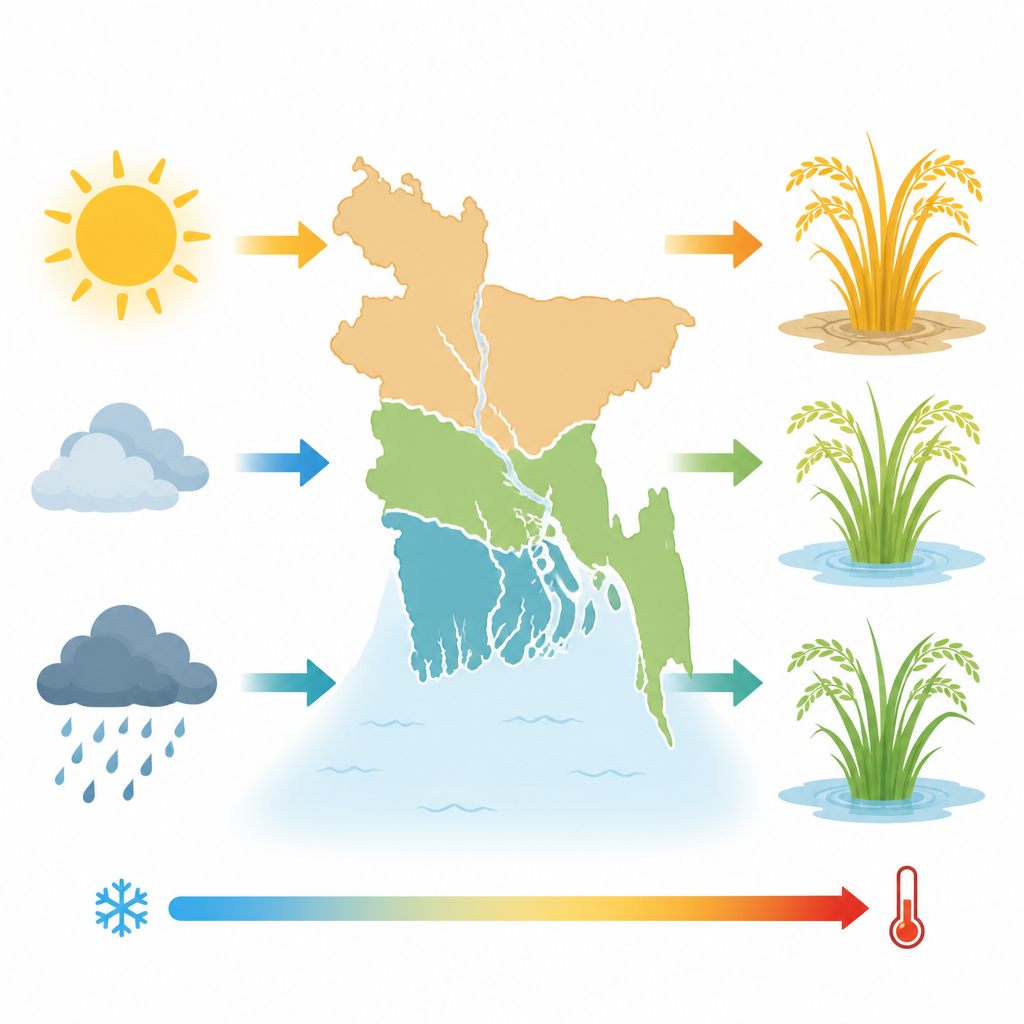
Bangladesh is not uniform in its climate. The researchers focused on three contrasting regions: the dry Barind uplands, the humid Coastal belt by the sea, and the low-lying wetland basin known as the Haor. Using weather records from 1970 to 2025, they examined daily maximum and minimum temperatures along with rainfall, humidity, and sunshine during the Boro season. They found that Barind has the widest range of temperatures, with very hot days and cold nights, while the Coastal region is warmer on average but more stable. Haor stays somewhat cooler but faces stronger risks from cold spells in winter.
Teaching computers to read the weather
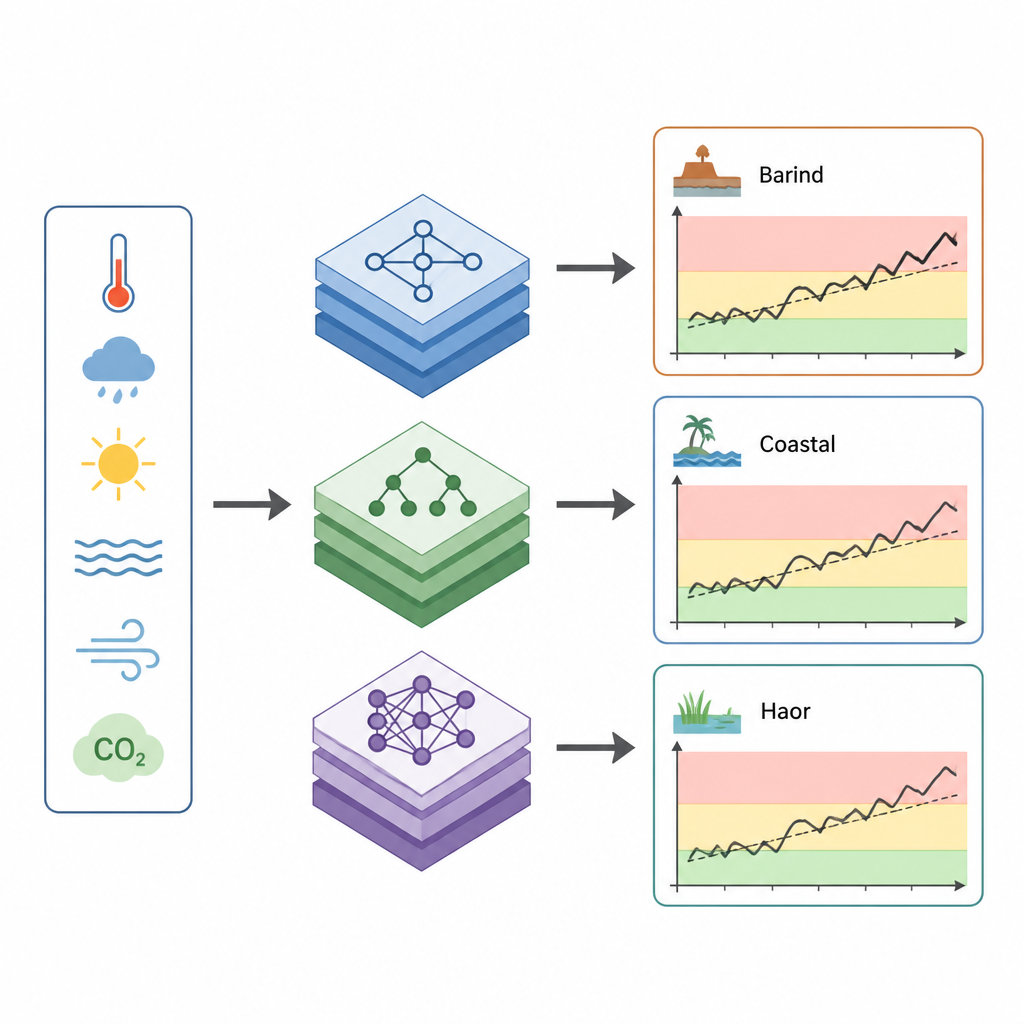
To turn this long history of weather data into useful forecasts, the team used a suite of machine learning methods. These are computer programs that learn patterns from data rather than following fixed equations. The models took in many clues at once, such as recent temperatures, rainfall, humidity, sunshine, and even how warm or cool previous years had been at the same time. The data were carefully cleaned to remove errors and fill small gaps so that the programs would not be misled by missing or unrealistic numbers.
Which models gave the sharpest forecasts
The researchers compared a wide range of models, from simpler approaches like linear regression and decision trees to more advanced "ensemble" methods that combine many small models into a stronger one, as well as deep learning methods inspired by brain networks. They judged performance using several measures of forecast error. Across most tests, an ensemble method called CatBoost gave the most accurate predictions for both daytime highs and nighttime lows in the Barind and Haor regions. In the Coastal region, another method known as support vector machines did best. Simpler models tended to make larger errors, while the strongest methods performed at similar, reliably low error levels.
Mapping districts at greatest temperature risk
Good forecasts matter most where the risks are highest. The team used spatial analysis to see how extreme heat and cold are clustered across districts. In Barind, districts such as Rajshahi, Natore, and Pabna often reach very high Boro-season temperatures, while others like Dinajpur and Rangpur can fall into very severe cold categories. Coastal districts are widely exposed to strong heat, and Haor districts show a mix of severe heat and extreme cold. By combining these maps with the machine learning forecasts, the study points to where farmers and local officials should focus adaptation plans, such as adjusting sowing dates, improving irrigation, or choosing more tolerant rice varieties.
What this means for farmers and planners
For a lay reader, the main message is that smarter temperature prediction can help keep rice harvests more stable in a warming world. The study shows that advanced machine learning tools can track and forecast temperature patterns for specific regions and seasons in Bangladesh with relatively low error. Barind, with its sharp swings between heat and cold, and Haor, with its cold risks, need particular attention, while the Coastal zone faces persistent heat stress. By feeding these localized forecasts into early warning systems and farm advice services, Bangladesh can better schedule water use, choose suitable rice types, and prepare for heat or cold waves. The work offers a practical blueprint for using data and computers to support food security under climate change.
Citation: Rahman, N.M.F., Haque, N., Asadullah, M. et al. Machine learning-based temperature prediction across diverse ecosystems for the Boro Season in Bangladesh. Sci Rep 16, 15437 (2026). https://doi.org/10.1038/s41598-026-46341-z
Keywords: Bangladesh rice, temperature prediction, machine learning, Boro season, climate risk