Clear Sky Science · en
The triple threat of Cryptosporidium, Giardia, and Entamoeba infections in Nigerian children
Why tiny gut infections matter for children
Diarrhea is often dismissed as a short‑lived nuisance, but for young children in low‑income settings it can be deadly and can stunt both growth and learning. This study focuses on three microscopic culprits—Cryptosporidium, Giardia, and Entamoeba—that quietly infect huge numbers of Nigerian children. By using modern DNA testing rather than older microscope methods, the researchers reveal just how widespread these infections really are, how often they occur together, and how closely they are tied to unsafe water, crowded homes, and contact with animals.
The study at a glance
Researchers collected stool samples from 977 children aged ten and under across ten Nigerian states, spanning different regions and living conditions. Parents or caregivers also answered detailed questions about each child’s home, water sources, toilets, household crowding, contact with animals, and family income and education. Instead of relying on traditional microscopy, the team used real‑time PCR, a sensitive technique that detects parasite DNA, to test for all three organisms in each sample. This approach allowed them to pick up infections that might otherwise be missed and to document simultaneous infections by more than one parasite.
A widespread hidden burden
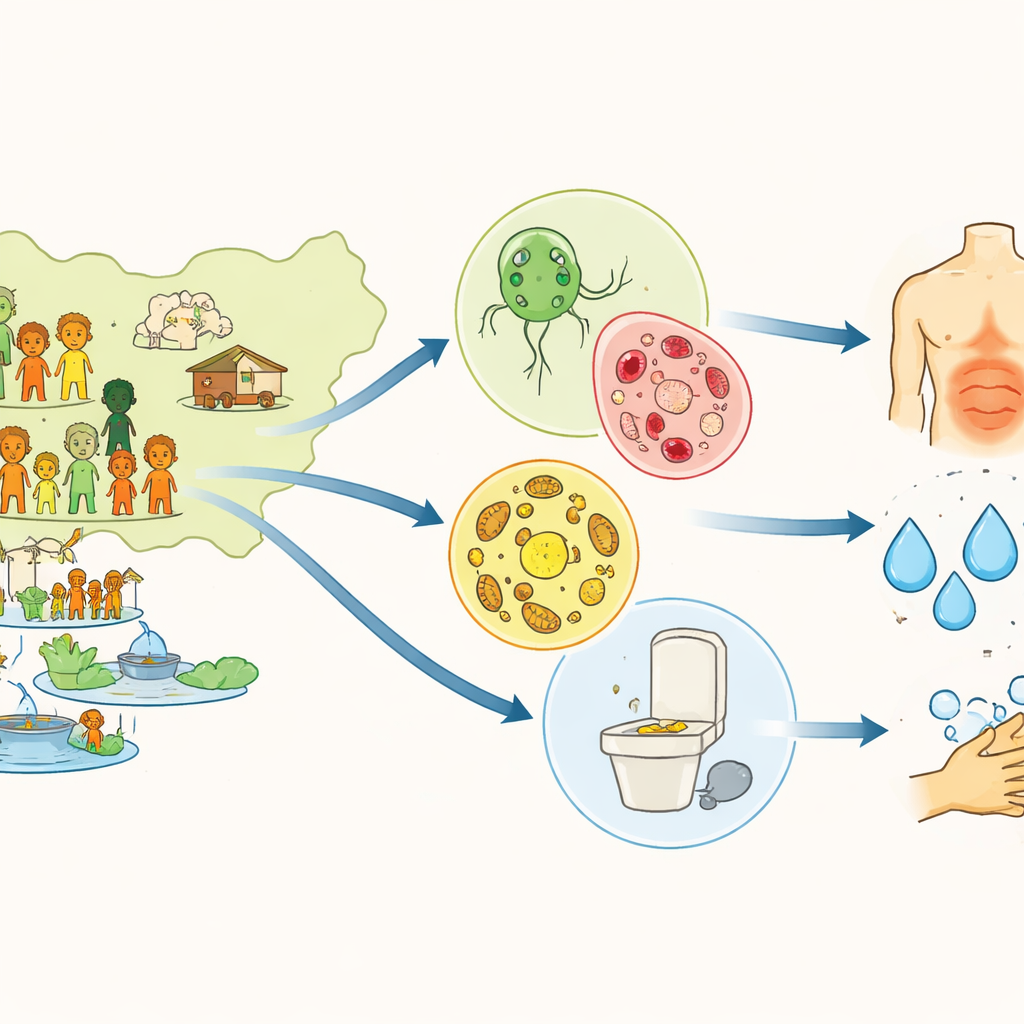
The results show that these parasites are far more common than earlier surveys suggested. Nearly one in five children carried Cryptosporidium, about one in eight carried Entamoeba, and more than three out of four were infected with Giardia. Many children were infected with more than one parasite at the same time: roughly 17% had both Cryptosporidium and Giardia, 12% had Giardia and Entamoeba, and almost 3% carried all three. Infection patterns differed by state, with some regions showing much higher coinfection rates than others, reflecting differences in local water quality, sanitation, and housing.
Who is most at risk
By linking infection data to the questionnaire responses, the researchers identified several clear risk patterns. Older children (five to ten years) were more likely to have Cryptosporidium, and boys were more likely to carry Entamoeba. Surprisingly, Giardia infection was common even among children whose household heads had higher education, hinting that child‑care settings, food handling, or other shared environments may play a role. Children from trading households showed especially high levels of both single and mixed infections, likely because of frequent exposure to market produce that may not be thoroughly washed.
Water, animals, and crowded homes
Unsafe water emerged as a central driver of infection. Compared with borehole water, drinking from wells raised the odds of both Cryptosporidium and Giardia, while tap water—often assumed to be safer—was strongly linked to Entamoeba and to several types of coinfection. The authors suggest that aging or poorly maintained pipes and intermittent supply can leave tap water vulnerable to contamination. Crowded households increased the risk of dual infections, supporting the idea that person‑to‑person spread within families is important. Children who lived with poultry, and to a lesser extent cats, also had higher odds of carrying Cryptosporidium and Giardia, pointing to animals as additional sources of exposure.
A complex role for Giardia
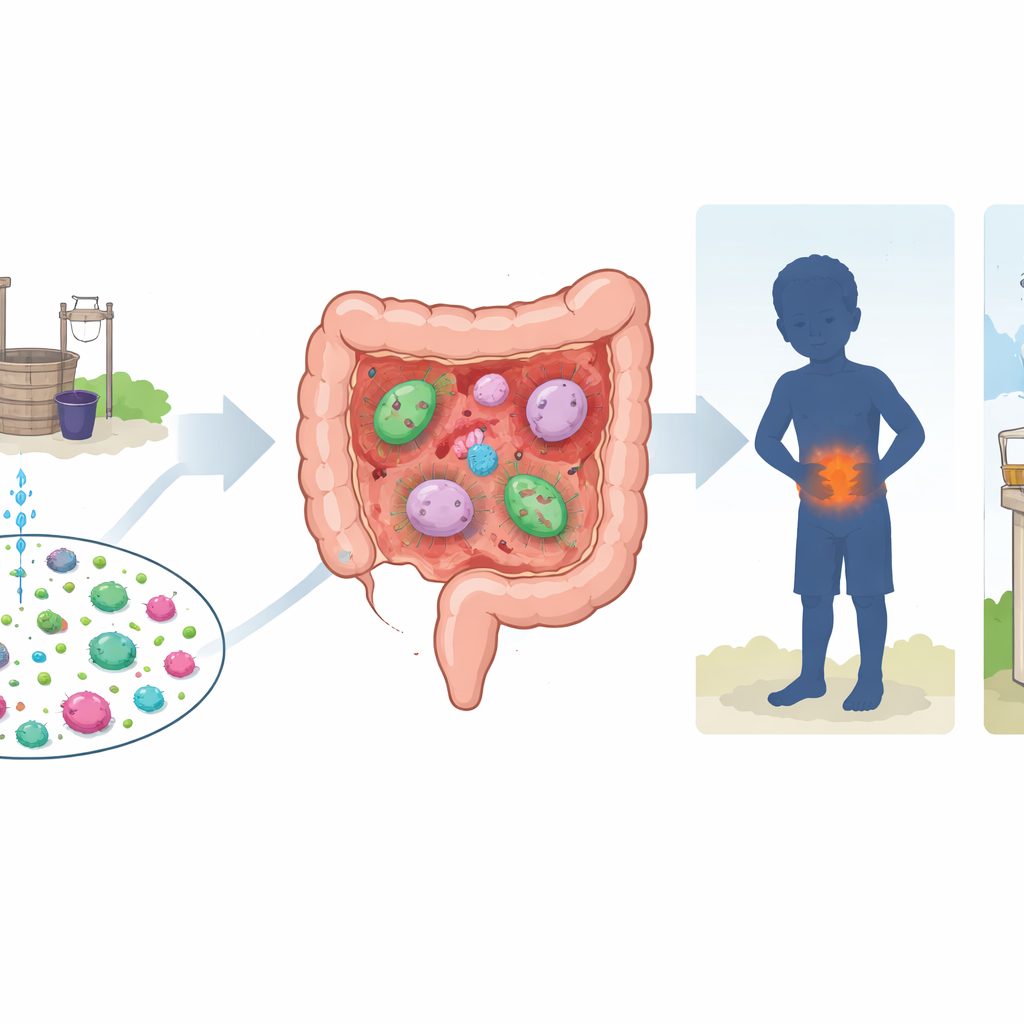
One striking finding was the extraordinarily high rate of Giardia across all locations and its tight link with Entamoeba coinfections. Other research has suggested that Giardia may sometimes dampen harmful inflammation in the gut, potentially softening the impact of other infections, while in other cases it may make children more vulnerable. This study could not directly test immune responses, but the patterns it uncovered support the idea that Giardia is more than a simple villain: it may be both a marker of dirty water and a biological wildcard that changes how other gut infections behave.
What this means for children’s health
For non‑specialists, the key message is that millions of Nigerian children are living with a constant, largely invisible assault on their intestines from multiple parasites at once. These infections can sap nutrition, slow growth, and impair learning long before they cause dramatic illness. The authors argue that routine use of modern DNA‑based tests is essential to see the true scale of the problem, and that the most effective fixes are not high‑tech drugs but basics: reliably safe drinking water, better toilets, less crowded living spaces, and more careful handling of fruits, vegetables, and animals. Addressing these foundations of everyday life could sharply cut childhood diarrhea, improve development, and save lives.
Citation: Ajakaye, O.G., Adeyemi, E.E., Ali, M. et al. The triple threat of Cryptosporidium, Giardia, and Entamoeba infections in Nigerian children. Sci Rep 16, 10692 (2026). https://doi.org/10.1038/s41598-026-46339-7
Keywords: waterborne parasites, childhood diarrhea, Nigeria, Giardia and Cryptosporidium, WASH infrastructure