Clear Sky Science · en
LIF signaling pathway regulates the heterogeneous Sox2 transcriptional dynamics in mESCs
How Stem Cells Decide What To Become
Stem cells in early mouse embryos can either stay flexible, able to become many cell types, or start settling into a specific fate. This study asks a simple but important question: how does a growth signal in the dish control a key gene that helps these cells stay flexible, not just on average, but in each single cell over time?
A Support Signal That Keeps Cells Youthful
Mouse embryonic stem cells are prized because they can turn into almost any tissue and keep dividing without losing this potential. In the lab, a protein called LIF is routinely added to their culture medium to preserve this youthful state. LIF works by turning on a small network of genes, among them Sox2, which sits at the heart of the stem cell identity program. Both too little and too much Sox2 push cells toward unwanted fates, so its activity must be held within a narrow, safe window.
Watching a Single Gene Turn On and Off
To see exactly how Sox2 behaves inside living cells, the researchers used a clever tagging system that makes each new Sox2 RNA molecule briefly glow inside the nucleus. By editing the Sox2 gene to carry special RNA loops and supplying matching fluorescent proteins, they could film tiny bright spots that appear whenever Sox2 is being copied. Tests confirmed that this tagging did not alter Sox2 levels or the stemness of the cells, meaning the glowing spots faithfully reported natural gene activity. This setup allowed them to follow thousands of individual cells and measure how often, how strongly, and for how long Sox2 switches on.
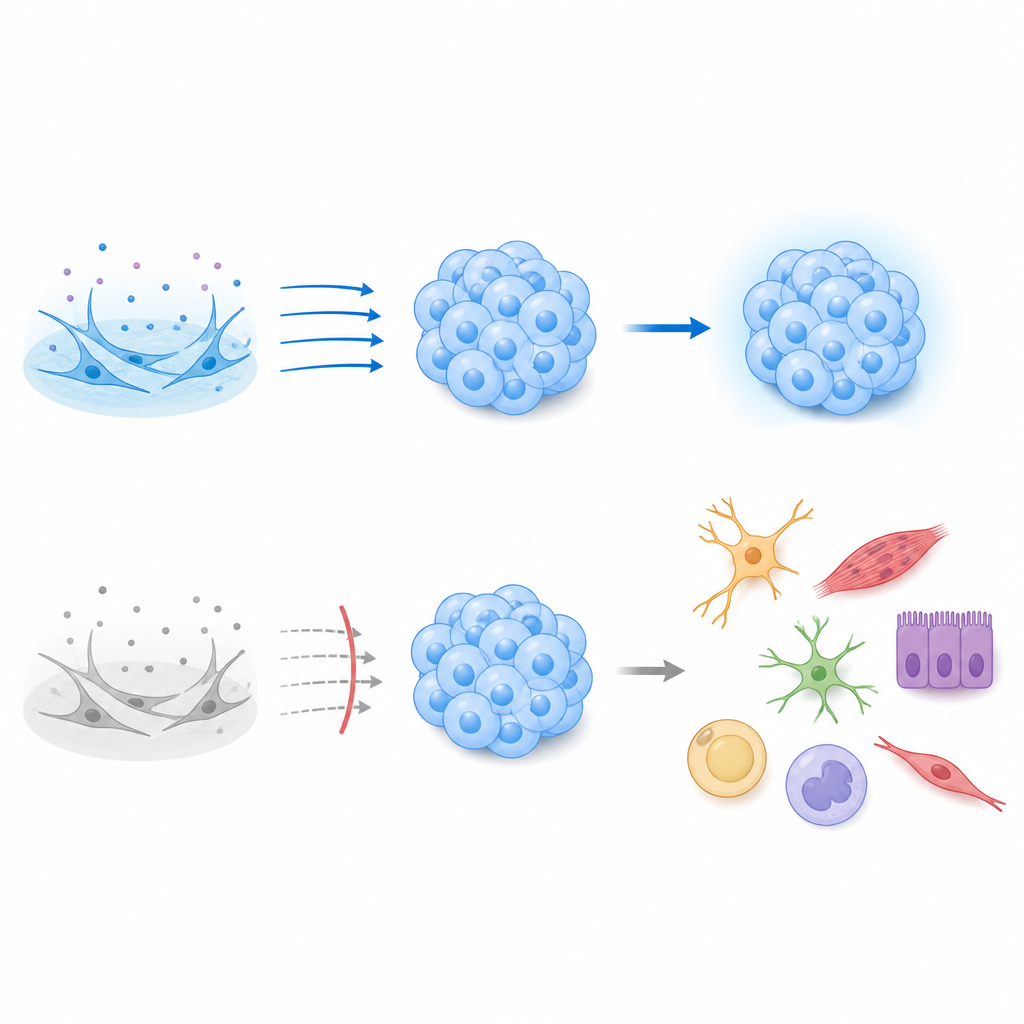
When the Lifeline Is Cut
The team then weakened the LIF support in two ways: by removing LIF from the medium, or by blocking a key relay protein (JAK) that carries LIF signals inward. In both cases, fewer cells showed active Sox2 over time, but the shutdown was gradual and uneven across the population. Some cells kept Sox2 on, others went silent, and the timing differed from cell to cell. Even in cells that remained active, total Sox2 output dropped by roughly half. Detailed analysis revealed why: the bursts of Sox2 activity became smaller, less frequent, and shorter, so each cell produced fewer RNA copies during the observation window.
Links Between Gene Activity and Stem Cell Identity
Next, the researchers asked whether these changes in Sox2 activity matched changes in cell identity. They used a surface marker called SSEA1 to distinguish cells that still behaved like stem cells from those drifting toward differentiation. Under full LIF support, nearly all cells were SSEA1 positive, regardless of Sox2 bursting details. After LIF removal or JAK blockade, the share of SSEA1 positive cells fell sharply, showing that many cells were losing their stem-like traits. Among cells that still showed Sox2 activity, those with higher Sox2 output were more likely to remain SSEA1 positive. Under JAK blockade in particular, cells that had lost SSEA1 tended to have weaker Sox2 activity, suggesting that Sox2 must stay above a threshold to preserve flexibility.
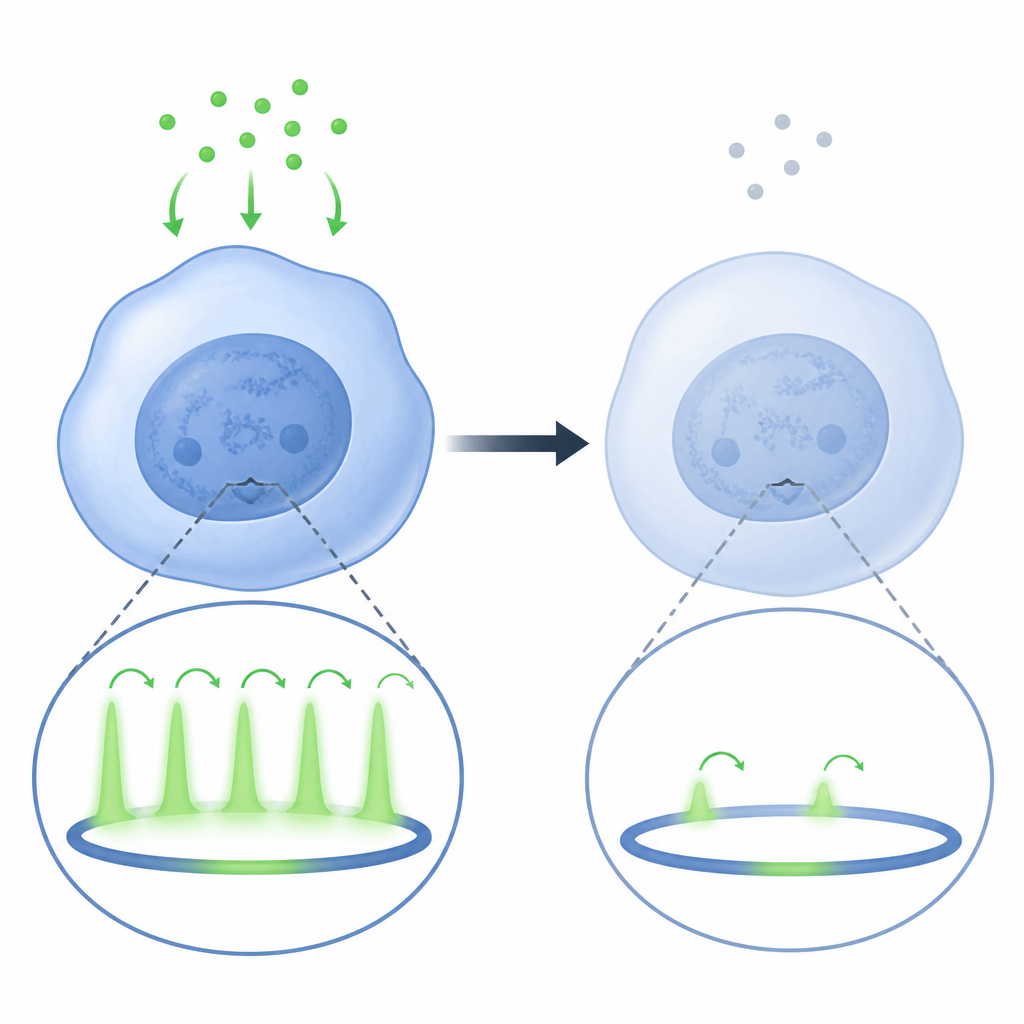
Gene Activity Memories That Survive Stress
The study also followed cells through division to see whether Sox2 behavior is passed from mother to daughters. If a mother cell showed Sox2 activity before dividing, its daughters were very likely to reactivate Sox2 soon afterward. In contrast, daughters of Sox2 quiet mothers tended to remain quiet. This “memory” of activity persisted even when LIF signals were weakened, although overall Sox2 levels were lower and more unstable. The finding suggests that cells carry an internal record of their readiness to express Sox2 that does not depend entirely on the outside environment.
What This Means for Controlling Cell Fate
Overall, the work shows that LIF does more than simply switch Sox2 on or off; it shapes how often and how strongly the gene fires in each cell. When LIF signals are reduced, fewer cells keep Sox2 active, and those that do show weaker bursts, pushing many cells below the level needed to remain true stem cells. At the same time, an internal memory helps some lineages preserve Sox2 activity across divisions, even under stress. For a lay reader, the takeaway is that stem cell fate is governed not just by whether a key gene is on, but by the fine-grained rhythm of its activity in single cells, tuned by external signals yet stabilized by internal memory.
Citation: Jin, G., Porello, E.A.L., Zhang, J. et al. LIF signaling pathway regulates the heterogeneous Sox2 transcriptional dynamics in mESCs. Sci Rep 16, 15932 (2026). https://doi.org/10.1038/s41598-026-46330-2
Keywords: embryonic stem cells, Sox2, LIF signaling, gene expression dynamics, pluripotency