Clear Sky Science · en
Biomass formation and yield performance in diverse multicrops and their potential for biofuel use in short-growing boreal climate conditions
Why Growing Mixed Crops Matters
As countries search for cleaner energy sources, the humble farm field could become an important power plant. This study explores whether growing three familiar crops—maize, industrial hemp, and faba beans—together in the same field can produce more plant material for biofuel, while also being kinder to the environment. The work was done in Lithuania, where summers are short and cool, making it a good test of what future farming and energy systems might look like in northern regions.
Three Crops, One Field
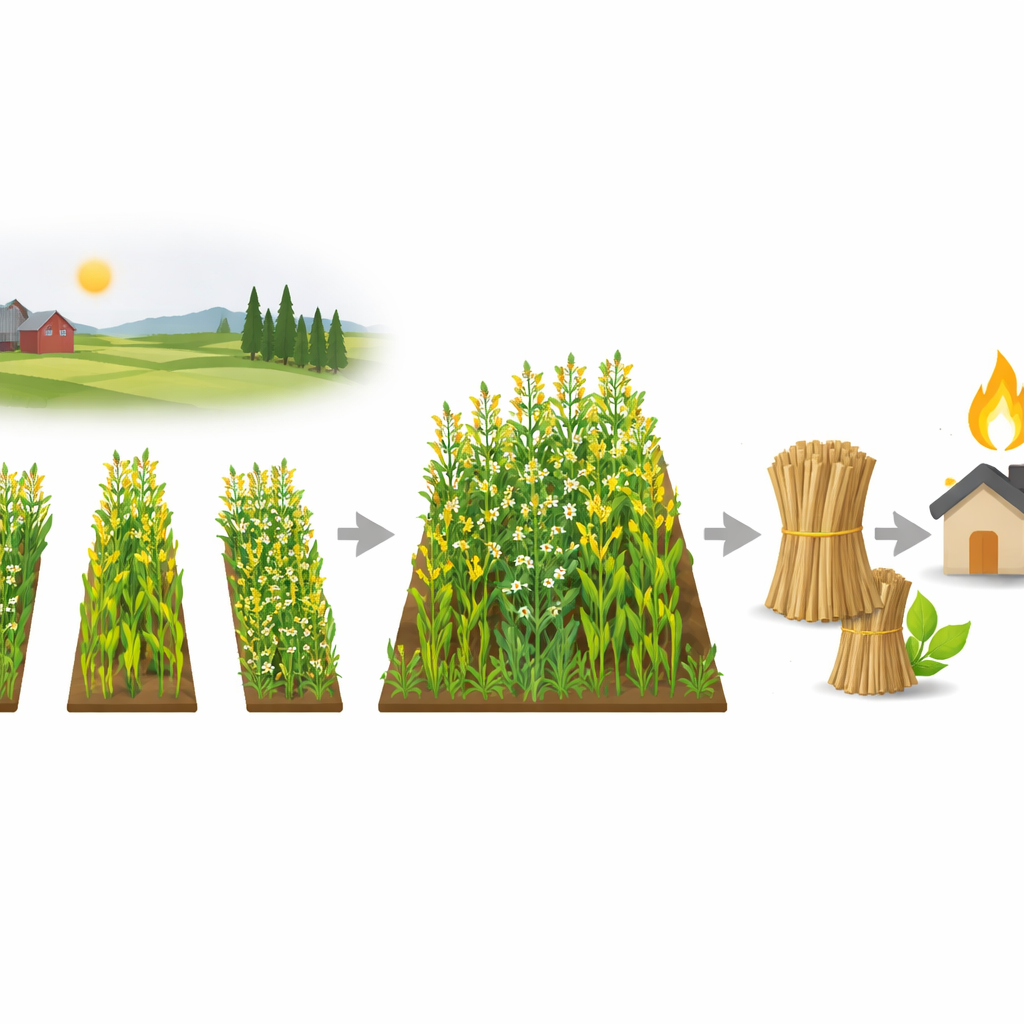
The researchers compared ordinary single-crop fields with more diverse mixtures. They set up seven cropping patterns: each crop grown alone; pairs of crops grown together; and a three-way mix of maize, hemp, and faba beans. All were managed with low fertilizer inputs and no pesticides and were harvested after just 103–105 days, when faba beans reached full maturity. This design reflects a realistic, low-input system that could give farmers an early source of biomass for fuel, instead of waiting for full-season crops.
How Plants Help Each Other
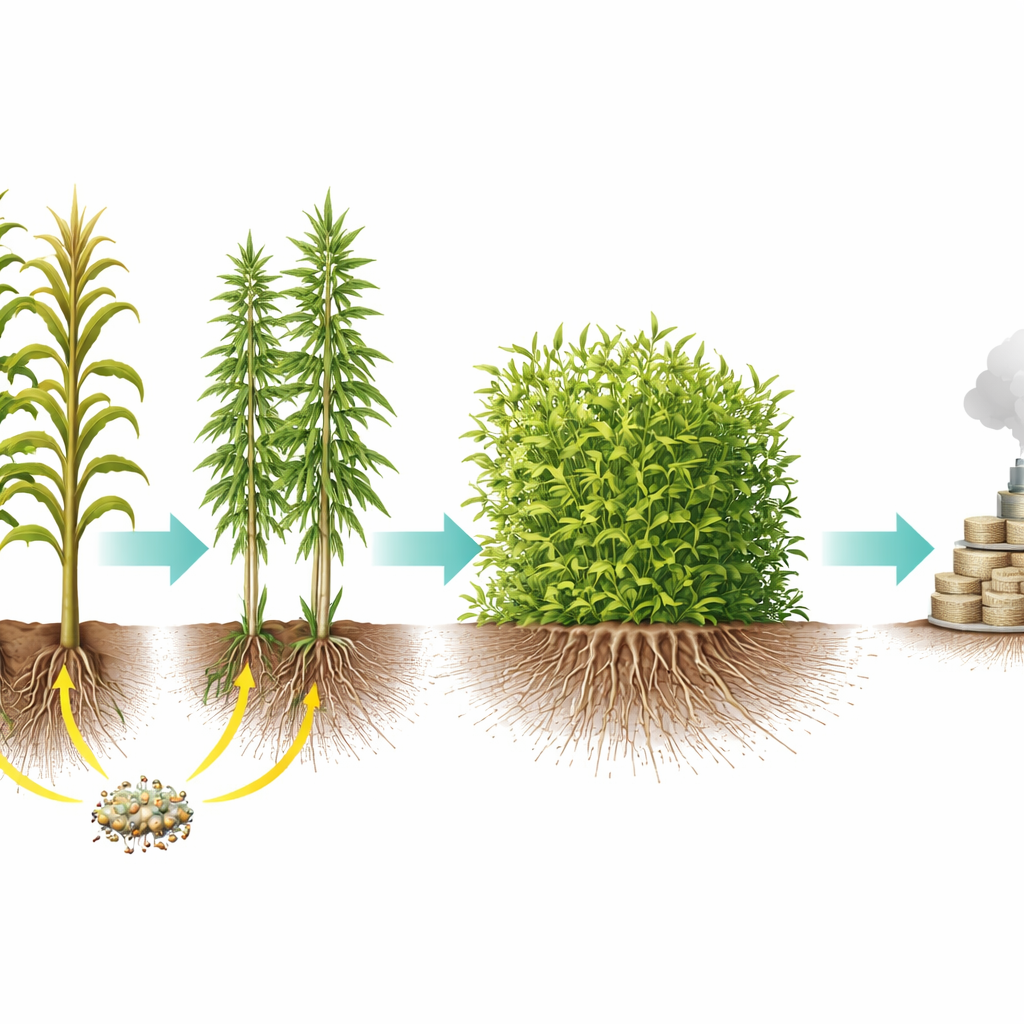
Faba beans played a starring role. Like many legumes, they host bacteria on their roots that can pull nitrogen from the air and turn it into a nutrient plants can use. In mixtures, this “free fertilizing” helped their neighbors. Maize and hemp grown with faba beans were, on average, 14% taller, had 24% more leaf area, and showed a 19% higher chlorophyll index than when grown alone, signs of better access to nutrients and stronger photosynthesis. Even though each individual plant in a mixture was often smaller than its single-crop counterpart—because of competition for space and light—the field as a whole produced more biomass when species were combined.
From Green Fields to Fuel
The most productive system was the three-way mixture of maize, hemp, and faba beans. In the first year, this mixed stand produced 4–8 times more dried biomass per area than any single crop. It also scored highest in a combined performance rating that pulled together growth, physiology, and yield into one index. Although this system used the most fuel for field operations, it still delivered the greatest net energy return—over 360,000 megajoules per hectare—because of the large amount of harvestable material. The team then pressed the mixed biomass into pellets and found that these had high density, low ash content, and a high ash softening temperature, meeting international quality standards for solid biofuels.
Climate and Soil Considerations
The study spanned three years, and not every season was equally kind to the crops. Weather shifts and gradual soil nutrient depletion reduced yields over time, especially nitrogen loss in the most productive mixtures. By the third year, total biomass in all systems had dropped sharply. This shows that even smart plant combinations cannot fully replace long-term soil care: diverse mixtures work best when integrated into broader crop rotations and supported by thoughtful nutrient management, rather than being repeated on the same field without adjustment.
Cleaner Energy from Smarter Cropping
When the researchers assessed environmental impacts across the whole life cycle—from field to pellet burning—they found that biomass from mixed crops, especially maize–hemp and hemp–faba bean systems, caused less climate warming, acidification, and water pollution than biomass from single maize. In short, planting a mix of maize, hemp, and faba beans in short northern summers can yield more usable fuel, better-quality pellets, and lower environmental burdens than relying on a single energy crop. For farmers and policymakers, the message is clear: diversifying what grows in the field can power homes and businesses while moving food and energy systems toward greater sustainability.
Citation: Balandaitė, J., Romaneckas, K., Kimbirauskienė, R. et al. Biomass formation and yield performance in diverse multicrops and their potential for biofuel use in short-growing boreal climate conditions. Sci Rep 16, 10665 (2026). https://doi.org/10.1038/s41598-026-46324-0
Keywords: bioenergy crops, intercropping, industrial hemp, faba bean, boreal agriculture