Clear Sky Science · en
Emotion-specific regulation components differentially predict profiles of adolescent psychosocial dysfunction
Why teen feelings matter for everyday life
Teenagers often ride an emotional roller coaster, and how they handle strong feelings can shape their friendships, school life, and mental health. This study looks at which specific ways of dealing with sadness, fear, and anger are most closely tied to how well teens are doing in daily life. By focusing on real patterns in a large group of adolescents, the researchers show that not all emotional struggles, and not all coping styles, are created equal.
Different levels of teen struggle
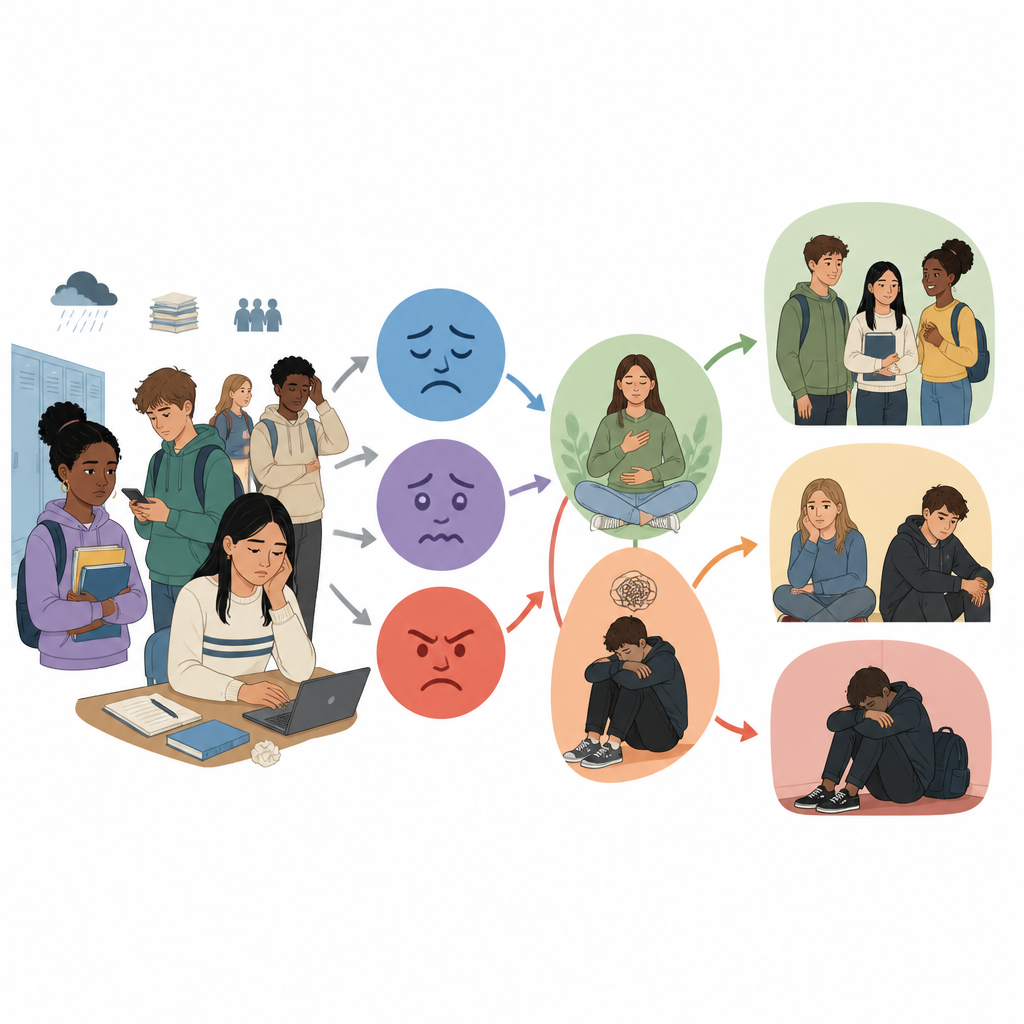
The researchers surveyed 795 adolescents in Tehran about their behavior, personality traits linked to mental health problems, and everyday difficulties at home, school, and with peers. Using these answers, they grouped teens into profiles based on how much trouble they were having. They found three clear groups: one with relatively low problems and good social behavior, one with moderate difficulties, and one with high levels of emotional and behavior issues plus greater everyday disability. Rather than fitting neatly into separate diagnoses, these groups formed a severity ladder running from doing well to seriously struggling.
Zooming in on specific feelings
Instead of treating emotion management as one broad skill, the team measured how teens typically deal with three specific negative feelings: sadness, fear, and anger. For each emotion, teens reported how often they used strategies such as distracting themselves, rethinking the situation, holding back their expression, seeking support, dwelling on the problem, trying to keep control, or feeling swept away. This produced 21 detailed emotion–strategy combinations, like "rethinking when angry" or "seeking support when sad," allowing the researchers to see which ones truly set the struggling teens apart from their better-adjusted peers.
Finding the few signals in a noisy picture
Because many of these emotion strategies tend to move together, ordinary statistics can make it hard to tell which ones matter most. The authors used advanced methods designed to sift through many overlapping predictors and keep only the most stable and useful ones. They first used cluster analysis to define the three levels of dysfunction, then applied a variable-selection technique that penalizes weaker predictors. Finally, they added a heavy layer of bootstrap testing, repeatedly resampling the data to see which findings held up across thousands of simulated versions of the study.
When emotions spill over versus stay in check
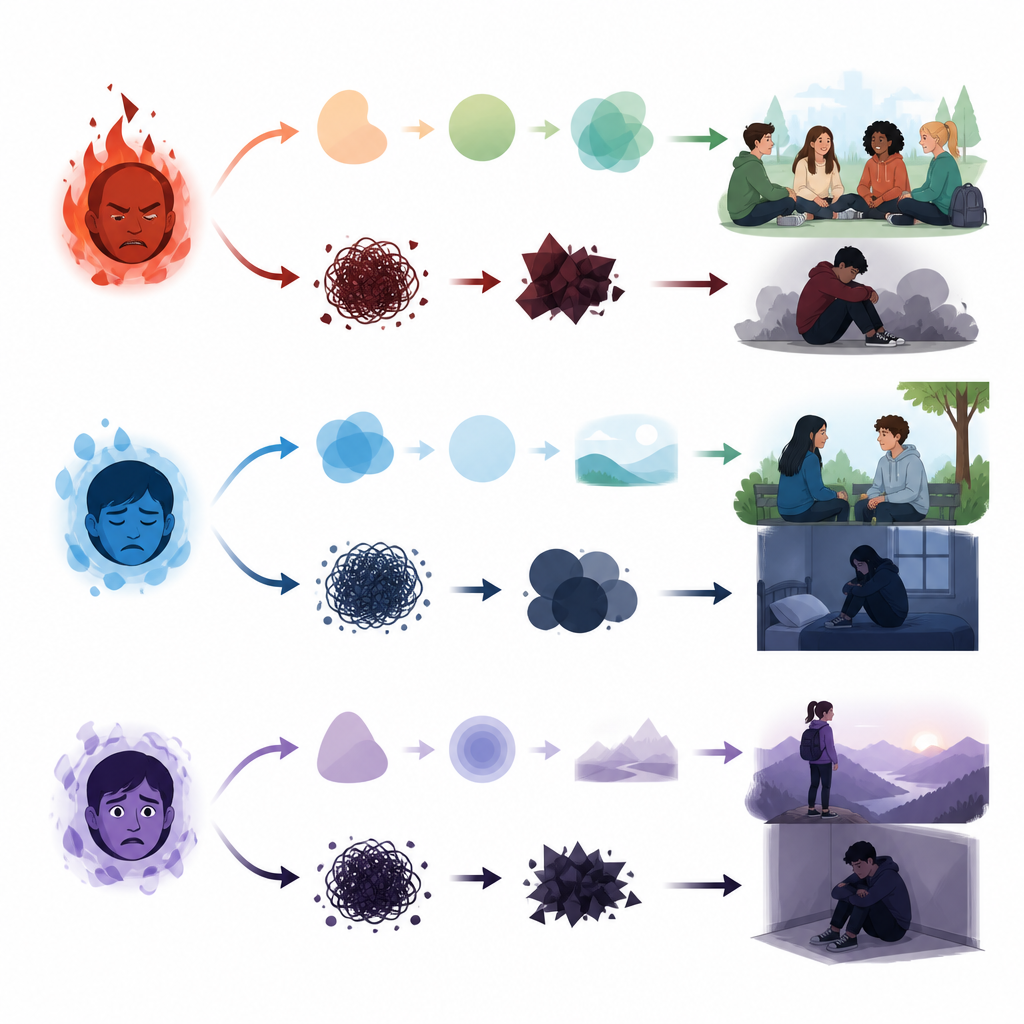
Across all three emotions, the strongest signal was a general sense that feelings "overflow" and are hard to control. Teens who often felt this way about anger, sadness, or fear were much more likely to fall into the moderate and especially the high-dysfunction groups. This pattern held up even when the researchers relaxed their methods and looked at a simpler two-group split, suggesting that being easily overwhelmed by feelings is a broad risk factor rather than just a mirror of symptoms. At the same time, some emotion–strategy pairs stood out. Dwelling on angry thoughts was linked to moving from low to higher levels of struggle, while rethinking anger and seeking support when sad were linked to staying in the less troubled groups. A few other patterns, like suppressing sadness or dwelling on fear, appeared important but were less consistent.
What this means for helping teens
To a layperson, the main message is that teen mental health is shaped both by a general capacity to keep strong feelings from taking over and by choosing strategies that fit the specific emotion. Feeling frequently overwhelmed by anger, sadness, or fear signals broad vulnerability. Yet the study also suggests more tailored lessons: repeatedly stewing over anger seems especially risky early on, while learning to rethink anger and reach out to others when sad may help prevent more severe problems. The authors argue that future prevention and treatment efforts might work best when they combine a focus on overall emotional control with coaching teens to match how they cope to what they are feeling in that moment.
Citation: Asgarizadeh, A., Tahan, M., Ebrahimi, F. et al. Emotion-specific regulation components differentially predict profiles of adolescent psychosocial dysfunction. Sci Rep 16, 15591 (2026). https://doi.org/10.1038/s41598-026-46321-3
Keywords: adolescent emotion regulation, emotional dysregulation, teen mental health, anger and rumination, social support in sadness