Clear Sky Science · en
Physics-guided explainable machine learning for multi-response modeling of electrochemical micro-machining using polymer graphite electrodes
Smaller Parts, Smarter Machines
From medical implants to tiny channels in electronics, modern products rely on microscopic features carved into tough metals. Making these structures cleanly and accurately is hard, and each experiment to fine tune the process costs time and money. This study shows how combining physics and machine learning can help engineers predict how a specialized machining method will behave, so they can reach better settings with fewer trial runs.
How Metal Can Be Shaped Without Cutting
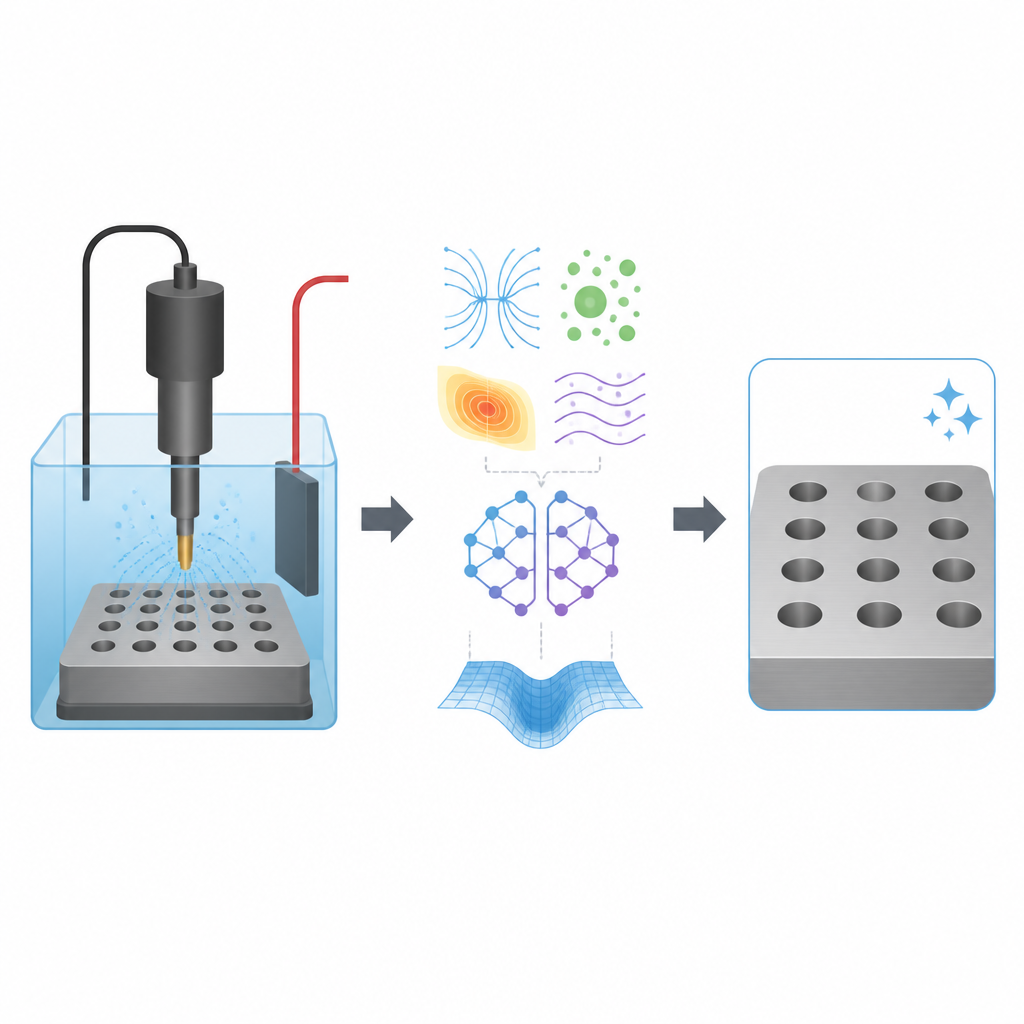
The work focuses on electrochemical micro machining, a method that shapes metal not by cutting, but by dissolving it in a controlled way. A sharp graphite-based tool is brought very close to a stainless steel part inside a flowing salt solution, and short electrical pulses cause the metal surface to dissolve where the electric field is strongest. This approach produces tiny holes and channels with almost no tool wear and little mechanical stress, making it attractive for aerospace components, medical devices, and microelectronics. However, the process is tricky to control because several factors, such as voltage, salt concentration, and the duty cycle of the pulses, interact in complex ways.
Why the Tool Material Matters
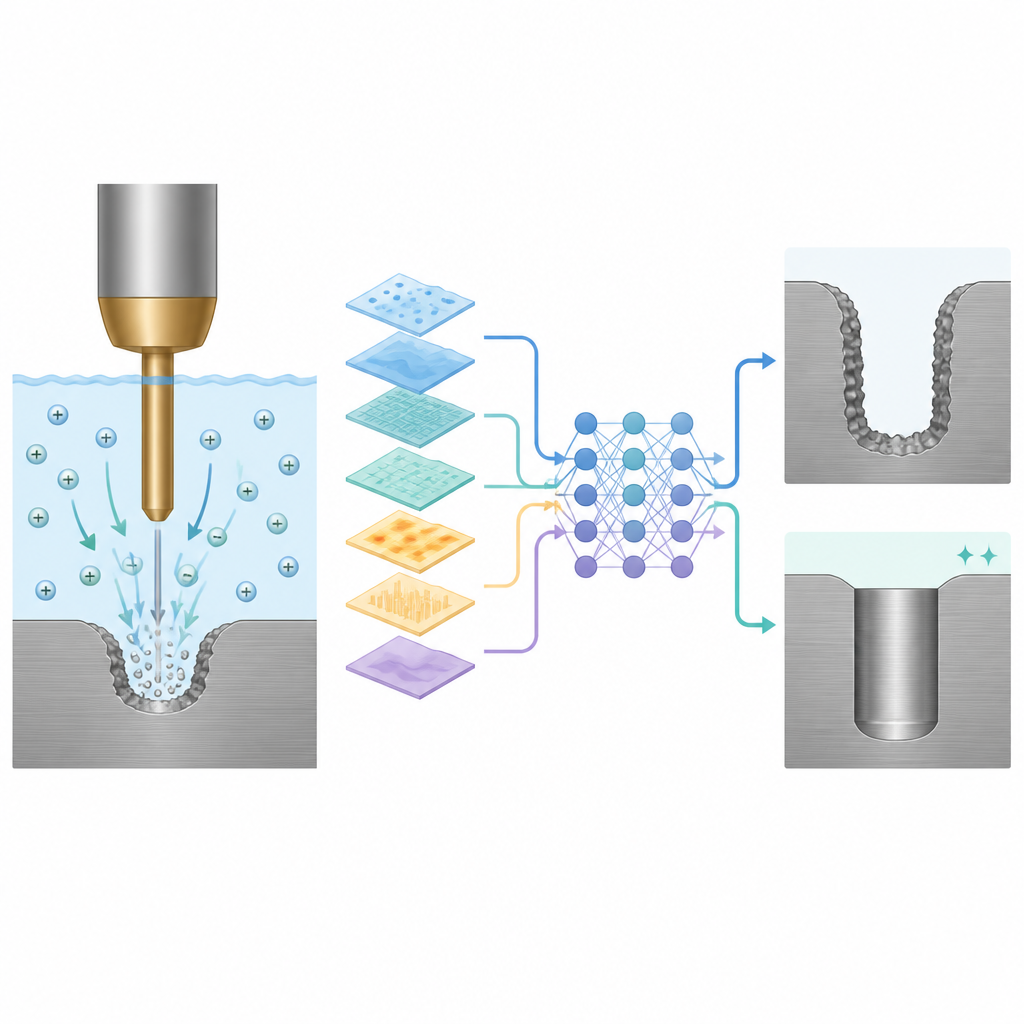
The researchers compared two kinds of polymer graphite electrodes: a standard version and one that had been cryogenically treated, meaning cooled to very low temperatures to change its internal structure. Under a microscope, the untreated tool surface looked rough and porous, while the treated tool appeared smoother and more uniform. These differences translated into the shape and quality of the tiny holes produced. Holes made with the untreated tool tended to have wider entrances, tapering walls, and rougher surfaces, while those made with the treated tool were more circular, straighter, and smoother. These observations confirmed that the state of the tool has a major impact on how the metal dissolves and provided a physical basis for including tool condition in the modeling.
Teaching a Model to Respect the Physics
Instead of feeding only raw settings like voltage and salt concentration into a machine learning model, the team built extra input features that reflect how the process actually works. Guided by electrochemistry, they combined variables into terms that represent the overall severity of the electrical loading and the way electrical pulses and solution properties interact. Using a small but carefully designed set of 34 experiments, they trained ensemble models to predict four key results at once: how fast material is removed, how much the hole overshoots the tool size, how much the walls taper, and how rough the surface becomes. They compared these physics-guided models with standard polynomial fits and with models that used only the basic inputs.
Seeing Inside the Model’s Decisions
The physics-guided models consistently predicted outcomes more accurately than both traditional equations and purely data-driven versions. For example, the best model explained over 90 percent of the variation in overcut and about 87 percent of the variation in surface roughness. Just as important, the researchers used explainable AI tools to see which inputs mattered most. Features that encoded combined effects of voltage, pulse duty cycle, and electrolyte concentration dominated the predictions, matching expectations from electrochemistry. The condition of the tool also showed up as a major driver of geometric accuracy and surface quality. Residual checks and tests with shuffled data confirmed that the remaining errors were mostly random rather than signs of a hidden trend the model had missed.
Guiding Better Settings and Future Tools
By turning a handful of well-planned experiments into a reliable, physically grounded predictor, this work offers a way to explore process settings on a computer instead of entirely on the shop floor. The model can generate smooth maps that show how changes in voltage or solution strength will affect material removal rate, hole size, taper, and roughness, and it highlights wider stable operating regions when cryogenically treated tools are used. For engineers, this means faster tuning of new jobs, clearer understanding of trade-offs between speed and quality, and a pathway toward digital twins and adaptive control in electrochemical micro machining.
Citation: Reddy, B.V.S., Pradeep, N., Bhaskar, A.S. et al. Physics-guided explainable machine learning for multi-response modeling of electrochemical micro-machining using polymer graphite electrodes. Sci Rep 16, 15623 (2026). https://doi.org/10.1038/s41598-026-46315-1
Keywords: electrochemical micromachining, physics-guided machine learning, surface roughness, micro-manufacturing, polymer graphite electrode