Clear Sky Science · en
A long-range enhancer at -52Kb drives expression of the COUP-TFII transcription factor in erythroid cells
Why this research matters
The way our genes turn on and off during life is key to how we develop, and to how certain diseases arise. This study zooms in on a single gene switch that helps control blood formation before birth. Understanding this switch could help scientists find new routes to boost fetal hemoglobin, a form of hemoglobin that can lessen symptoms in disorders such as sickle cell disease and beta thalassemia.
A gene with many jobs in early life
The work centers on a protein called COUP-TFII, made from a gene named NR2F2. COUP-TFII is very active in the embryo, where it helps shape the heart, blood vessels, brain, and other organs. Mice that lack this protein die early in development, and people with rare changes in NR2F2 can have heart and growth problems, showing how important it is in both species. In adult tissues, however, COUP-TFII is mostly quiet. In red blood cell development, it switches on in early, yolk sac–derived cells and then fades when the body moves to adult hemoglobin production.
Hunting for a hidden gene switch
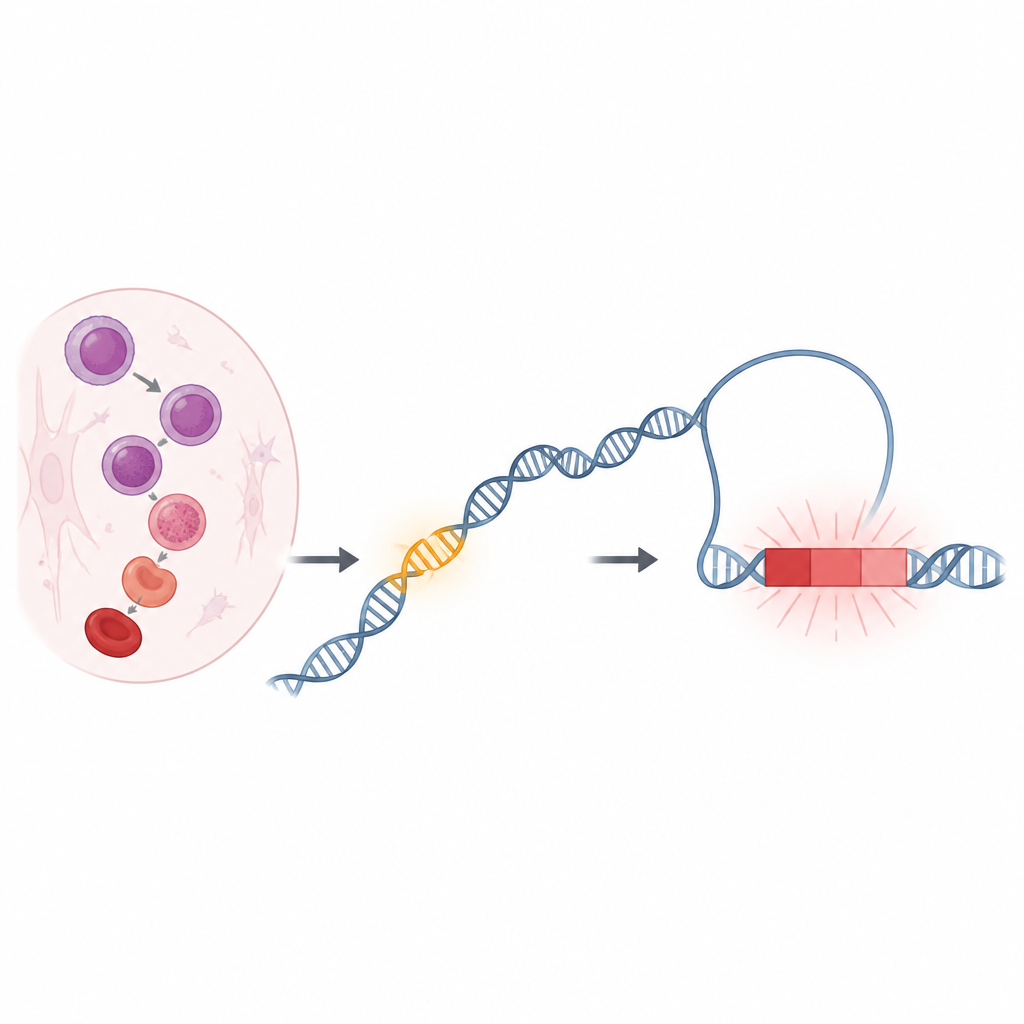
Because NR2F2 behaves so differently across tissues and stages, the authors suspected that distant control regions in the DNA guide when and where the gene is active. Using computer tools that integrate large public datasets, they scanned the NR2F2 neighborhood for such control elements, known as enhancers. Four strong candidates emerged far upstream of the gene. Only one site, sitting about 52 thousand DNA letters before the start of NR2F2, showed open and active chromatin specifically in an erythroid cell line that makes embryonic and fetal hemoglobin. When the team placed this −52Kb DNA fragment next to a basic NR2F2 promoter in a reporter test, it strongly boosted gene activity, unlike the other candidate regions.
Proving the switch is real
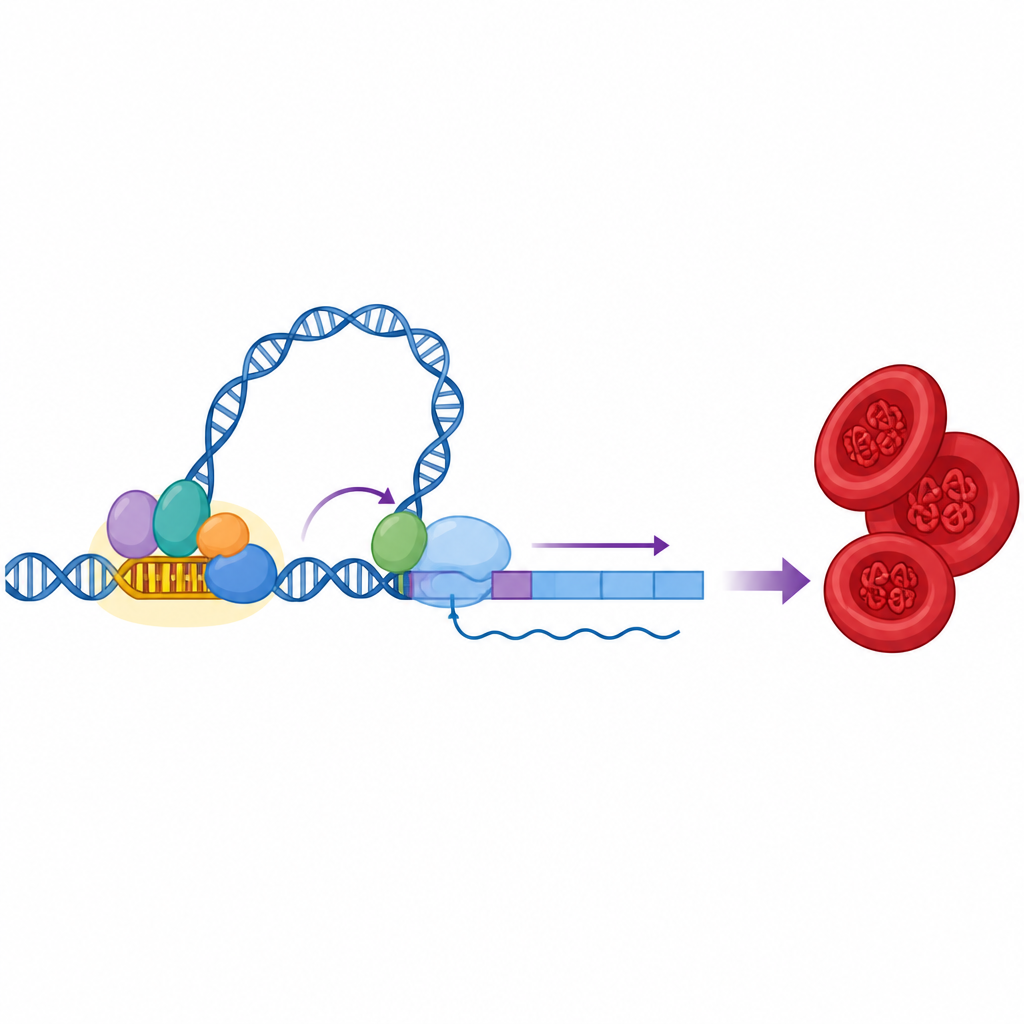
The researchers next asked whether this −52Kb fragment truly controls NR2F2 inside the genome. Using CRISPR gene editing in erythroid cells, they cut out the region or trimmed key parts of it. COUP-TFII levels then dropped by about 80 percent, and chemical marks linked to active genes decreased at the NR2F2 promoter. They also found that the enhancer is packed with docking sites for several red blood cell regulators and contains DNA motifs that can form special four-stranded structures, features often seen in strong enhancers. COUP-TFII itself binds there, suggesting a feedback loop in which the protein helps maintain its own production.
Links to fetal hemoglobin and a brake on the switch
To connect this enhancer to fetal hemoglobin, the team studied human erythroid progenitor cells that normally make only adult hemoglobin and do not express COUP-TFII. During the creation of a reporter line, they isolated rare subclones that spontaneously turned on fetal and embryonic globins. In these clones, NR2F2 was reawakened and the −52Kb region became accessible, fitting with the idea that this enhancer drives COUP-TFII in cells that regain a fetal-like state. The authors also focused on ZBTB7A, a known brake on fetal globin genes. The −52Kb enhancer carries ZBTB7A binding sites, and in cells lacking ZBTB7A, the enhancer opened and NR2F2 gained active marks. In high fetal hemoglobin clones, ZBTB7A levels were reduced, again pointing to its role as a repressor of this switch.
What this means for future therapies
Together, the findings reveal a previously unknown control element that sits far from NR2F2 yet is crucial for turning this gene on in erythroid cells. By mapping how this enhancer works and how it is held in check by ZBTB7A, the study provides a clearer picture of the wiring that links COUP-TFII to fetal hemoglobin production. While much work remains, understanding this wiring is an important step toward strategies that might one day safely restore fetal hemoglobin in adults with inherited blood disorders.
Citation: Pastori, V., Labedz, A., Simanovich, M.A. et al. A long-range enhancer at -52Kb drives expression of the COUP-TFII transcription factor in erythroid cells. Sci Rep 16, 15295 (2026). https://doi.org/10.1038/s41598-026-46308-0
Keywords: COUP-TFII, NR2F2 enhancer, fetal hemoglobin, erythroid cells, ZBTB7A