Clear Sky Science · en
Age-grading and species identification of male mosquito Anopheles gambiae s.l. using mid-infrared spectroscopy and machine learning
A new way to spot risky mosquitoes
Most malaria control tools focus on female mosquitoes, because they bite people and spread the parasite. But many new strategies instead rely on releasing or targeting male mosquitoes to shrink wild populations. For these ideas to work, scientists need fast ways to tell how old male mosquitoes are and which species they belong to. This study tests a light based method combined with computer algorithms to read those traits from the tiny bodies of male malaria mosquitoes.
Why male mosquitoes matter
Male mosquitoes do not bite humans, but they decide the fate of future generations through mating. New control methods such as gene drive, sterile insect releases, and Wolbachia based tools depend on releasing large numbers of laboratory reared males that can compete with wild males. To judge whether these approaches are working, researchers must monitor the species mix and age structure of male mosquitoes in the wild. Existing tools are slow, require dissection or genetic tests, and are not practical for routine checks in many malaria affected regions.
Reading mosquitoes with invisible light
In this study, scientists worked with two closely related malaria vector species in Burkina Faso: Anopheles gambiae and Anopheles coluzzii. They shone mid infrared light onto individual dried male mosquitoes and recorded how the light was absorbed by the outer shell of the body. Because the surface of the insect changes as it ages and differs slightly between species, each mosquito produced a distinctive light pattern or spectrum. The team then used machine learning, a type of computer pattern recognition, to train models that linked these spectra to three age groups and to species identity. 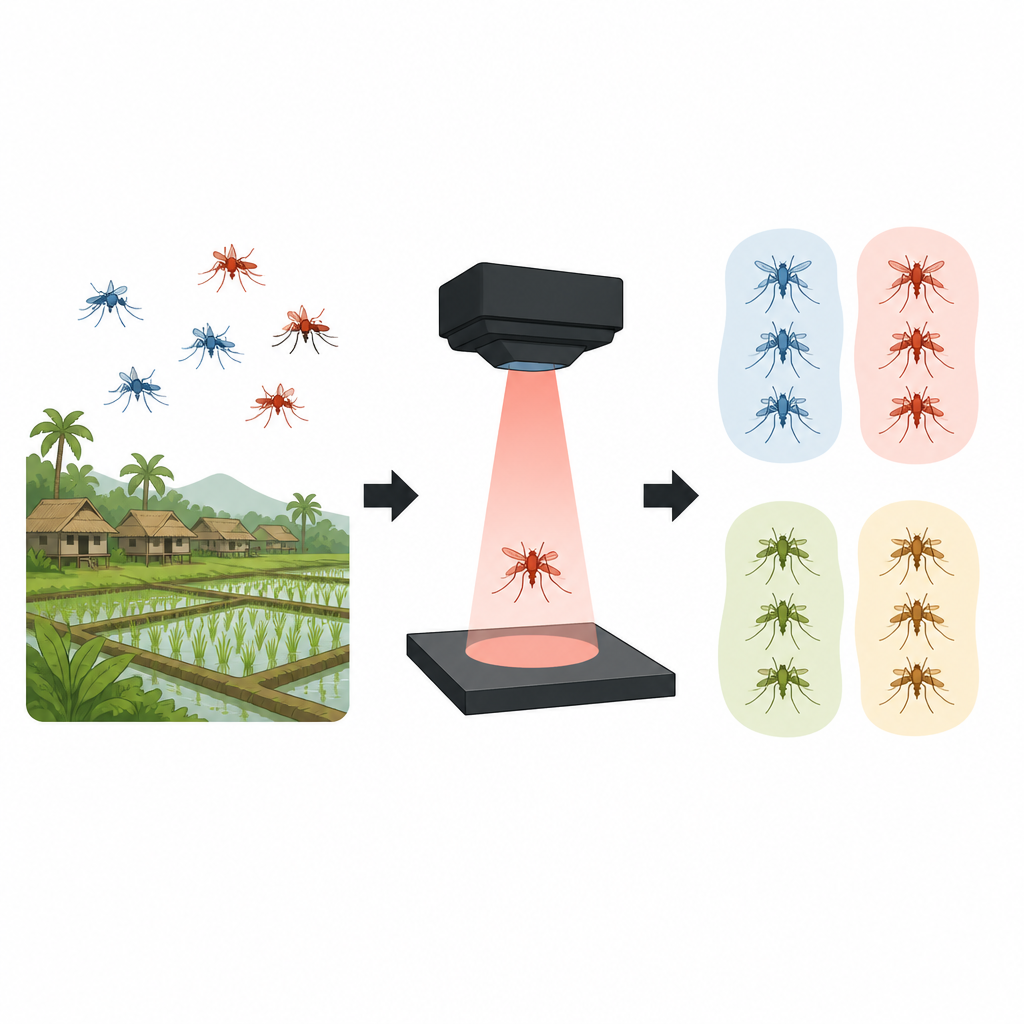
From lab benches to semi natural settings
The researchers first built and tested their models using males raised under stable laboratory conditions, where temperature, humidity, and food are carefully controlled. With just over a thousand laboratory samples, the computer system correctly classified species about 86 percent of the time and age group about 85 percent of the time. These rates are much higher than random guessing and show that the mid infrared approach captures real biological signals related to age and species in male mosquitoes.
Challenges in the real world
Next, the team turned to a more realistic test. They collected female mosquitoes from houses in two villages, identified their species using genetic methods, and reared their male offspring in a semi field facility that mimicked outdoor conditions. When the lab trained model was applied directly to these more variable mosquitoes, accuracy dropped to 64 percent for species and 50 percent for age. Mid infrared light still carried useful information, but the model struggled with the greater mix of environments, genetics, and life histories found outside the lab. To tackle this, the scientists used transfer learning, adding a modest number of semi field samples to retrain the model. This step lifted accuracy to 73 percent for species and 70 percent for age, especially improving classification of mid aged males. 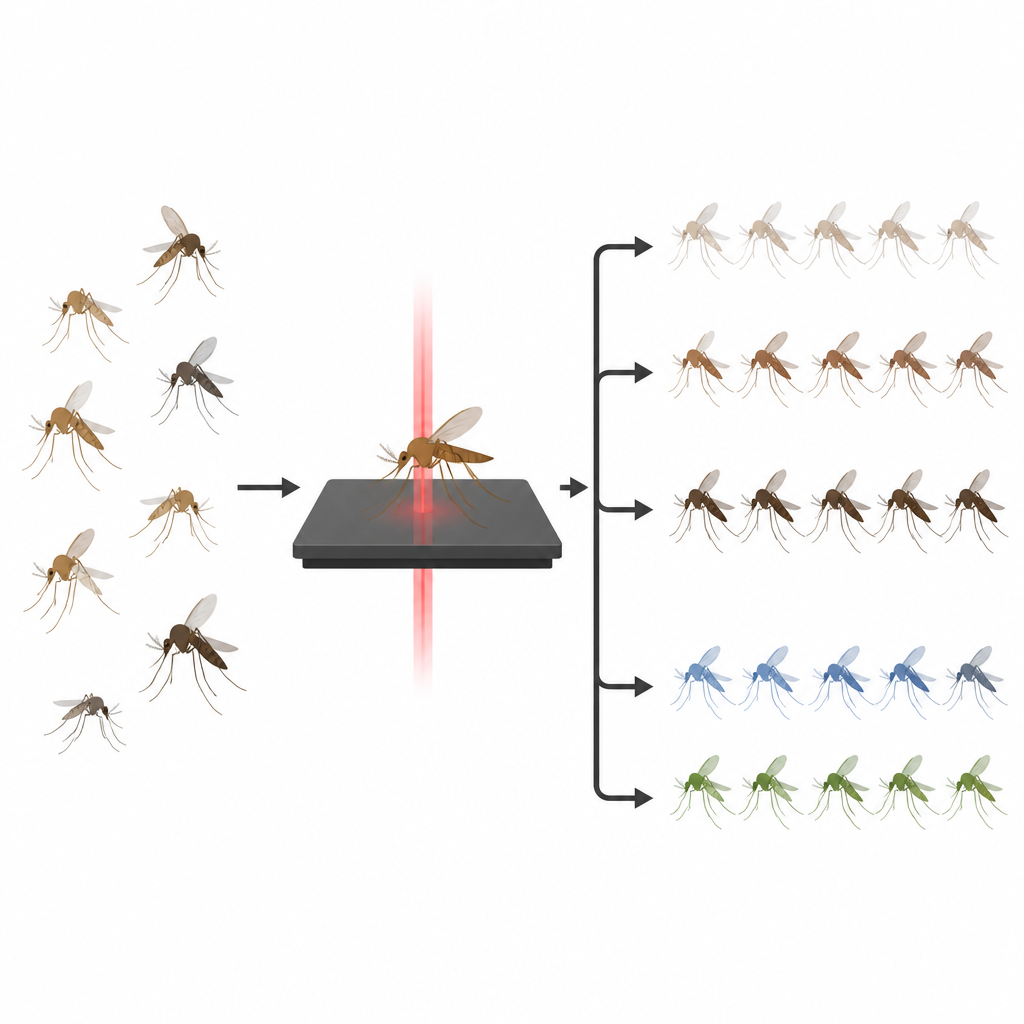
What the light is really seeing
By inspecting which parts of the light spectra were most useful, the researchers found that signals linked to proteins, waxes, and the tough chitin in the mosquito shell were key to age and species prediction. These findings match earlier work on female mosquitoes and other species, suggesting that changes in the outer body with age and between species are a consistent source of information. The authors also noted some sensitivity to background light effects, highlighting the need for careful data cleaning and larger, more diverse training sets to avoid misleading patterns.
What this means for malaria control
For a non specialist, the main message is that shining invisible light on dead male mosquitoes and letting computers read the patterns can provide a fairly quick and cheap way to estimate how old they are and which species they belong to. The study shows that this works very well in the lab and reasonably well in more natural settings when local samples are included in training. Before the method can guide real world malaria programs, broader collections from different regions and conditions will be needed. Still, the work points toward a future where health teams can track male mosquito populations at scale, helping to plan and evaluate new control tools that depend on manipulating these often overlooked insects.
Citation: Sanou, R., Mwanga, E.P., Sow, B.B.D. et al. Age-grading and species identification of male mosquito Anopheles gambiae s.l. using mid-infrared spectroscopy and machine learning. Sci Rep 16, 16079 (2026). https://doi.org/10.1038/s41598-026-46306-2
Keywords: malaria mosquitoes, male mosquitoes, infrared spectroscopy, machine learning, vector control