Clear Sky Science · en
Sustainable production of cellulose nanocrystals from sugarcane bagasse via statistically optimized acid hydrolysis
Turning farm leftovers into useful materials
Sugarcane is grown in huge quantities around the world, and once the sweet juice is squeezed out, a mountain of fibrous leftovers called bagasse is usually burned for energy or left underused. This study shows how that residue can be transformed into tiny, needle-like building blocks called cellulose nanocrystals, which could strengthen biodegradable plastics, packaging, and other greener products—while adding value to an agricultural waste stream.
From sugar fields to hidden fibers
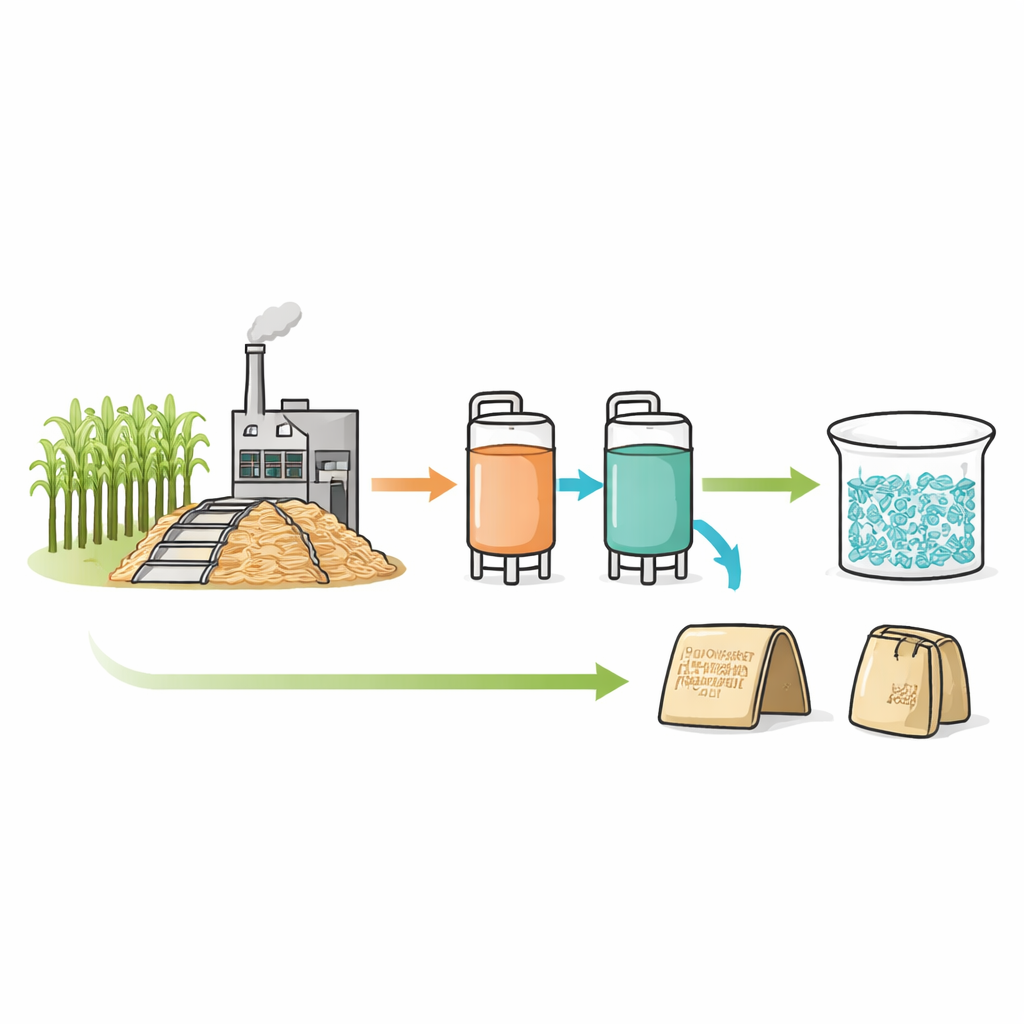
Sugarcane bagasse looks like a rough, mixed bundle of plant matter. Inside, however, it holds a high share of cellulose, the tough, natural polymer that gives plants their structure. The researchers focused on Ethiopian sugarcane bagasse, which is produced in large quantities as the country expands its sugar industry. Their analysis showed that this bagasse contains about 44% cellulose, along with hemicellulose, lignin, extractives, ash, and moisture. That composition makes it a promising local feedstock for advanced biomaterials, instead of something that is simply burned or discarded.
Cleaning and shrinking the plant fibers
To reach the pure cellulose inside the bagasse, the team first cleaned the raw material in several stages. They removed waxes and oils with solvents, then used an alkaline solution and a bleaching step to strip away most of the hemicellulose and lignin that bind the plant cell walls together. These treatments turned the fibers from brown to nearly white and smoothed their surfaces. Under an electron microscope, the original tangled network gradually gave way to cleaner, more distinct cellulose fibers, ready to be broken down into much smaller pieces.
Finding the sweet spot in the reaction
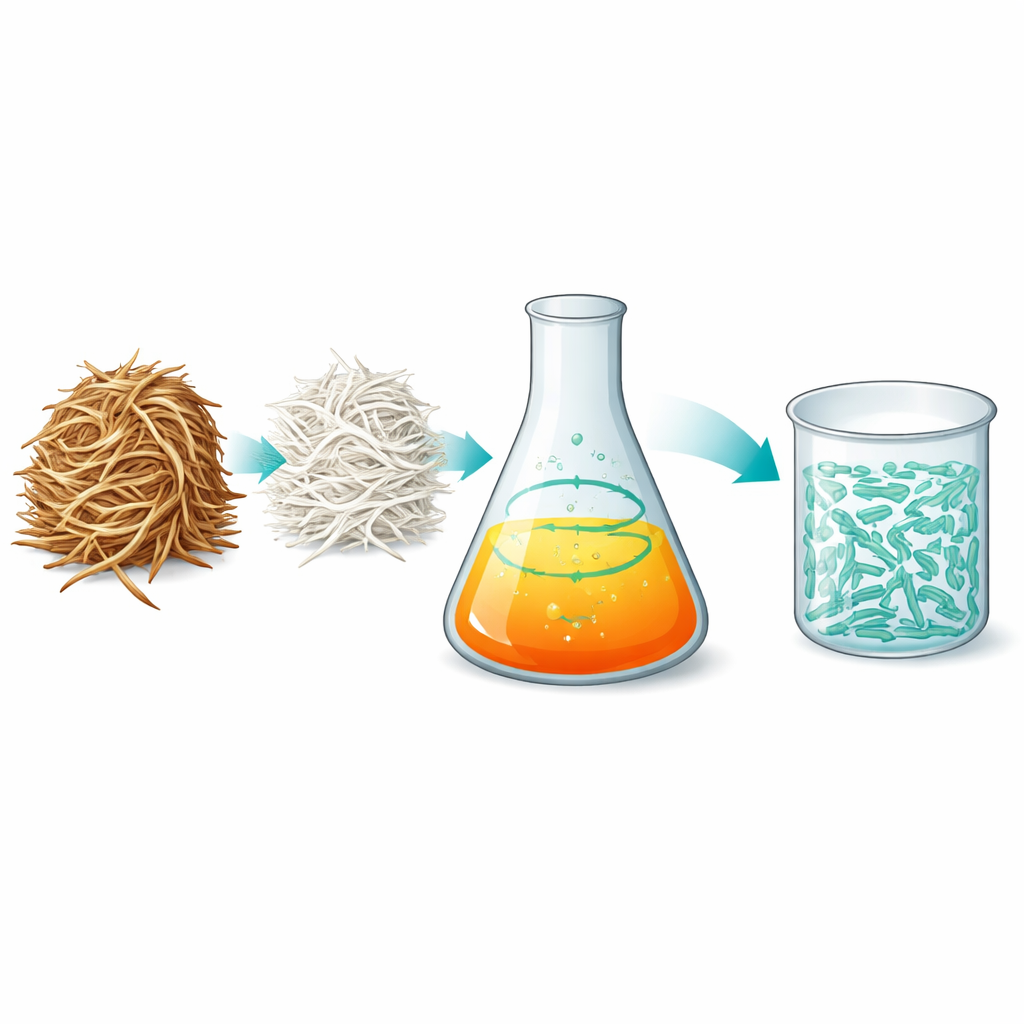
The key step in making cellulose nanocrystals is an acid treatment that eats away the more disordered parts of the cellulose while leaving its stiff, ordered regions intact. Rather than guessing at the best conditions, the scientists used a statistical approach called response surface methodology to balance three main knobs: how strong the sulfuric acid should be, how hot the reaction should get, and how long it should run. By carefully planning and analyzing a limited set of experiments, they found combinations that maximized both the amount of nanocrystals produced and the quality of their crystal structure. The best-performing window was around 61% acid, a temperature of 45 °C, and a reaction time of just under an hour, which yielded about 42% nanocrystals from the starting cellulose.
Seeing the crystals and testing their strength
Once the reaction was complete, the suspension of tiny particles was cleaned, dispersed, and dried. Measurements of particle size showed that most of the resulting crystals were in the nanometer range, with an average diameter of about 100 nanometers—far smaller than the width of a human hair. Microscopy images revealed rod-shaped “whiskers,” confirming that the larger fibers had been broken down into nanoscale pieces. Other techniques that probe structure and bonding showed that the non-cellulosic components had largely been removed and that the remaining cellulose became more ordered, with crystallinity rising from about 45% in the raw bagasse to about 70% in the final product. Heat-flow tests also indicated that these nanocrystals could withstand higher temperatures before breaking down, an advantage for processing them into new materials.
Why this matters for greener products
By combining a careful chemical process with statistical optimization, this work demonstrates a practical way to turn an abundant sugar-industry residue into high-quality cellulose nanocrystals. The optimized method delivers a relatively high yield of well-structured, thermally stable particles that can serve as reinforcing agents in bioplastics, paper, rubber, and sustainable packaging. For countries like Ethiopia, where sugarcane production is expanding, such approaches can help convert a low-value by-product into ingredients for advanced, eco-friendly materials, supporting both rural economies and a more circular use of biomass resources.
Citation: Mamo, K.A., Andualem, T.L., D.M., R.P. et al. Sustainable production of cellulose nanocrystals from sugarcane bagasse via statistically optimized acid hydrolysis. Sci Rep 16, 10682 (2026). https://doi.org/10.1038/s41598-026-46269-4
Keywords: cellulose nanocrystals, sugarcane bagasse, biomass valorization, sustainable materials, acid hydrolysis