Clear Sky Science · en
Identification of an R2R3-MYB gene regulating tepal background coloration in Tricyrtis sp.
Why these spotted lilies matter
Gardeners prize flowers not just for their colors, but for the patterns that make each bloom unique. The ornamental plant Tricyrtis, sometimes called a toad lily, has especially striking flowers: pale purple petals sprinkled with darker purple spots. This study asks a deceptively simple question with big implications for horticulture and basic biology: what controls the soft background color of these petals, and why do the background and spots behave differently?
Two kinds of color on one petal
The authors focus on the petal-like structures of Tricyrtis, called tepals, which show two distinct features: a light purple wash over the whole surface and many darker purple spots scattered at random. Earlier work had cataloged the genes involved in making anthocyanins, the pigments that give many flowers their reds, purples, and blues, and had identified a candidate “switch” gene called TrMYB1. This gene belongs to a well-known family that turns pigment production on or off in many plant species. What remained unclear was whether TrMYB1 actually controls the background color in Tricyrtis and how its activity is tied to light.
Turning down the light
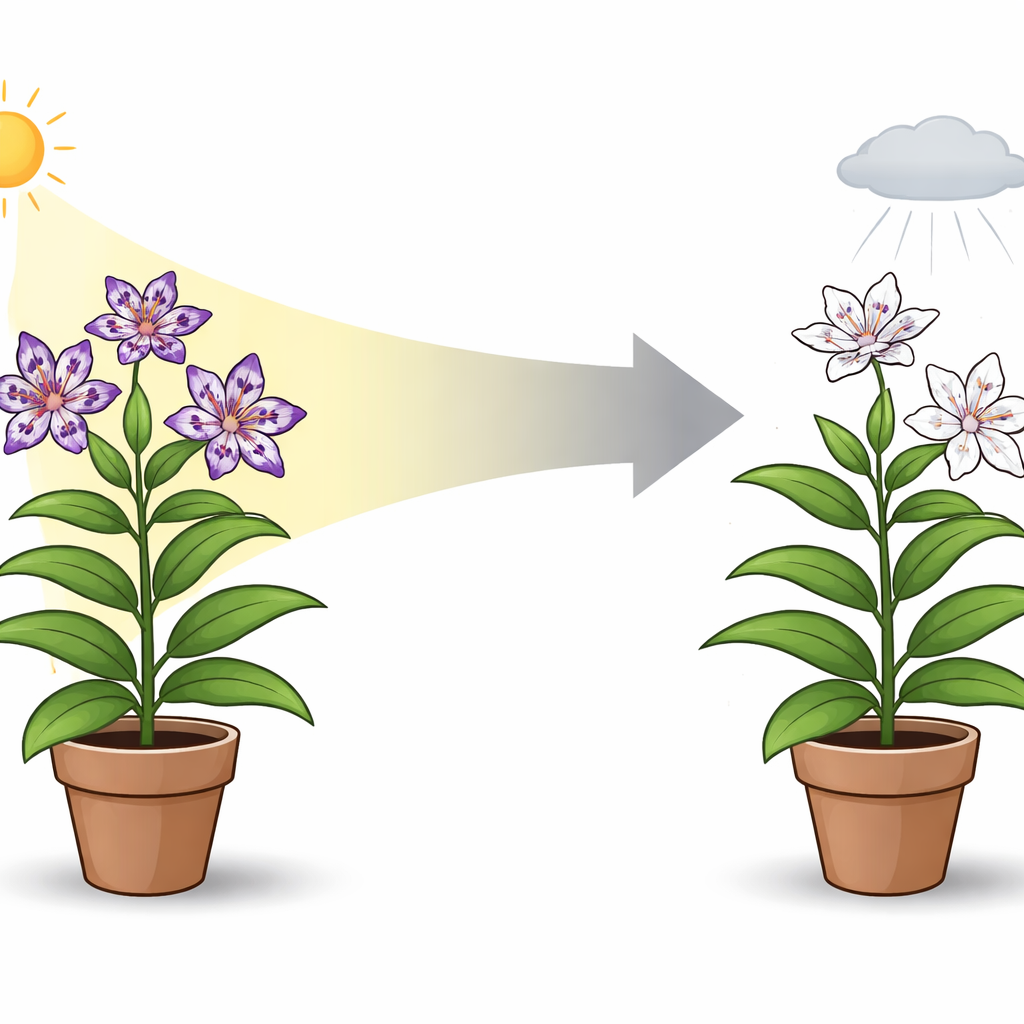
To probe the role of light, the researchers wrapped developing flower buds in aluminum foil, shading them from illumination as they grew. Under normal light, the tepals gradually developed a pale purple background with bold spots as the buds matured. Under shade, overall background color was greatly reduced at every stage, yet the dark spots still appeared in roughly the same pattern. Chemical measurements confirmed that total anthocyanin levels dropped sharply in shaded flowers. At the same time, the activity of TrMYB1 and several pigment-making genes fell, suggesting that light promotes background pigmentation at least in part by boosting TrMYB1.
Dialing the color up and down
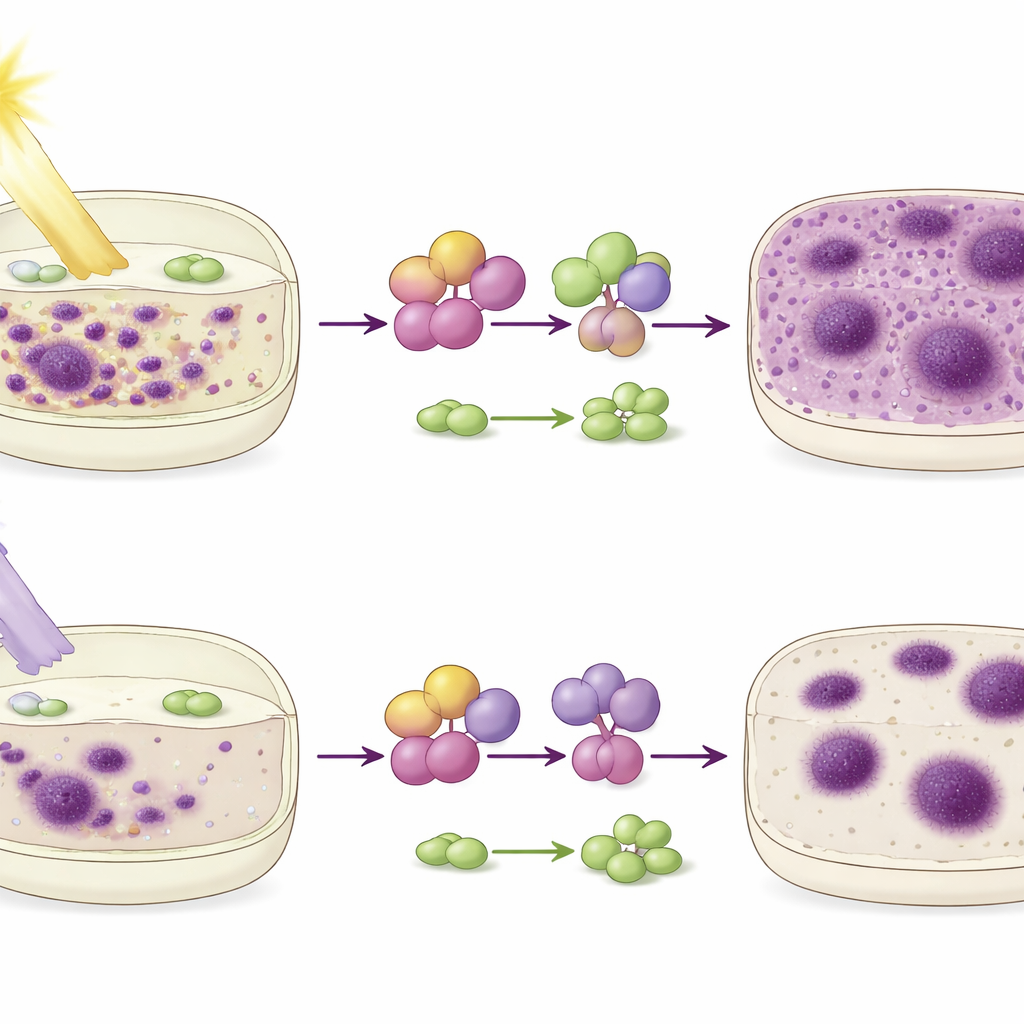
The team then used genetic engineering to push TrMYB1 activity either above or below its normal level in Tricyrtis plants. In plants engineered to overproduce TrMYB1, leaves and naturally pigmented flower regions became much more intensely colored, and the amount of anthocyanin increased. Several pigment-enzyme genes also became more active, fitting the idea that TrMYB1 acts as a master switch that turns on the pigment-making machinery. However, regions that are normally colorless, such as the bases of the tepals, did not suddenly gain new color, hinting that TrMYB1 needs partner factors or local signals to act there.
When the color switch is muted
In a complementary experiment, the researchers used an RNA interference approach to reduce TrMYB1 activity. These knockdown plants produced flowers whose tepal backgrounds were almost entirely white, on both sides of the petals. Dark spots were still present, but fainter than in normal flowers. Again, pigment measurements and gene-activity tests showed that anthocyanin levels and the expression of several pigment-enzyme genes dropped markedly, while another component of the pigment-control complex changed little. Together, these results indicate that TrMYB1 is essential for generating the soft wash of color across the tepals, and that spot formation is at least partly controlled by other factors.
What the findings mean for flowers and beyond
In simple terms, this work shows that TrMYB1 is a light-responsive genetic switch that controls the background coloration of Tricyrtis petals by turning pigment production up or down. The random purple spots, however, largely follow their own rules, only modestly affected when TrMYB1 is dampened and barely changed by shade. This separation between background and spot control systems suggests that flower patterns can evolve by tweaking different gene switches rather than rewriting the entire pigment program. For breeders, understanding such switches could someday make it possible to design new ornamental varieties with custom color washes and spot patterns. For biologists, Tricyrtis now offers a promising model to uncover how plants paint such intricate patterns on a living canvas.
Citation: Shinoku, Y., Kazama, I., Kanemaki, Y. et al. Identification of an R2R3-MYB gene regulating tepal background coloration in Tricyrtis sp.. Sci Rep 16, 10743 (2026). https://doi.org/10.1038/s41598-026-46254-x
Keywords: flower color, anthocyanin, gene regulation, ornamental plants, light response