Clear Sky Science · en
Advanced channel estimation in OTFS and NOMA using deep bayesian gaussian processes and compressive sensing
Why fast-moving connections need smarter helpers
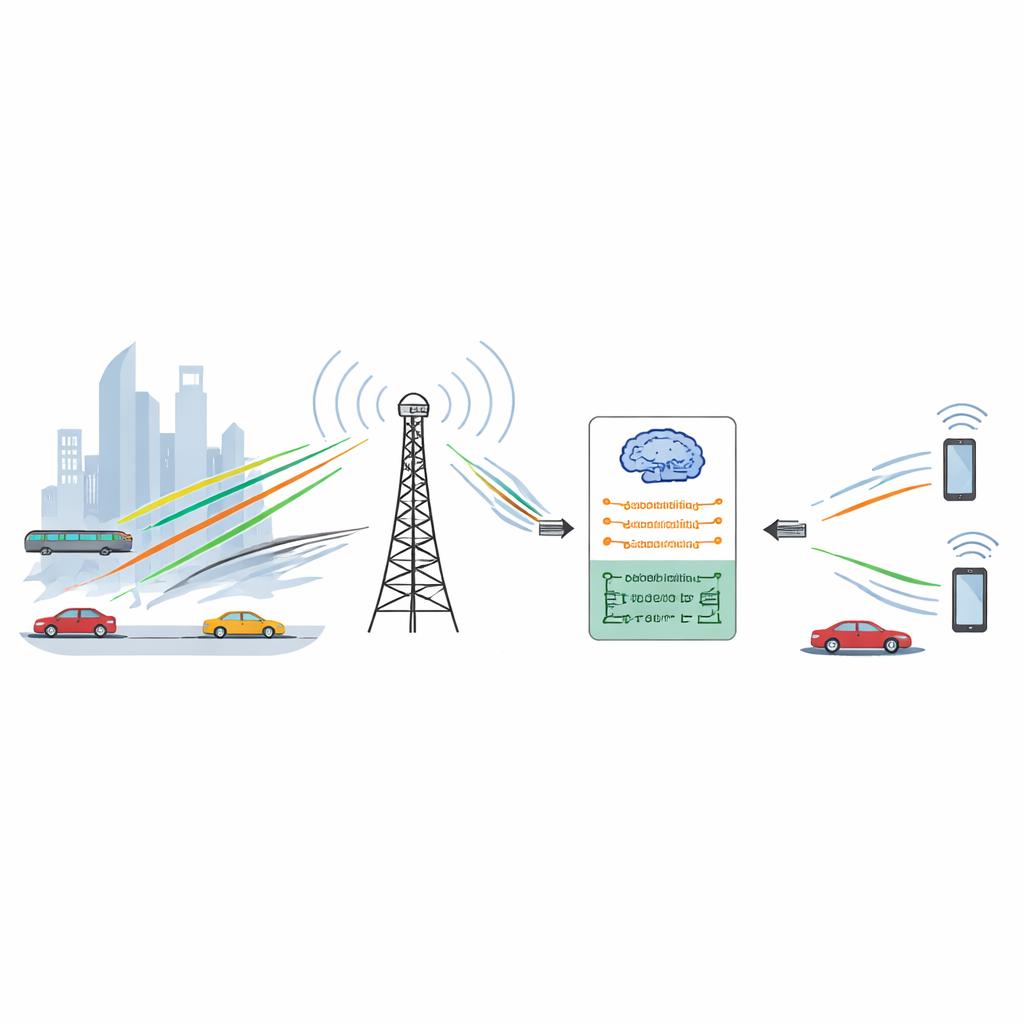
From streaming in a speeding train to cars talking to each other to avoid collisions, our devices increasingly need to stay connected while moving quickly through crowded cities. In these situations, wireless signals bounce off buildings and vehicles, and their frequencies shift as everything moves. This paper explores a new way to keep those connections clear and reliable by teaching the network to "sense" the invisible paths that radio waves take, even when both users and surroundings are constantly in motion.
The challenge of talking on the move
Modern networks like 5G and future 6G are expected to serve many fast-moving users at once, from highway traffic to high-speed trains. Two promising tools help with this: OTFS, a way of arranging data that is naturally aware of how signals are delayed and shifted by motion, and NOMA, a way of letting many users share the same frequencies. Both rely on a crucial ingredient called channel estimation, which is essentially the network’s guess about how the environment is warping each user’s signal. Traditional methods send many known “pilot” signals and then fit simple models, which works well when users move slowly. But in crowded cities with speeds above 100 km/h and lots of reflections, these simple models struggle, need too many pilots, waste bandwidth, and fail to keep up with rapid changes.
A new blend of learning and sensing
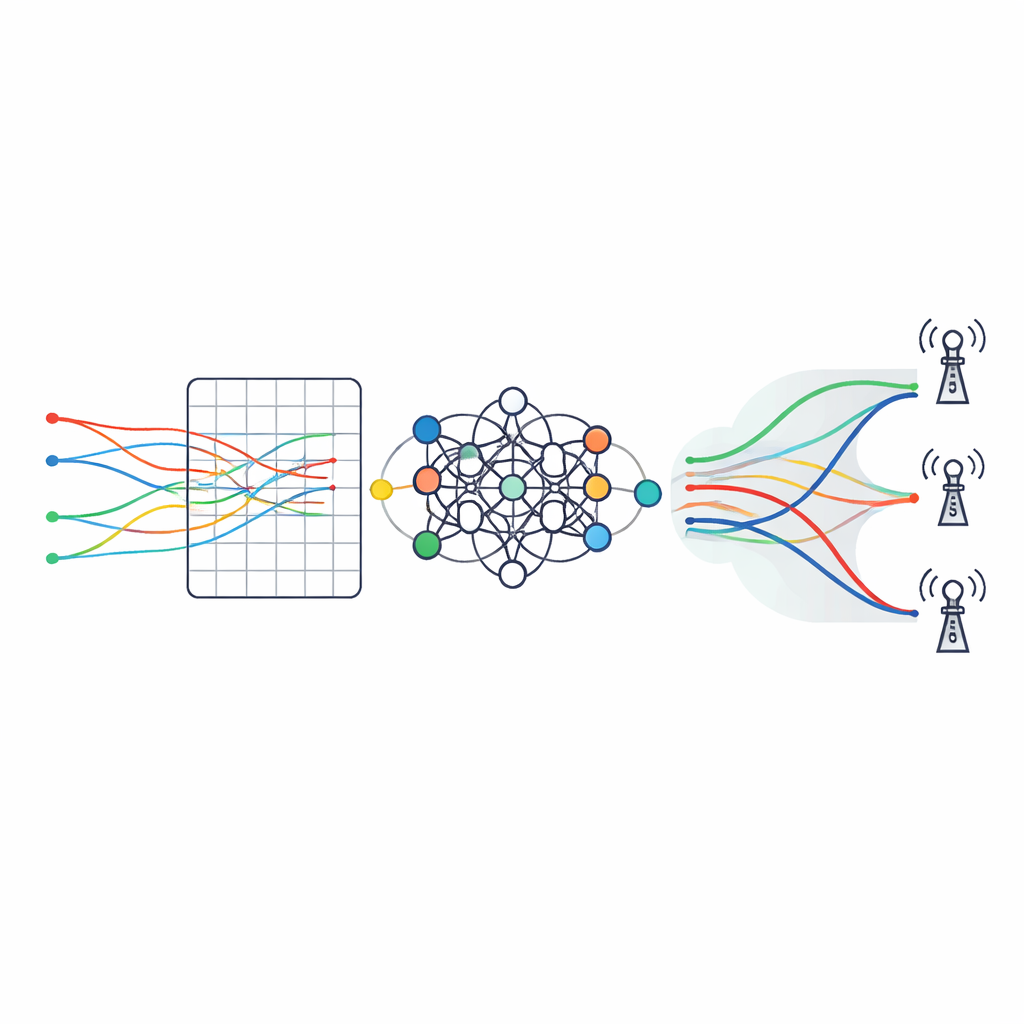
The authors propose a hybrid method called Deep Bayesian Gaussian Process with Compressive Sensing (DBGP-CS) to tackle this problem. It combines three ideas. First, a deep neural network learns useful patterns from the complicated raw measurements that describe how signals are delayed and shifted, turning them into a more compact representation. Second, a Bayesian Gaussian process sits on top of these learned features and treats the channel as a smooth but uncertain function, producing not only a best guess but also a measure of how confident that guess is. Third, compressive sensing takes advantage of the fact that only a few paths actually carry most of the signal energy, allowing the system to reconstruct the channel from far fewer pilots than usual. Together, these parts aim to cut overhead, capture non‑linear behavior, and still tell the network how sure it should be before making decisions about power, coding, and scheduling.
Putting the idea to the test
To see whether the new approach pays off, the researchers simulate a demanding scenario: 100 users moving at highway speeds of up to 120 km/h in a dense urban setting, using a standard 5G millimeter‑wave channel model with nine reflected paths. They compare DBGP-CS with three other strategies: a basic least‑squares method, a more sophisticated linear minimum‑mean‑square method, and a deep Bayesian Gaussian process without compressive sensing. Across a wide range of signal‑to‑noise levels, the hybrid method produces much more accurate channel estimates and far lower error rates in the decoded data. Notably, it cuts a key error measure to about one‑tenth of that of the best conventional method at typical operating conditions and slashes the required number of pilot signals by half, freeing that bandwidth for actual user data.
Robust performance in many real-world conditions
The team also stresses the method under varying speeds, different numbers of reflected paths, changes in how energy is split between pilots and data, and different pilot counts. Even when the number of paths grows or vehicles move faster and the channel becomes harder to predict, the new model keeps a clear advantage. With only 20 pilots, it matches or beats the performance that older methods achieve with 40, confirming the promised 50% reduction in overhead. At the same time, the approach is designed to be practical: the heavy training stage can be done offline, while the real‑time estimation step can run within a few milliseconds on modern hardware, fast enough for many vehicular applications when combined with prediction and edge computing.
What this means for everyday users
In plain terms, this work shows that blending modern machine learning with clever signal processing can make wireless links more reliable when it matters most—at high speeds and in busy environments. By learning the structure of the radio channel, quantifying uncertainty, and needing fewer reference signals, the proposed method can deliver clearer connections, lower error rates, and more efficient use of spectrum for OTFS‑NOMA systems. If adopted in future 5G and 6G networks, such techniques could help keep your car, train, or phone connected smoothly even as it races through a maze of reflections, paving the way for safer autonomous driving, better vehicle‑to‑everything communication, and more robust high‑speed mobile internet.
Citation: Anilkumar, N., Sengan, S. Advanced channel estimation in OTFS and NOMA using deep bayesian gaussian processes and compressive sensing. Sci Rep 16, 10901 (2026). https://doi.org/10.1038/s41598-026-46253-y
Keywords: wireless communication, channel estimation, OTFS NOMA, machine learning, vehicular networks