Clear Sky Science · en
Quantitative comparison of explainable AI methods for interpreting deep learning–based classification of 3D gait kinematics
Why this research on walking and AI matters
Many children with conditions such as cerebral palsy or neuromuscular disease walk in ways that are difficult to diagnose and classify by eye alone. Doctors already use 3D motion capture of walking to guide treatment, but recent advances in artificial intelligence can spot subtle patterns beyond human perception. The problem is that these powerful deep learning tools often act like black boxes, giving answers without clear reasons. This study asks a simple question with big implications: can we get these models to show which parts of the walk they rely on, so clinicians can understand and trust their help?
From motion capture to smart pattern finding
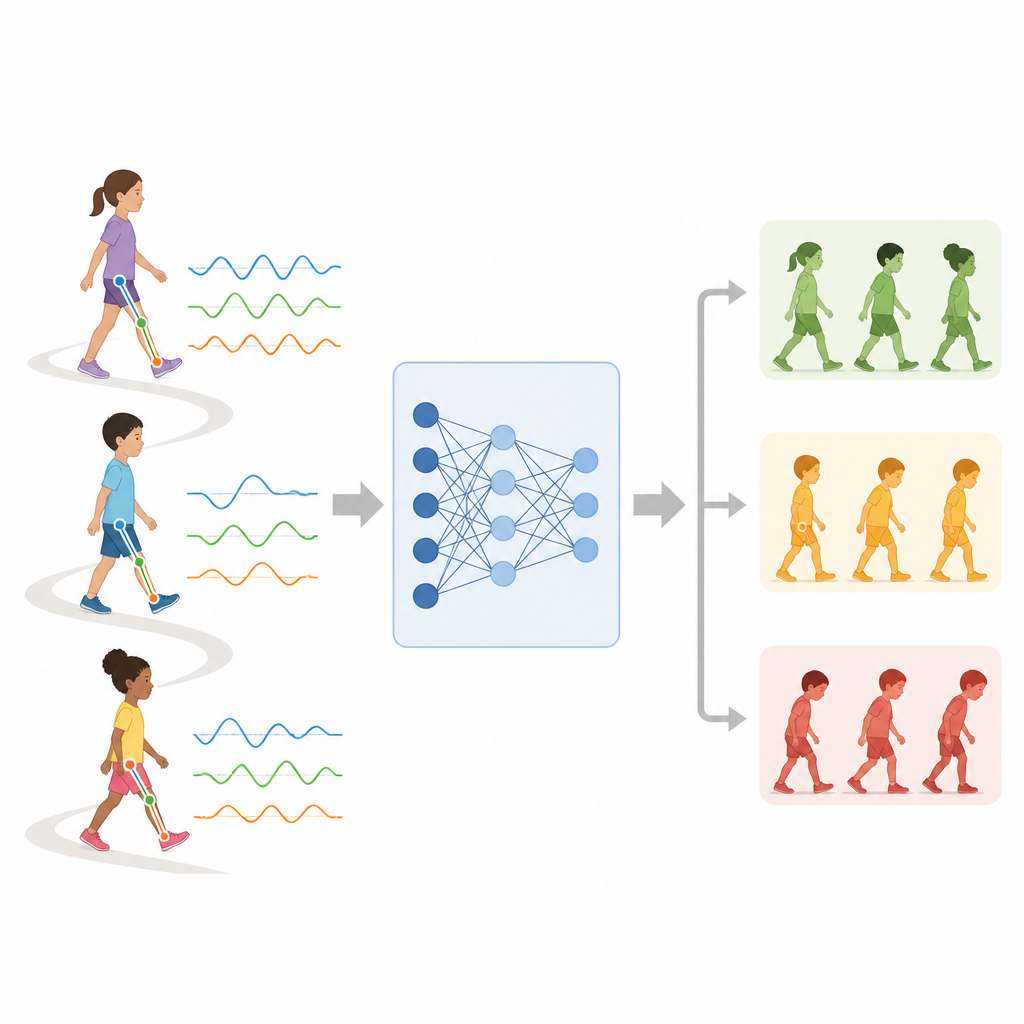
Over 15 years, a hospital gait lab in France recorded detailed 3D movements of children’s hips, knees, ankles, and feet as they walked. Each gait cycle was turned into time-varying curves describing 22 joint angles on the more and less affected sides. The team had already trained several deep learning models to tell apart typically developing children from those with unilateral or bilateral cerebral palsy, neuromuscular disease, or idiopathic toe walking, reaching accuracies up to the high 90 percent range. In this new work, instead of designing yet another model, they focused on opening the hood of these existing systems to see which joint angles and patterns truly drive the computer’s decisions.
Teaching black boxes to explain themselves
The researchers compared four explainable AI methods, each offering a different way to trace a prediction back to input features. Three of them (LIME, DeepLift, and Integrated Gradients) look at how small changes in the input affect the model’s output for a given walking trial. The fourth, called sequential feature selection, repeatedly trains models while adding or removing joint angles to see how accuracy changes. By applying these tools to three different gait datasets and three deep learning architectures, the team created ranked lists of which joints mattered most for each diagnostic task, and then checked how stable and faithful those rankings were.
What the models say about how we walk
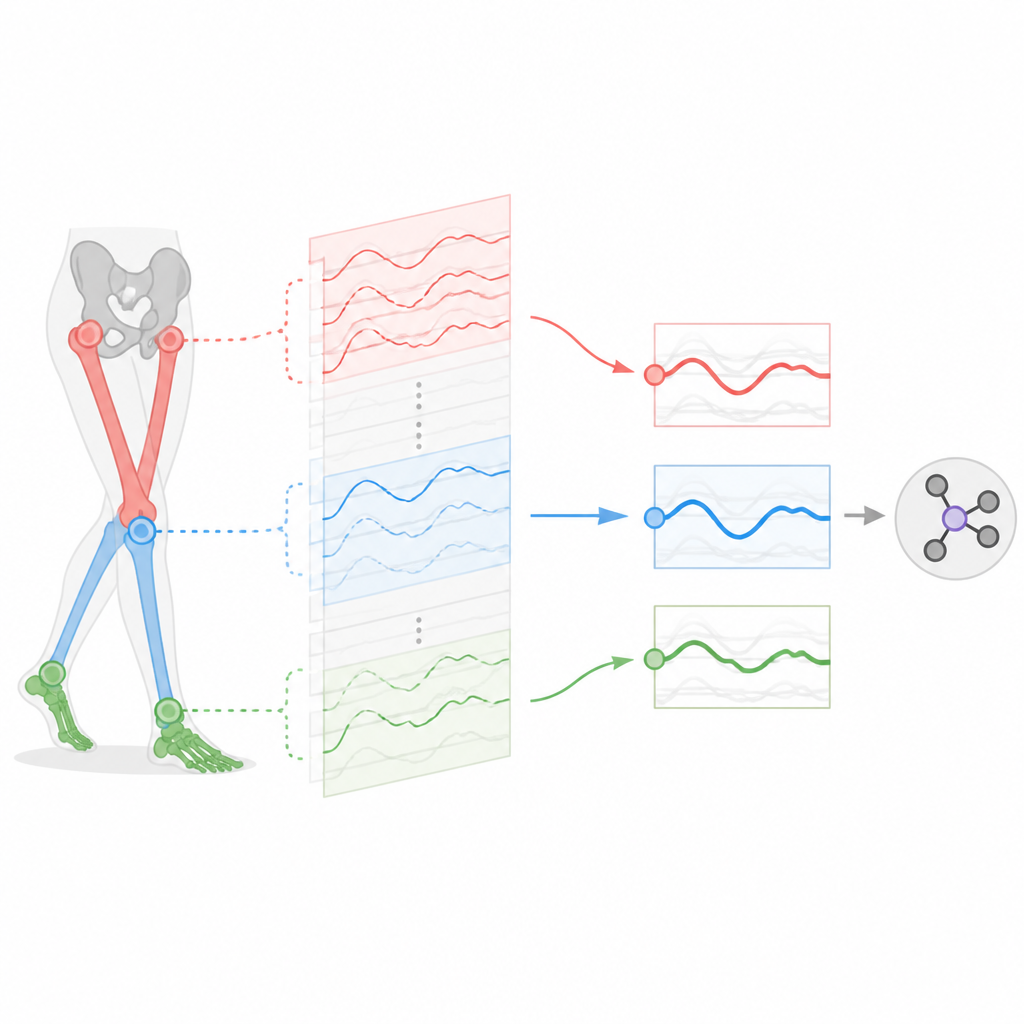
Across all methods and datasets, a clear pattern emerged. Flexion and extension of the hip, knee, and ankle, especially on the more affected side, consistently appeared among the most important angles. These are the same joints that clinical gait experts have long considered central to understanding cerebral palsy and related disorders. When the researchers tested how robust each explainable method was to small variations in the data, and how much model performance dropped when “important” features were removed, Integrated Gradients stood out as the most reliable overall. It produced explanations that changed little across similar gait cycles and that aligned well with which features truly hurt the model when taken away.
Doing more with fewer, better chosen signals
The study also explored what happens if deep learning models are fed only the most critical angles instead of all 22. Using forward feature selection, the team found that in many cases a single joint angle could come within a few percentage points of the full model’s accuracy. With a small set of top-ranked angles, performance could even surpass the original model that used every feature. This suggests that removing noisy or less relevant information can sharpen the model’s focus, making it both simpler and more accurate, while highlighting a compact set of gait features that clinicians can readily interpret and monitor over time.
What this means for future clinic visits
For non-specialists, the main message is that deep learning tools for gait analysis are not just guessing; they rely on the same key joint movements that human experts already watch closely. By showing that one explainable method, Integrated Gradients, gives robust and clinically meaningful explanations, the study moves AI-based gait diagnosis closer to everyday use. Doctors can see which hip, knee, and ankle motions led to a suggested diagnosis, and even base simplified models on these critical features alone. This combination of strong performance and transparent reasoning may help these tools become trusted partners in deciding how best to support children with walking difficulties.
Citation: Lan, Z., Lempereur, M., Aïssa-El-Bey, A. et al. Quantitative comparison of explainable AI methods for interpreting deep learning–based classification of 3D gait kinematics. Sci Rep 16, 15560 (2026). https://doi.org/10.1038/s41598-026-46243-0
Keywords: gait analysis, cerebral palsy, deep learning, explainable AI, joint kinematics