Clear Sky Science · en
Non-Fermi liquid of extended range at zero temperature without quantum criticality
Why this strange metal matters
Many modern materials, including high temperature superconductors and designer layered crystals, behave like no ordinary metal. Their electrical resistance often increases in a simple straight line with temperature instead of following the textbook rules of Fermi liquids, which describe familiar metals like copper. This puzzling "strange metal" behavior is widespread, yet its origin remains hotly debated. In this work, the authors use a well studied model of electrons interacting with lattice vibrations to show that such nonstandard metallic behavior can exist on its own over a broad range of conditions, without being tied to a delicate quantum tipping point. Their results suggest a new route to understanding strange metals and their connection to superconductivity.
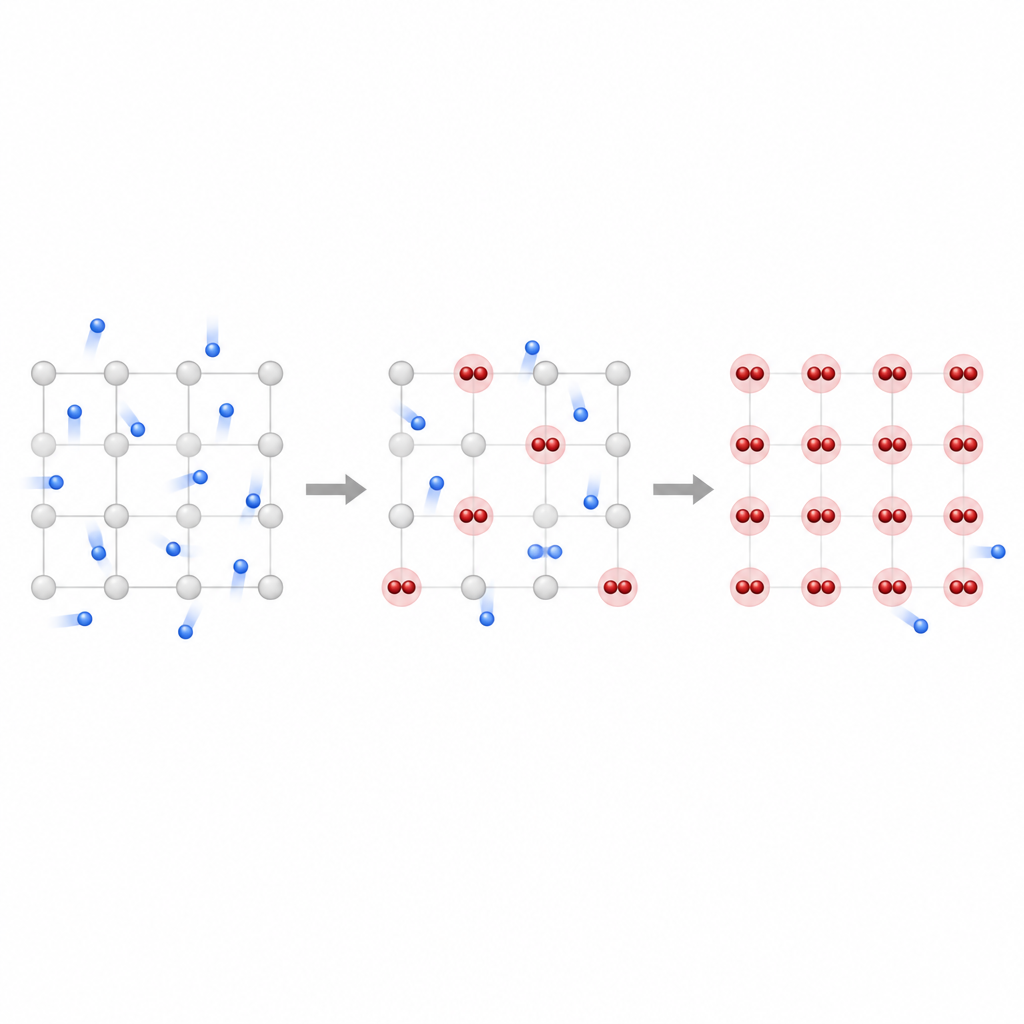
A new kind of metal between metal and insulator
The study focuses on the Holstein model, a simple but powerful description of electrons that hop between sites of a crystal while interacting locally with atomic vibrations, or phonons. Using a numerical approach called dynamical mean field theory combined with the numerical renormalization group, the authors map out the zero temperature phase diagram as they vary the electron density and the strength of the effective attraction generated by the phonons. Instead of a direct switch from a conventional metal to an insulator, they find a third, intervening metallic phase. This phase is a non Fermi liquid: it conducts electricity but does not host well defined long lived quasiparticles, the basic building blocks of standard metallic theory.
Strange metal without a quantum tipping point
In many earlier ideas, non Fermi liquid behavior was tied to a quantum critical point, a sharp continuous transition at absolute zero where quantum fluctuations become scale free and disrupt ordinary metallic behavior. Near such a point, strange metal signatures are expected only at a single value of a control parameter at zero temperature, fanning out into a broader region as temperature is raised. In contrast, the phase uncovered here exists as a full fledged ground state across a finite density range, even at zero temperature, and it appears through first order transitions. As the interaction strength is tuned, the system jumps discontinuously from a normal Fermi liquid metal to the non Fermi liquid, and then from this phase to an insulating state. This step like evolution naturally creates extended regions where strange metallicity should be observed.
A tale of paired spins and flowing charge
To understand what makes this metallic state unusual, the authors examine how spin and charge excitations behave. They find that in the strange metal phase, spin excitations are gapped, meaning that flipping a spin costs a finite amount of energy, while charge excitations remain gapless so that electrical conduction is still possible. In physical terms, electrons at a site tend to form tightly bound spin singlet pairs, often called bipolarons, but these pairs coexist with mobile single electrons that can hop through the lattice. This combination defines what the authors call a spin gap metal: a conducting state where the spin degrees of freedom are frozen out at low energies, yet charge can still flow. The metallic phase on the insulating side of the diagram, by contrast, has gaps in both spin and charge and behaves as a fully localized spin gap insulator.
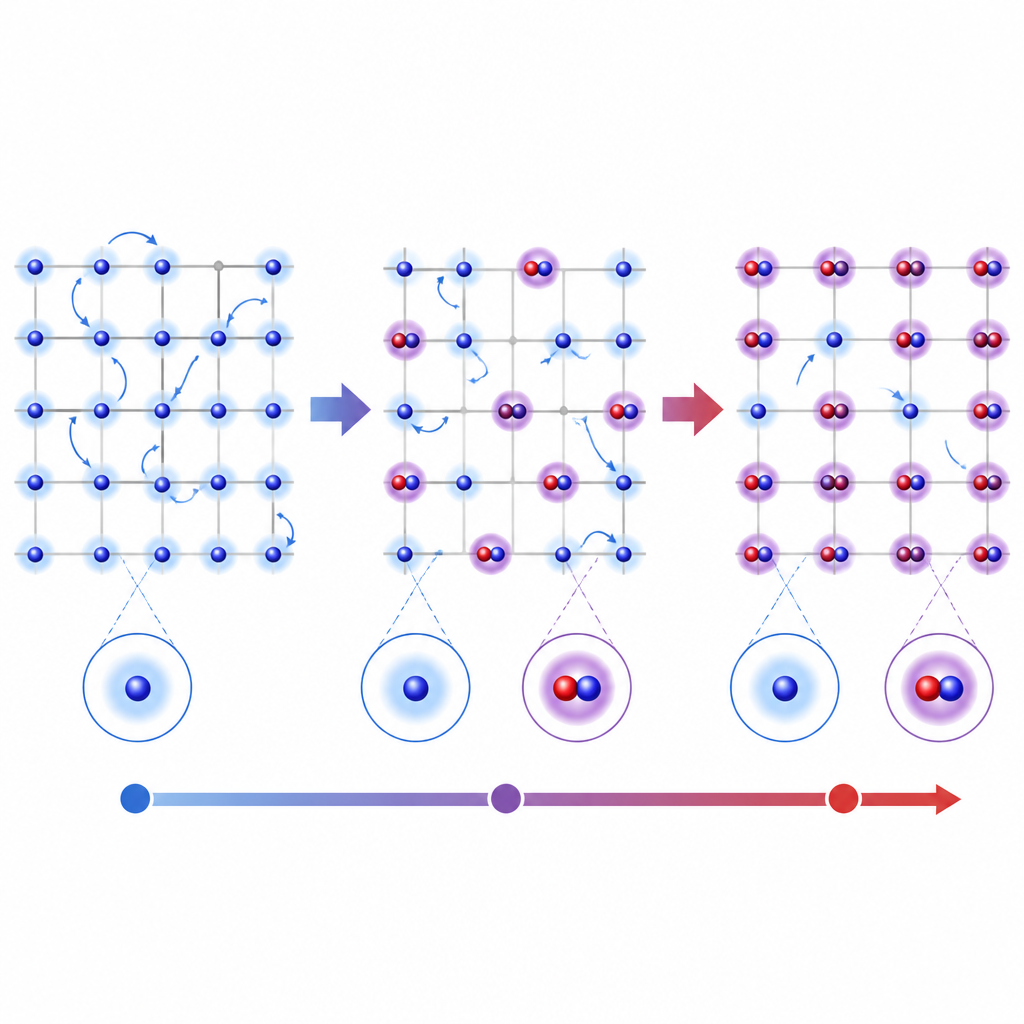
Mixtures, two fluids, and links to real materials
Because the transitions between phases are first order, the system does not always switch cleanly from one pure state to another. At the phase boundary between the conventional metal and the spin gap metal, theory predicts a regime where the two states coexist, much like water and ice at the freezing point. In this mixed region, one expects transport to look as if two distinct fluids are present: one behaving like a standard metal and the other like a strange metal. This two fluid picture echoes interpretations of experiments in cuprate superconductors and other quantum materials, where resistivity and magnetoresistance often show a blend of ordinary and anomalous contributions over an extended range of doping, pressure, or magnetic field.
What this means for strange metals and superconductors
Overall, the work demonstrates that a non Fermi liquid metal can arise as a stable ground state over a broad range of conditions in a clean, non random model of electrons coupled to phonons, without relying on quantum criticality. The key ingredient is the formation of local spin singlet pairs that open a spin gap while leaving charge motion free, combined with first order transitions that generate mixed phase regions. These findings strengthen the idea that extended strange metal behavior and two fluid like transport can be rooted in underlying first order transitions between different electronic states. They also suggest that the same mechanisms that form spin singlet pairs in the strange metal may be closely related to the pairing responsible for superconductivity, offering a fresh perspective on how these two phenomena may be intertwined in complex quantum materials.
Citation: Park, TH., Choi, HY. Non-Fermi liquid of extended range at zero temperature without quantum criticality. Sci Rep 16, 15402 (2026). https://doi.org/10.1038/s41598-026-46239-w
Keywords: strange metal, non Fermi liquid, Holstein model, spin gap metal, electron phonon coupling