Clear Sky Science · en
Comparative analysis of advanced constraint-handling in quantum PSO with differential mutation for optimal power flow
Smarter Ways to Steer Electric Power Grids
Modern power grids must constantly juggle competing demands: keep the lights on, keep costs down, limit pollution, and avoid overloading equipment. Doing all of that at once is a huge mathematical juggling act. This paper explores new ways to help computer algorithms respect the many safety limits of a grid while still finding cheaper, cleaner operating points, offering insight into how smarter software can quietly improve everyday electricity service.
The Challenge of Balancing Many Grid Goals
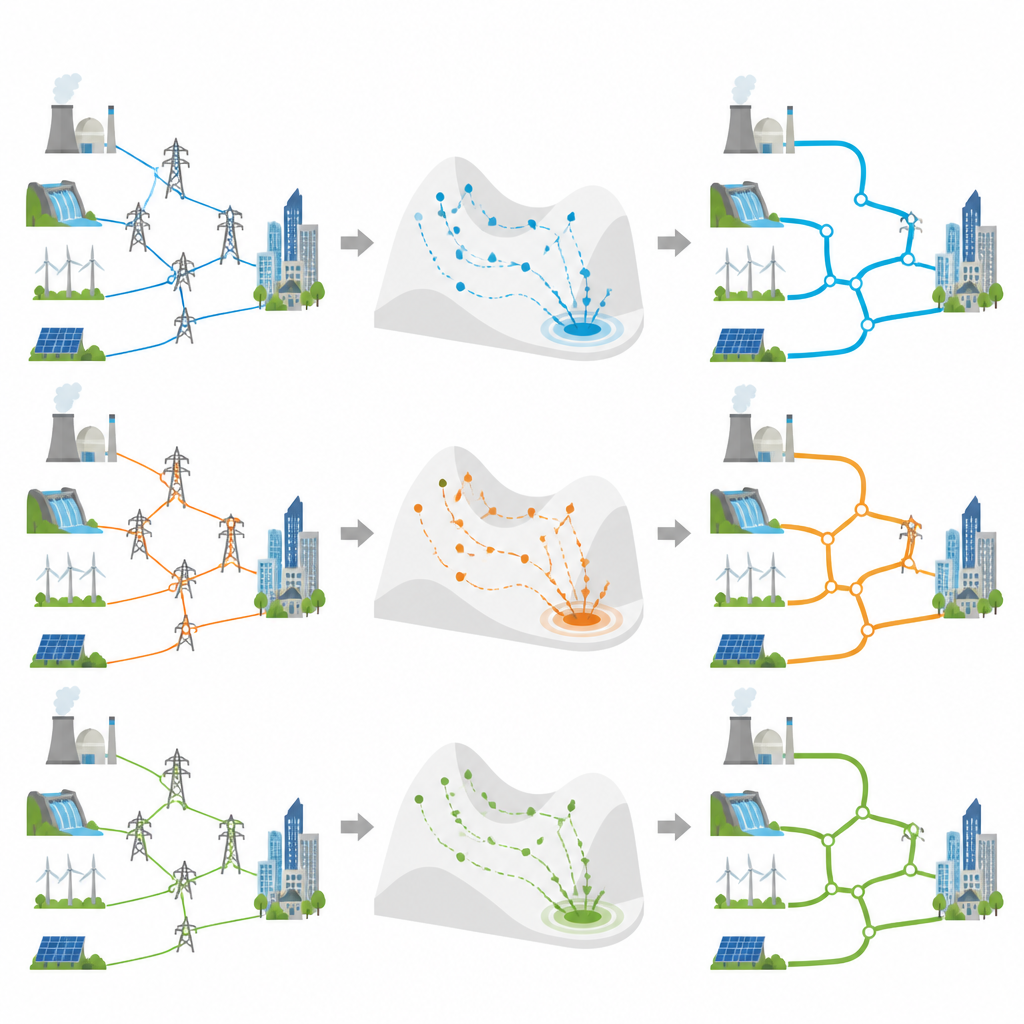
Running a large power system is like coordinating thousands of invisible rivers of electricity. Operators must decide how much power each plant should produce, how voltages should be adjusted, and how much energy can safely flow along each line. This problem, known as optimal power flow, is difficult because the grid behaves in a complex, non-linear way and must obey strict engineering limits. Traditional methods often get stuck in local solutions or fail when the model includes realistic features such as generators that burn different fuels or cost curves that bend and ripple due to the mechanics of steam valves.
Swarm Intelligence with a Quantum Twist
To tackle this complexity, the authors build on a family of so called swarm algorithms, inspired by the way flocks of birds or schools of fish explore their surroundings. In these methods, many trial solutions move through the search space, learning both from their own past success and from the best performers in the group. The paper uses a variant called quantum behaved particle swarm optimization with differential mutation. Here, candidate solutions move according to probability patterns rather than simple velocities, which helps them escape poor regions, while mutation steps keep the population diverse and prevent everyone from settling too early on a mediocre answer.
Why Respecting Limits is So Difficult
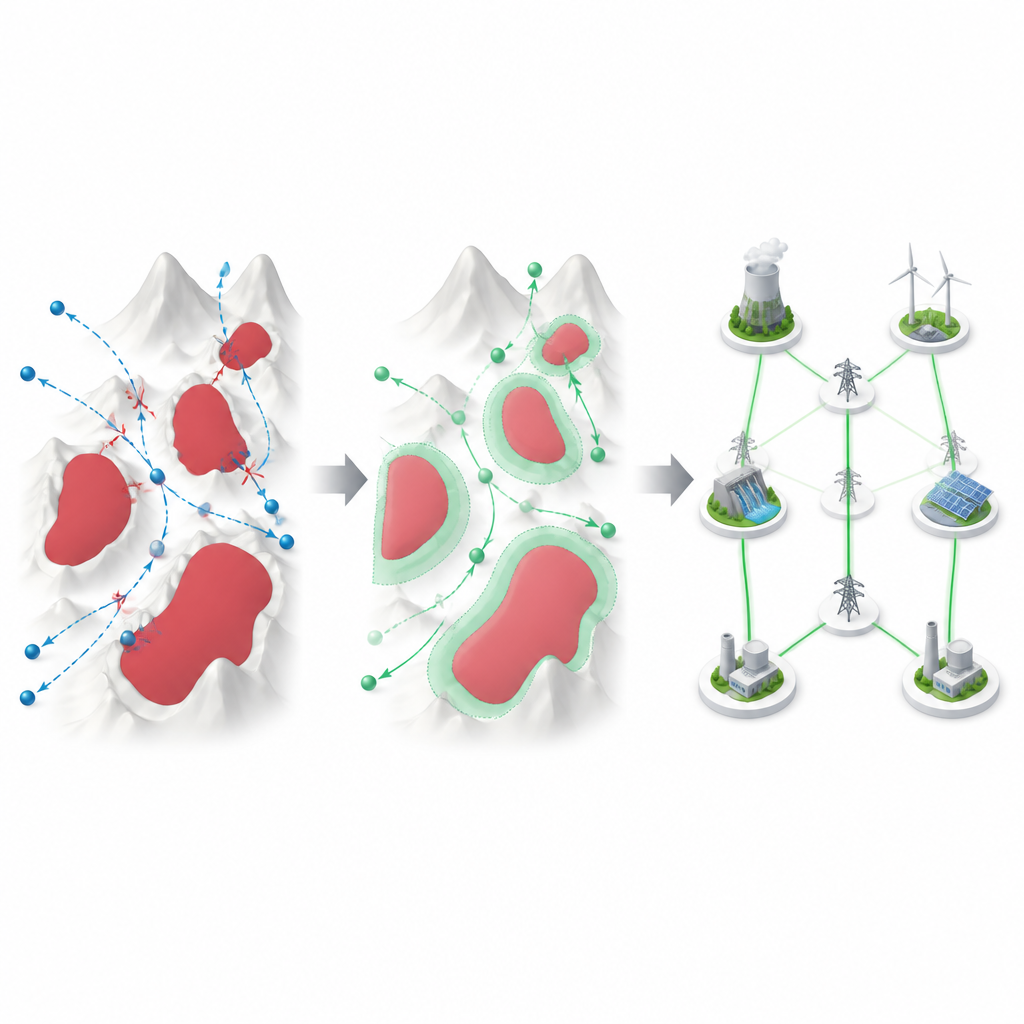
A key difficulty is making sure suggested operating points obey all grid limits, such as maximum line loading, allowed voltage ranges, and generator capabilities. Many algorithms use penalty terms that simply punish violations, but choosing the right penalty strength is more art than science and can still allow unsafe results. The authors focus instead on three more advanced ways to treat limits. One favors any solution that is fully acceptable over those that are not. Another uses a probability rule that sometimes ranks by quality and sometimes by how badly limits are broken. The third, called the epsilon method, temporarily allows small violations within a shrinking tolerance band, encouraging the search to explore near the boundaries where good answers often lie.
Testing on Realistic Network Models
The team tests these three strategies inside the same swarm framework on standard benchmark grids with 30, 57, and 118 buses, representing small, medium, and large systems. They look at several aims: cutting fuel cost, reducing pollution, improving voltage stability, lowering overall losses, and dealing with more realistic fuel and valve behavior at generators. By keeping the search engine identical and only changing how it handles limits, they can fairly compare the impact of each strategy on cost, reliability, and how quickly the algorithm settles. They also run each case many times and use a non parametric statistical test to check whether observed differences are meaningful rather than random luck.
What the Results Mean for Future Grids
Across most test cases, the epsilon based strategy works as well as or better than the other two, and its advantage grows in the largest and most constrained system. It tends to find solutions with lower operating costs, fewer broken limits, and smoother convergence. The more rigid method that always favors fully acceptable solutions can stagnate when safe regions are tiny, while the probabilistic ranking method struggles to be reliable in these particular grid problems. For non specialists, the key message is that how an algorithm treats “almost acceptable” options can make a big difference. By allowing a controlled amount of trial and error near the edges of safety and then tightening the rules, the epsilon approach helps the swarm home in on safe, efficient settings, suggesting a promising path for smarter and more reliable power system control.
Citation: Naidji, M., Toubal Maamar, A.E., Rahal, M.I. et al. Comparative analysis of advanced constraint-handling in quantum PSO with differential mutation for optimal power flow. Sci Rep 16, 15867 (2026). https://doi.org/10.1038/s41598-026-46233-2
Keywords: optimal power flow, swarm optimization, constraint handling, power system operation, electricity grid