Clear Sky Science · en
AI based ECG data recovery and cardiovascular diseases classification (CEDRC-network)
Why Cleaning Heart Signals Matters
Every beat of the heart leaves an electrical trace that doctors read to spot trouble early. But in real hospitals, these electrocardiogram (ECG) traces are often messy or incomplete because patients move, electrodes slip, or machines glitch. This study introduces a smart computer system, called CEDRC-Net, that automatically cleans up noisy ECGs, fills in missing pieces, and then helps classify several common heart rhythm problems. By making flawed recordings usable instead of discarding them, the approach could support faster, more reliable heart care for many patients at once.
From Real-World Hospital Data to a Smarter Pipeline
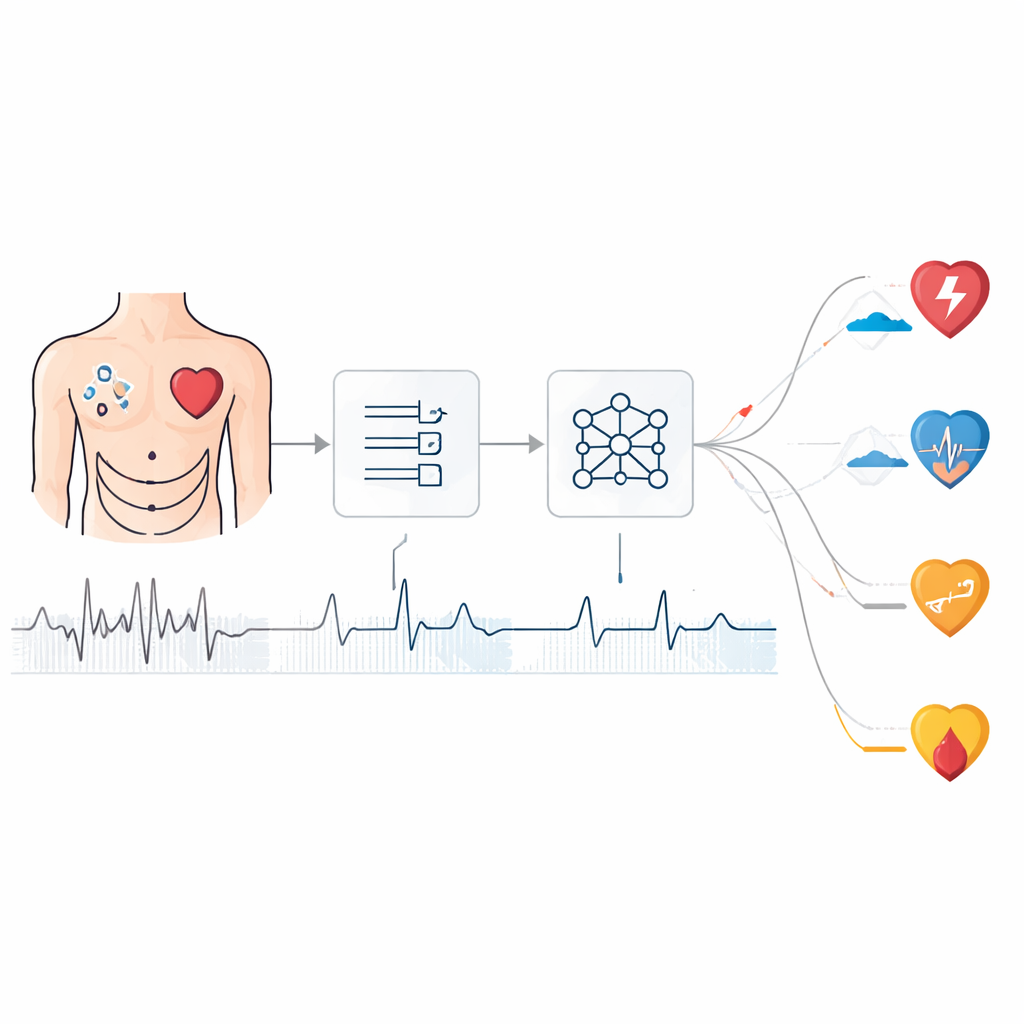
The researchers built and tested their system on the large MIMIC-IV-ECG collection: about 800,000 ten‑second, 12‑lead ECGs from roughly 160,000 patients, linked to clinical records. Rather than design a single opaque “black box,” they split the process into stages that mirror how a human expert might work: first clean the signal, then repair damaged parts, then look for disease patterns. This modular design makes it easier to check what each stage is doing and to adapt the system to different hospital settings or equipment.
Cleaning the Signal Without Losing the Story
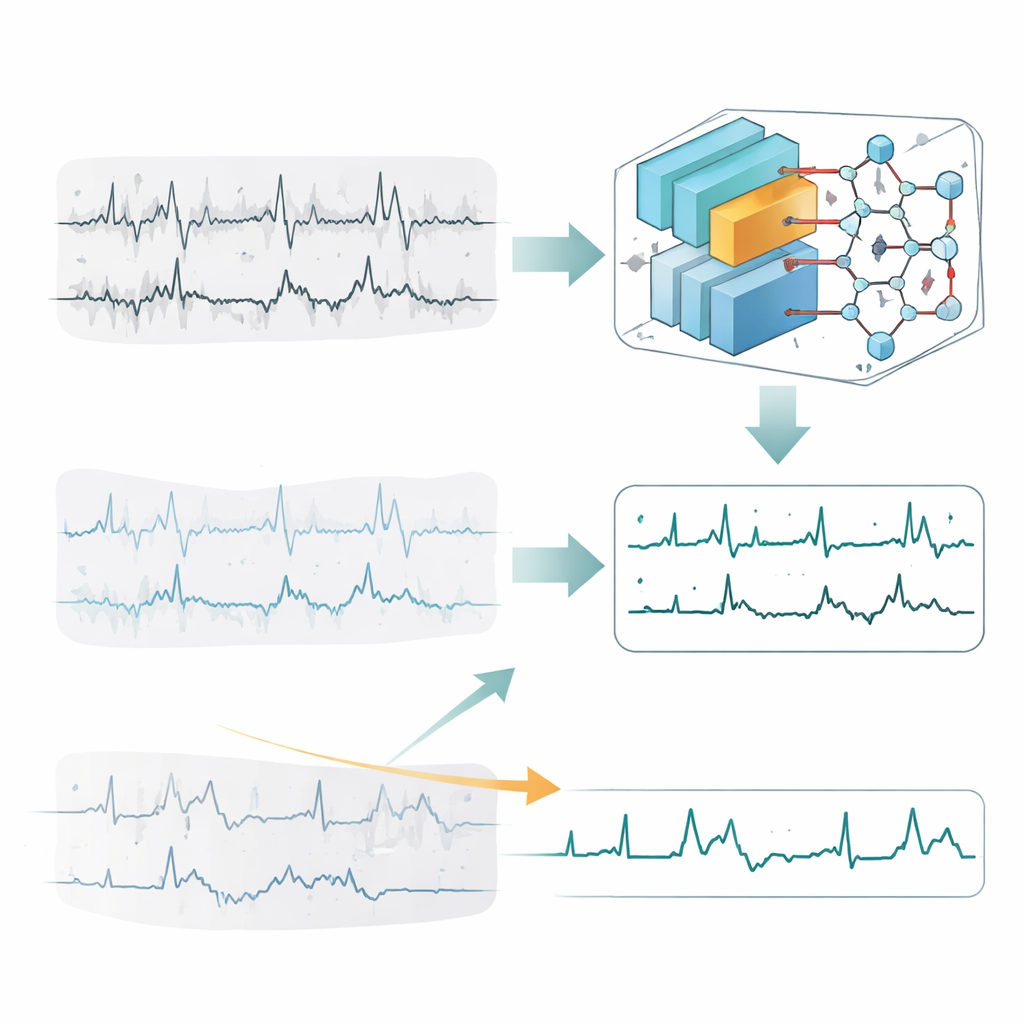
The first stage tackles one of the most basic problems in everyday ECGs: noise. Muscle twitches, loose wires, or other devices can all distort the delicate waves that carry information about heart function. To handle this, the team uses a Temporal Convolutional Denoising Autoencoder (TCDAE). In simple terms, this model learns what normal ECG waves should look like and then transforms messy input signals into cleaner versions while trying to preserve key shapes such as the sharp QRS spikes and the broader P and T waves. Tests comparing original and cleaned signals showed low error and strong similarity, meaning the model removed substantial noise without erasing important medical details.
Filling in the Gaps With Advanced Forecasting
Real ECGs are not only noisy; they can also have missing chunks when electrodes fall off or recordings are interrupted. To study this, the authors simulated missing segments at three levels—10%, 30%, and 50%—and then tried to reconstruct the full trace. They compared two families of modern AI tools. Variational Autoencoders (VAEs) work by compressing a signal into a hidden code and then rebuilding it, while Temporal Fusion Transformers (TFTs) are specialized for time‑series and use attention mechanisms to focus on the most informative parts of a sequence. Both could restore realistic waveforms even when half the data was missing, but TFTs were far more precise: their reconstruction errors were roughly five to ten times smaller than those of the VAE, corresponding to only about 1–2% deviation from the normalized ECG amplitude.
Turning Repaired Signals Into Heart Disease Decisions
Once the ECGs were cleaned and repaired, the next question was practical: do these better signals actually help detect disease? The authors extracted medically meaningful features, such as the timing between beats and the duration and orientation of key waves, and fed them into a range of standard machine‑learning classifiers (including Support Vector Machines, Random Forests, Gradient Boosting, and XGBoost). They focused on distinguishing rhythms such as normal sinus rhythm, atrial fibrillation, sinus bradycardia, and tachycardia. Across both perfectly intact and artificially damaged recordings, features derived from TFT‑reconstructed signals consistently led to higher accuracy, precision, and F1‑scores than those derived from VAE reconstructions. In several cases, models using TFT‑enhanced signals reached about 98–98.4% accuracy.
What This Means for Patients and Clinicians
For patients, the main takeaway is that imperfect ECGs no longer have to mean uncertain answers. CEDRC‑Net shows that combining noise removal, intelligent gap‑filling, and familiar classification tools can turn even flawed recordings into reliable diagnostic input. The study also demonstrates that transformer‑based methods like TFT are especially powerful at preserving the subtle timing patterns that reveal heart trouble, outperforming more traditional generative models. If adopted and validated in diverse clinics, this kind of pipeline could ease the workload on cardiologists, support earlier detection of dangerous rhythms, and improve care in busy or resource‑limited settings where clean, uninterrupted ECGs are hard to obtain.
Citation: Khan, M.R., Haider, Z.M., Hussain, J. et al. AI based ECG data recovery and cardiovascular diseases classification (CEDRC-network). Sci Rep 16, 11733 (2026). https://doi.org/10.1038/s41598-026-46232-3
Keywords: electrocardiogram, cardiovascular disease, deep learning, signal reconstruction, arrhythmia classification