Clear Sky Science · en
Multiscale characteristics and cracking behavior in reservoir sandstone under dry-wet cycles: Insights from NMR, AE and SEM
Why changing water levels can crack solid rock
Many large dams and reservoirs make the water level along nearby slopes rise and fall day after day. This constant soaking and drying might seem harmless, but over years it can slowly weaken the rock that holds the banks together. In the Three Gorges Reservoir region of China, this quiet process can help set the stage for landslides and collapses. The study described here peeks inside reservoir sandstone from the grain scale up to whole samples to explain how repeated dry wet cycles turn strong rock into a cracked, fragile material.
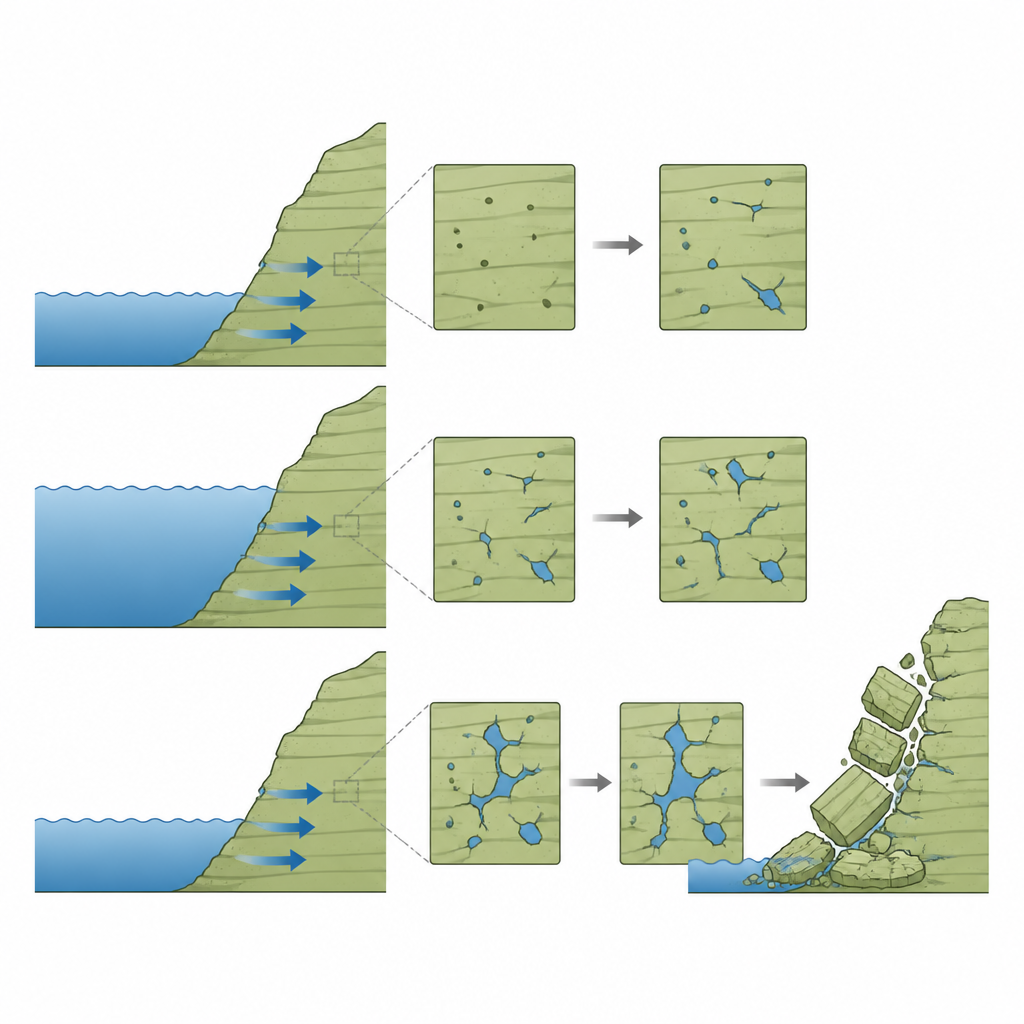
Rock slopes that quietly grow dangerous
The researchers focused on sandstone from the hydro fluctuation belt, the zone that is alternately covered and uncovered as the reservoir level changes. These rocks are built from minerals such as quartz, feldspar, and clay that are glued together by natural cements. When water repeatedly floods and drains from this zone, it not only washes through visible cracks but also seeps into tiny pores and grain contacts. Over time, this cycling erodes the internal fabric of the rock, making it less able to hold together when gravity and other forces pull on the slope.
Listening to rocks as they fail
To watch damage develop in real time, the team used acoustic emission, a technique that listens for high frequency “pings” as new cracks form and grow inside a loaded rock sample. As sandstone cores were squeezed, the number and energy of these tiny sound bursts rose sharply just before final breakage. By tracking changes in the statistical spread of these signals, the authors found that clear early warning signs consistently appeared when the applied stress reached about 92 to 99 percent of the rock’s peak strength, with a final critical point just above 99 percent. This pattern, known as critical slowing down, suggests that careful monitoring of similar signals in the field could give advance notice of approaching instability in reservoir slopes.
From tiny pores to big cracks
The scientists also examined how the internal pore space changed as samples were cycled between wet and dry conditions up to 30 times. Using nuclear magnetic resonance, which senses water inside pores, they showed that overall porosity rose in an exponential fashion with more cycles. The distribution of pore sizes shifted from mainly very small pores to a mix dominated by medium and large ones, and the signal shape evolved from a single peak to two peaks, a sign of growing structural unevenness. Calculations based on fractal theory indicated that the larger pores became more connected, forming pathways that make it easier for water to move and for cracks to link up.
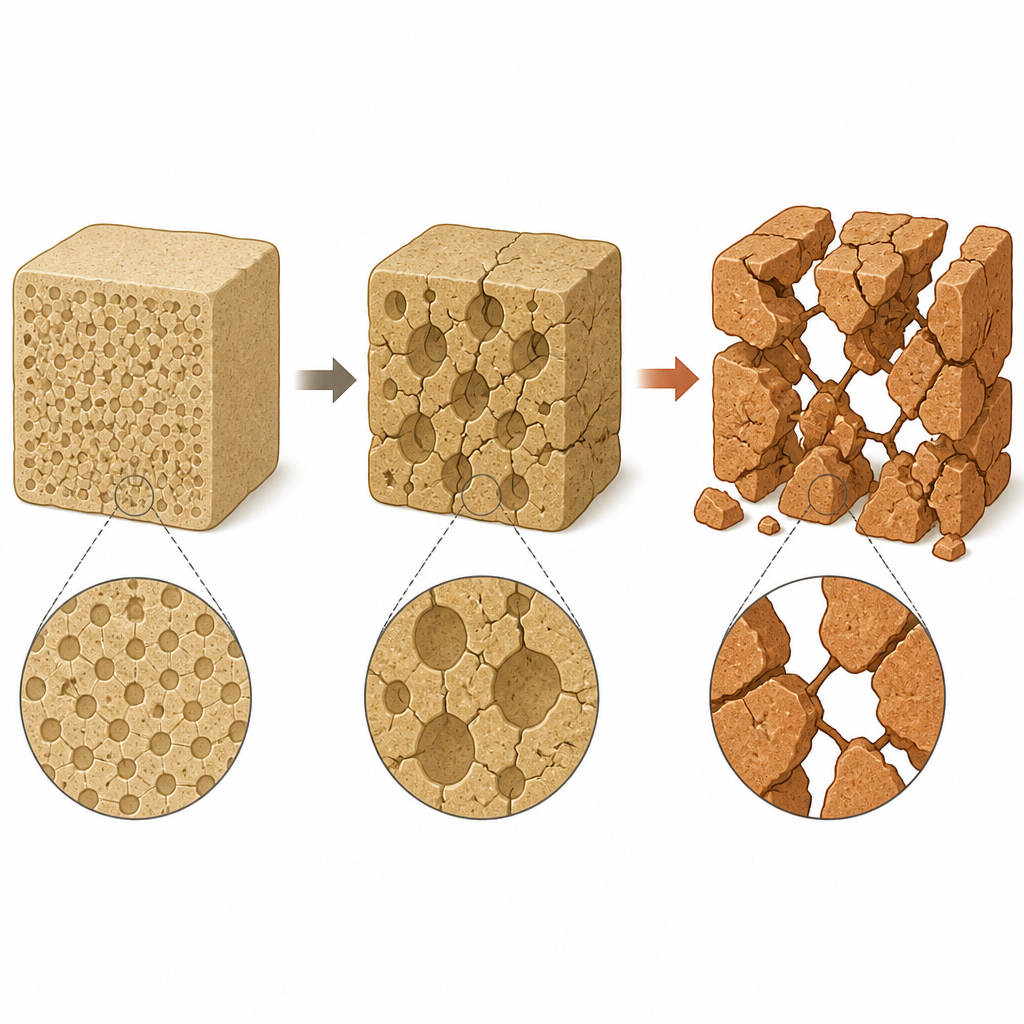
A close up look at breaking grains
Scanning electron microscope images added visual detail to this story. In fresh sandstone, grains fit tightly with only a few isolated microcracks. After a handful of dry wet cycles, the team saw small pits where minerals had dissolved and short cracks along grain edges. With more cycles, these pits deepened, grains shed debris, and cracks spread and joined together. By the time samples had gone through 30 cycles, grain boundaries were blurred, the cement between particles was badly weakened, and wide fractures cut across the rock. At the same time, acoustic data showed that the style of cracking shifted: the share of cracks that open in tension grew from about one third to nearly one half, even though shear type failure still dominated overall.
What this means for reservoir safety
Taken together, the measurements show how repeated soaking and drying reorganize sandstone from the inside out. Chemical reactions with water enlarge pores and eat away at the mineral glue, while physical swelling, shrinkage, and stress help link tiny defects into large cracks. As the internal network of voids becomes more connected, the rock’s strength drops and its cracking style changes, yet it still gives clear acoustic hints before it fails. These findings help explain why rock slopes in fluctuating reservoirs can degrade over time and offer tools for spotting when they are nearing the point of collapse.
Citation: He, P., Lei, R., Zhao, P. et al. Multiscale characteristics and cracking behavior in reservoir sandstone under dry-wet cycles: Insights from NMR, AE and SEM. Sci Rep 16, 15279 (2026). https://doi.org/10.1038/s41598-026-46226-1
Keywords: sandstone, dry wet cycles, reservoir slopes, pore structure, acoustic emission