Clear Sky Science · en
Differential distribution of antiviral serology across multiple sclerosis phenotypes and its implications for disease pathogenesis
Viruses and a Puzzling Nerve Disease
Multiple sclerosis (MS) is a long‑term disease in which the body’s own defenses attack the brain and spinal cord. Doctors have long suspected that common viruses help set this process in motion, but it has been unclear whether the body’s response to these viruses looks different in people with milder, attack‑driven MS versus those with steadily worsening forms. This study asks a simple but important question: do patterns of antiviral antibodies in the blood mirror how a person’s MS behaves over time?

Different Faces of the Same Illness
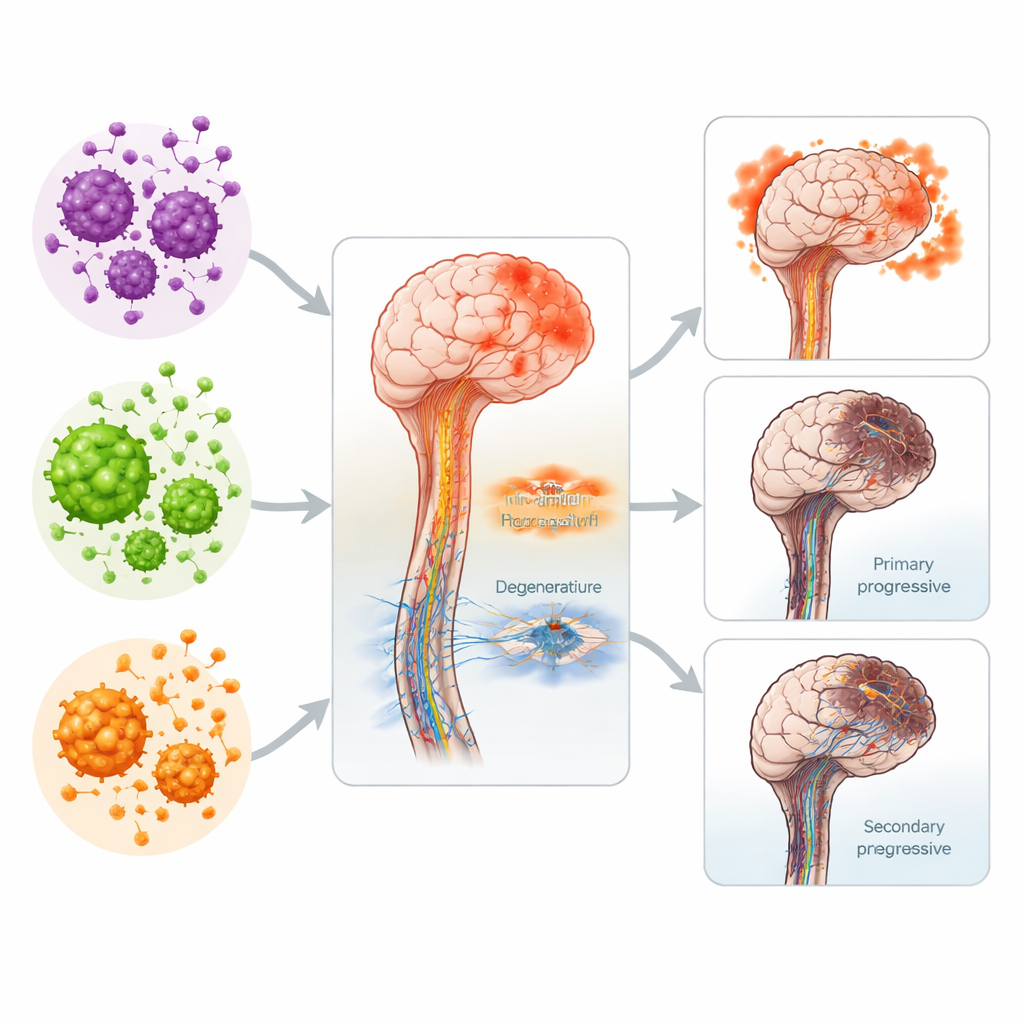
MS does not follow a single script. Most patients begin with relapsing–remitting MS, marked by sudden flare‑ups followed by partial recovery. Some later move into secondary progressive MS, where slow, background worsening dominates. A smaller group have primary progressive MS from the start, with steady decline and few obvious attacks. The researchers collected blood samples from nearly 700 people in Spain: patients with each of these three forms of MS and healthy volunteers. They measured antibodies against several common herpesviruses that linger in the body for life, including Epstein–Barr virus (EBV), cytomegalovirus (CMV), and human herpesvirus 6 (HHV‑6). They also measured two blood markers that reflect nerve and support‑cell damage in the brain.
Reading Viral Footprints in the Blood
The team found that the “viral fingerprints” were not the same across MS types. Antibodies to EBV were, as expected, higher in people with MS than in healthy volunteers, reinforcing the idea that EBV plays a key role in triggering the disease. But within MS, those with primary progressive disease had lower levels of one key EBV antibody than patients with the other two forms. In contrast, people with primary progressive MS showed higher levels and higher frequency of antibodies against CMV than those with relapsing–remitting MS. Antibodies indicating recent or ongoing HHV‑6 activity were more common in relapsing–remitting MS than in secondary progressive disease. Using a statistical model that considers all these measurements together, the authors could moderately distinguish the three MS forms based purely on their antiviral antibody patterns.
Linking Viruses to Nerve Injury
To move beyond simple associations, the researchers compared antiviral antibodies with blood markers of damage to nerve fibers and to the brain’s supporting cells. Higher CMV antibody levels were linked to higher levels of a protein associated with nerve support‑cell stress and progressive disease in patients with primary and secondary progressive MS. In healthy volunteers, however, stronger CMV responses were tied to lower levels of a marker of active nerve fiber damage, hinting that CMV might dampen certain inflammatory processes in people without MS. Antibodies to HHV‑6 were more closely tied to the inflammatory side of the disease, appearing more often in relapsing–remitting MS and showing negative links with the marker of chronic tissue damage. EBV antibodies, despite their strong association with MS risk overall, did not show clear ties to these damage markers once MS was established.
A Double‑Edged Role for Common Viruses
Putting these pieces together, the authors suggest that CMV may act as a double‑edged sword. In the general population and in people with early, attack‑driven MS, CMV infection might actually help rein in EBV and reduce inflammation, lowering the risk of developing relapsing–remitting disease. Yet in those who already have progressive MS, CMV appears to track with greater underlying neurodegeneration. EBV and HHV‑6, by contrast, seem to shape the early, more inflammatory stages of MS, particularly the relapsing form, with HHV‑6 playing a diminishing role as the illness shifts into a more degenerative phase.
What This Could Mean for Patients
For non‑specialists, the key takeaway is that MS is not only many diseases in one, but that lifelong viral infections may push patients toward different paths of inflammation and nerve loss. This study does not prove that treating these viruses will change the course of MS, but it strengthens the case that measuring antiviral antibodies and nerve injury markers together could help doctors better sort patients into risk groups. In the future, such blood‑based “immune signatures” might guide more personalized monitoring and open the door to targeted antiviral strategies, especially for people with progressive forms of MS.
Citation: Maria Inmaculada, DM., Ruberto, S., Rodríguez-García, C. et al. Differential distribution of antiviral serology across multiple sclerosis phenotypes and its implications for disease pathogenesis. Sci Rep 16, 10929 (2026). https://doi.org/10.1038/s41598-026-46208-3
Keywords: multiple sclerosis, Epstein-Barr virus, cytomegalovirus, herpesvirus, neurodegeneration