Clear Sky Science · en
Evaluation of bacterial reduction by contemporary irrigation activation methods against Enterococcus faecalis biofilm in root canals
Why cleaner root canals matter
Anyone who has had a root canal knows it is about saving a painful tooth. But even after careful cleaning, some germs can hide deep inside the tooth and later trigger infection again. This study looks at five modern tools dentists can use to flush out these stubborn bacteria and compares how well they work under controlled laboratory conditions.
The hidden germs inside treated teeth
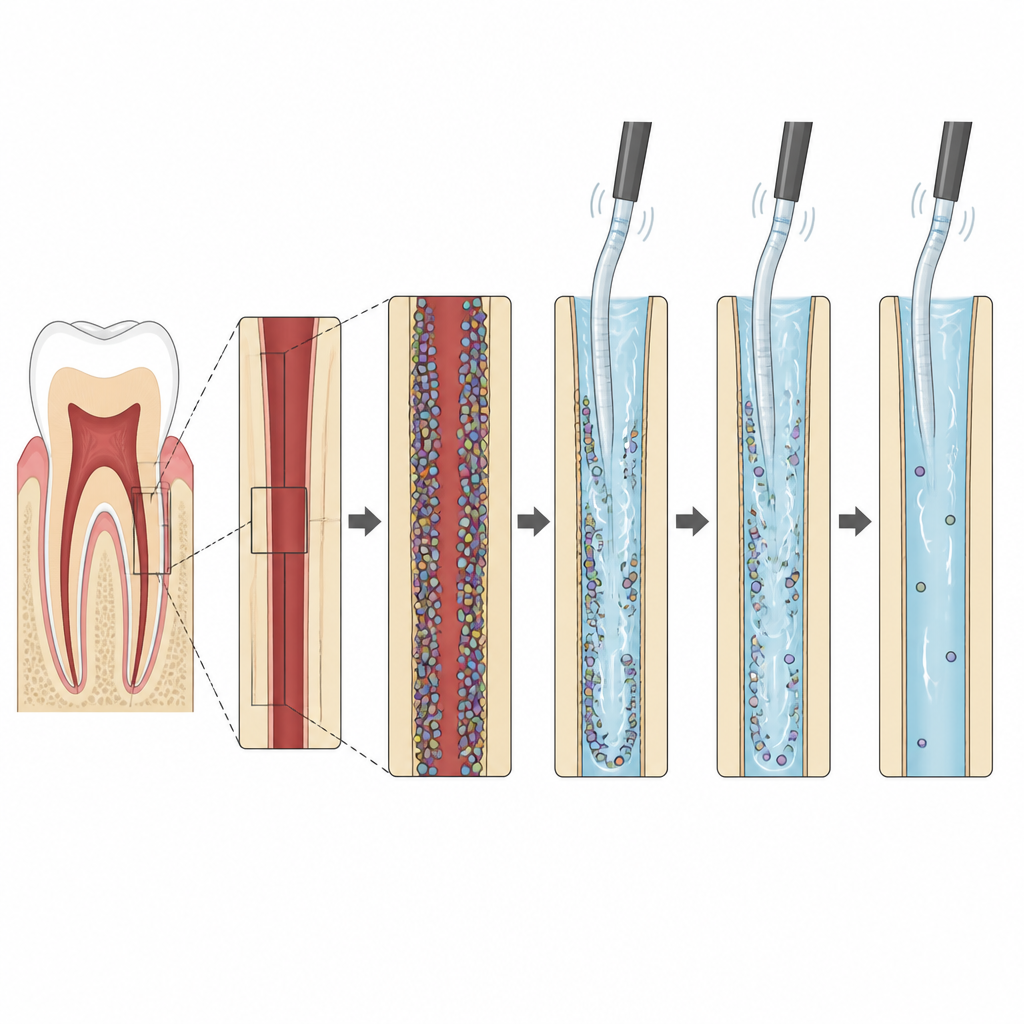
Root canal treatment aims to remove damaged tissue inside a tooth, disinfect the hollow space, and seal it so germs cannot return. A common culprit when treatment fails is Enterococcus faecalis, a hardy bacterium that can squeeze into tiny side channels and form slimy communities called biofilms on the inner tooth walls. These biofilms act like protective shields, making it harder for cleaning fluids to reach and kill the bacteria.
Five ways to boost the cleaning liquid
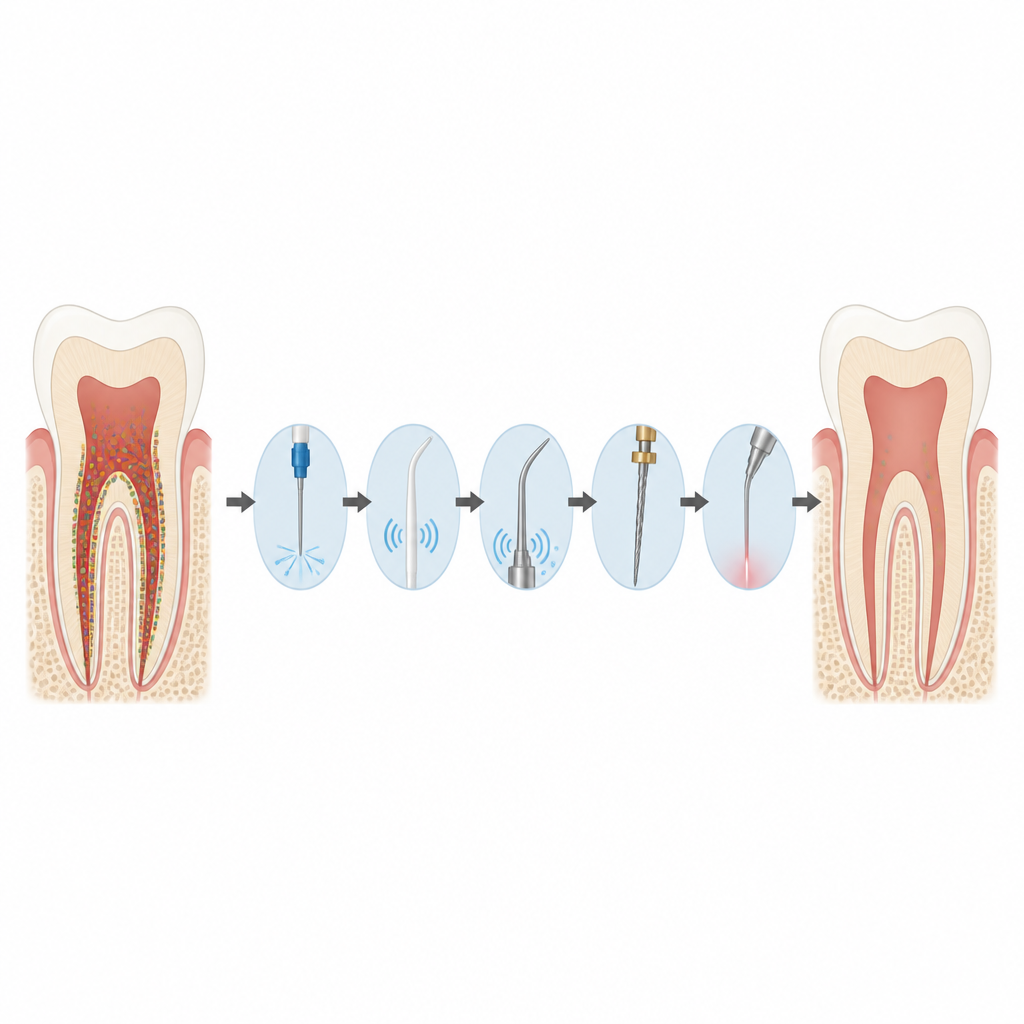
Dentists rely on liquid cleaners to wash out the root canal, but how the liquid is moved matters. The simplest method uses a standard needle that pushes fluid in and out. Newer systems try to stir and energize the fluid so it can reach more corners. In this study, the researchers compared the traditional needle with four activation methods: a sonic plastic tip called EDDY that vibrates rapidly, a passive ultrasonic tip that shakes at even higher frequencies, a flexible file called XP-Endo Finisher that physically sweeps the canal, and a light based Er:YAG laser that creates tiny bubbles and pressure waves in the fluid.
Building a realistic tooth infection in the lab
To test these approaches, the team collected 70 human premolar teeth that had been removed for other reasons. They shaped and cleaned the canals using standard steps, then deliberately infected most of the teeth with Enterococcus faecalis. Over 21 days, the bacteria formed mature biofilms inside the canals. Before any flushing treatment, the researchers sampled bacteria from each tooth and counted the number of living cells. Then each group of teeth was treated with one of the five methods, all using the same mild saline solution warmed to body temperature so that any differences would come from how the fluid was activated rather than from strong chemicals.
Which method cut the bacteria the most
After treatment, the canals were sampled again and examined under a microscope. All five methods reduced the number of bacteria compared with the starting point, showing that simply moving the fluid helps disturb and wash away the biofilm. However, the tools were not equal. The basic needle irrigation left the highest number of bacteria and showed the smallest average reduction. The four activation methods all performed better, and among them, the EDDY sonic system achieved the largest drop in bacterial counts, clearly outperforming the other approaches in this setup. The ultrasonic tip, XP-Endo Finisher, and Er:YAG laser produced similar levels of improvement, all noticeably better than the standard needle.
What this means for future dental care
For patients, the message is that the way a dentist moves cleaning liquid inside a tooth can strongly influence how many germs remain after a root canal. In this laboratory model, tools that vigorously stir and energize the fluid cleaned biofilms more effectively than a simple syringe, and the EDDY system did best of all. Because the study used a single type of bacteria and a gentle saline solution rather than the stronger cleaners used in real clinics, the results cannot be directly translated to everyday practice. Still, they suggest that modern activation gadgets may help dentists better clear hidden germs and could reduce the risk of future infection, a possibility that will need confirmation in studies on actual patients.
Citation: Sakin, T.Ö., Albayrak, F. & Tunç, T. Evaluation of bacterial reduction by contemporary irrigation activation methods against Enterococcus faecalis biofilm in root canals. Sci Rep 16, 16187 (2026). https://doi.org/10.1038/s41598-026-46204-7
Keywords: root canal disinfection, Enterococcus faecalis, irrigation activation, dental biofilm, EDDY sonic system