Clear Sky Science · en
Hydrothermal system dynamics at Pisciarelli fumarole field (Campi Flegrei): insights from geophysical and numerical modelling
Why this restless crater matters
On the western edge of Naples, Italy, a vast volcanic depression called Campi Flegrei has been slowly heaving, cracking and breathing out gas beneath a densely populated urban area. Within this caldera, the Pisciarelli fumarole field is now the main site where hot steam and carbon dioxide escape at the surface. Understanding how fluids move underground here is not just an academic exercise: it helps scientists judge how close the system may be to sudden steam-driven explosions that could threaten nearby communities.
A busy volcanic neighborhood
Campi Flegrei has a long history of powerful eruptions and quieter, but worrying, episodes of ground uplift, gas release and small earthquakes. Since the early 1980s the ground has risen by well over a meter in places, with cycles of swelling and sinking. More recently, gas emissions have intensified and activity has shifted toward Pisciarelli, where a roaring vent known as the Soffione now releases more than 600 tons of carbon dioxide every day, as much as some erupting volcanoes. At the same time, the landscape around the vents has changed rapidly, with new fumaroles opening, mud pools churning and slopes destabilized by landslides.
Hidden cracks and caps beneath the vents
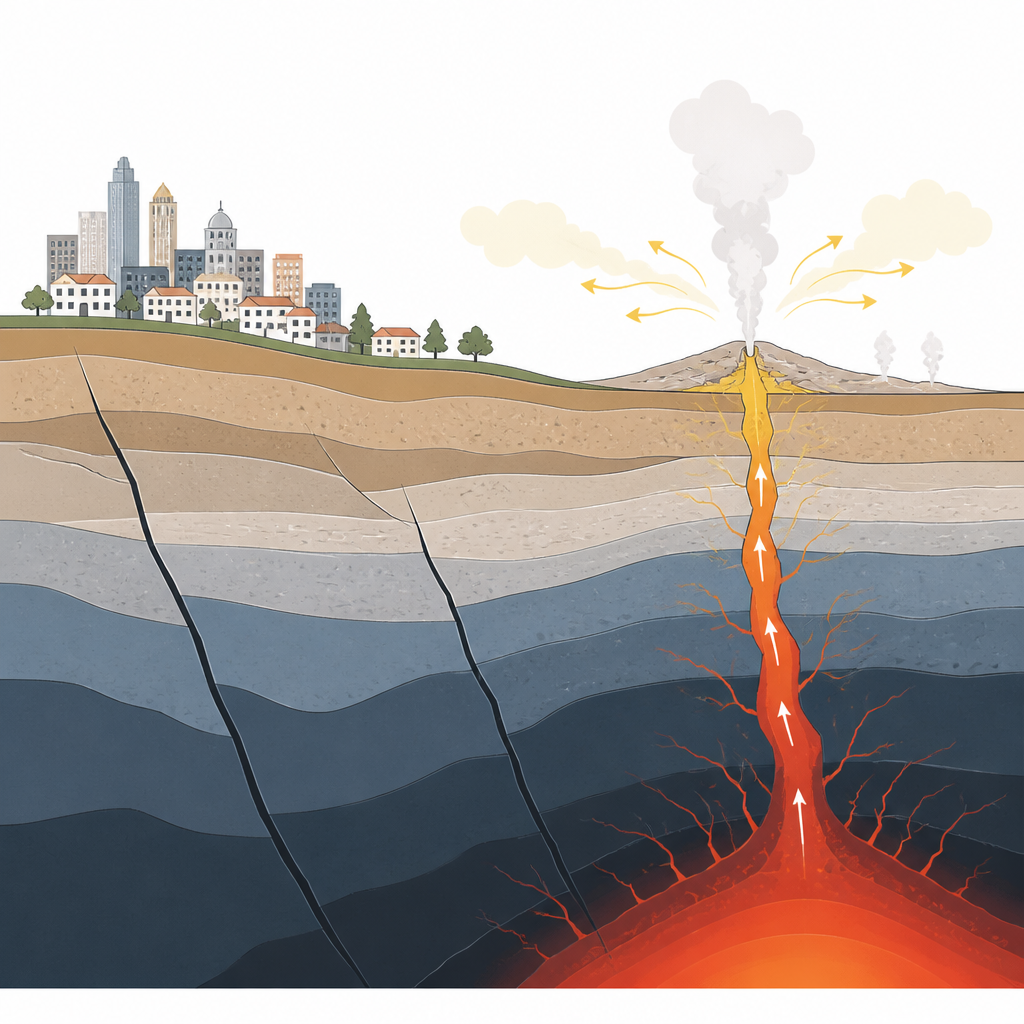
Previous fieldwork at Pisciarelli used electrical imaging and other geophysical tools to map the underground structure. These surveys revealed a tangle of faults that cut the shallow rocks, a vertical channel of broken ground that lets fluids rise, and a thin clay-rich layer close to the surface that acts as a leaky lid. One major fault, trending across the area, appears to partly block fluids from moving sideways, causing gas to build up on one side. Together, these features create preferred pathways and traps for hot water and gas that feed the main fumarole and mud pool.
Building a 3D digital model of the subsurface
To turn this picture into a quantitative tool, the authors built a three-dimensional digital model of the rocks and structures beneath Pisciarelli. They combined the geophysical images with geological logs, measurements of gas output and ground temperatures to assign realistic properties such as density, porosity and ease of fluid flow to each layer, the upflow channel, the clay cap and the main fault zone. Using a computer code that simulates how heat and a two-component water–carbon dioxide mixture move through porous rock, they injected hot fluid at about 100 meters depth and let the system evolve until it reached a steady pattern that matched the observed gas flux at the surface.
Where pressure, heat and gas build up
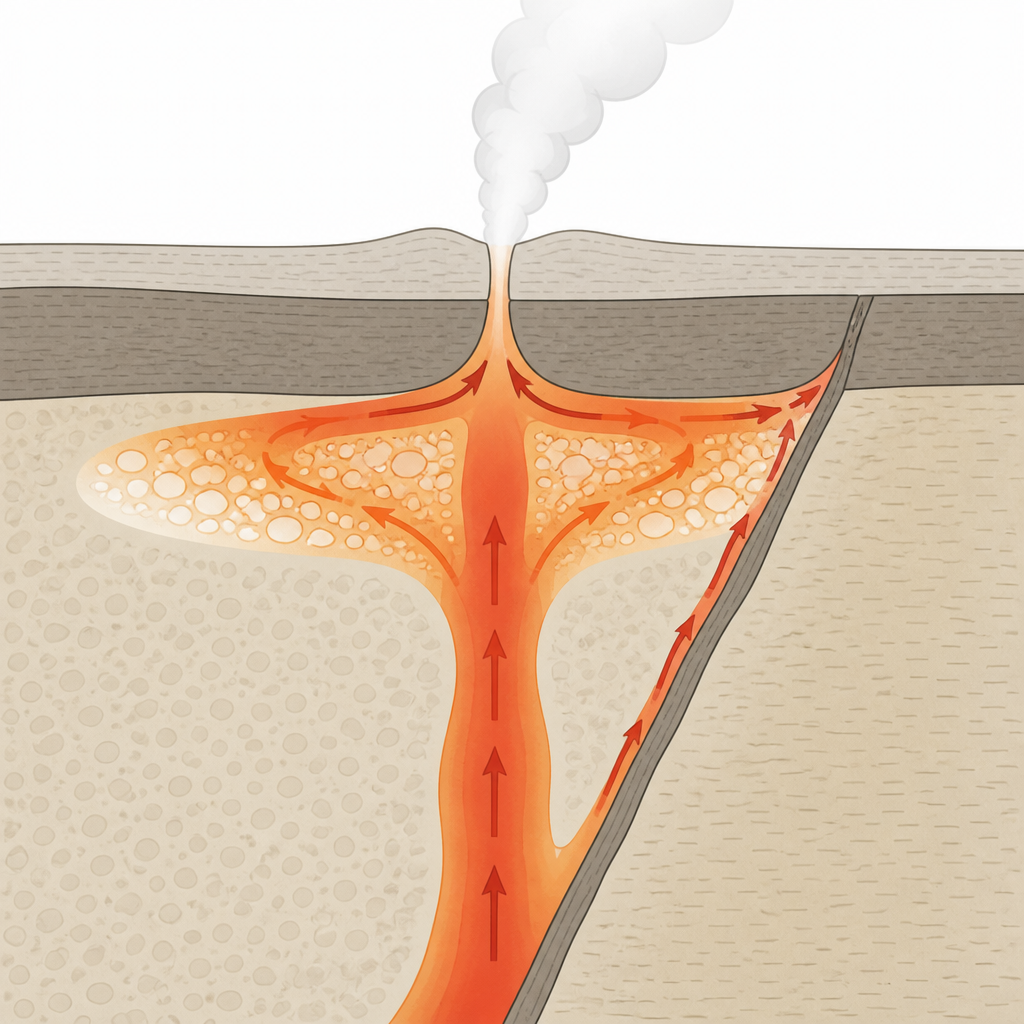
The simulations show that a pressurized pocket of fluid forms beneath the clay cap, with pressures similar to those estimated for the wider Campi Flegrei hydrothermal system. Carbon dioxide tends to accumulate at the base of the upflow channel, then rises and is pushed sideways just under the cap rather than moving straight up. Heat spreads even more broadly because it can conduct through the surrounding rock, so the hottest zone wraps around the gas plume and reaches closer to the cap. Immediately above the cap, the model predicts a ring-shaped zone where liquid water and steam coexist, enriched in vapor around the central fluid core. These patterns align well with independent maps of electric signals and soil temperature at Pisciarelli, suggesting that the virtual model captures the real behavior of the system.
A fault that acts more like a dam than a pipe
A key outcome of the study is the role of the main fault that cuts across the fumarole field. In the model, this fault behaves mostly as a barrier rather than as an open drain. Its low permeability weakens vertical pressure differences across it and steers rising fluids along its edge, concentrating gas, pressure and heat near the contact between the fault and the upflow channel. The partially sealing clay cap above then further stores pressure and gas while still allowing some leakage to the surface. This combination of a leaky lid, a focused channel and a barrier-like fault creates a delicate balance in which modest changes in pressure, temperature or rock permeability can reorganize flow paths and shift where energy is stored.
What this means for local risk
For people living around Campi Flegrei, the study does not predict an imminent eruption, but it does sharpen the picture of where trouble is most likely to begin. The results indicate that the Soffione area, the shallow clay cap and the zone where the upflow channel meets the fault are priority targets for monitoring. Changes in gas output, ground temperature or subtle electrical signals in these areas could reveal growing overpressure or shifts between water and steam, both of which are important ingredients for sudden steam-driven blasts. By tying surface measurements to a physics-based underground model, the work offers a clearer way to track the evolving state of this restless hydrothermal system.
Citation: Salone, R., Troiano, A., Di Giuseppe, M.G. et al. Hydrothermal system dynamics at Pisciarelli fumarole field (Campi Flegrei): insights from geophysical and numerical modelling. Sci Rep 16, 15852 (2026). https://doi.org/10.1038/s41598-026-46202-9
Keywords: Campi Flegrei, Pisciarelli fumaroles, hydrothermal system, volcanic gas, phreatic explosions