Clear Sky Science · en
Numerical investigation of soil parameter effects on the axial uplift bearing capacity of novel photovoltaic circular helicoid piles
Stronger solar supports under the wind
As solar farms spread across fields and deserts, their metal supports must resist powerful winds trying to pull them out of the ground. Engineers have begun using a new kind of spiral steel foundation called a circular helicoid pile to anchor photovoltaic racks, but how different types of soil actually help or hinder these piles has remained uncertain. This study uses computer simulations to untangle how key ground properties control the uplift strength of these special piles, offering guidance for safer, more reliable solar installations worldwide. 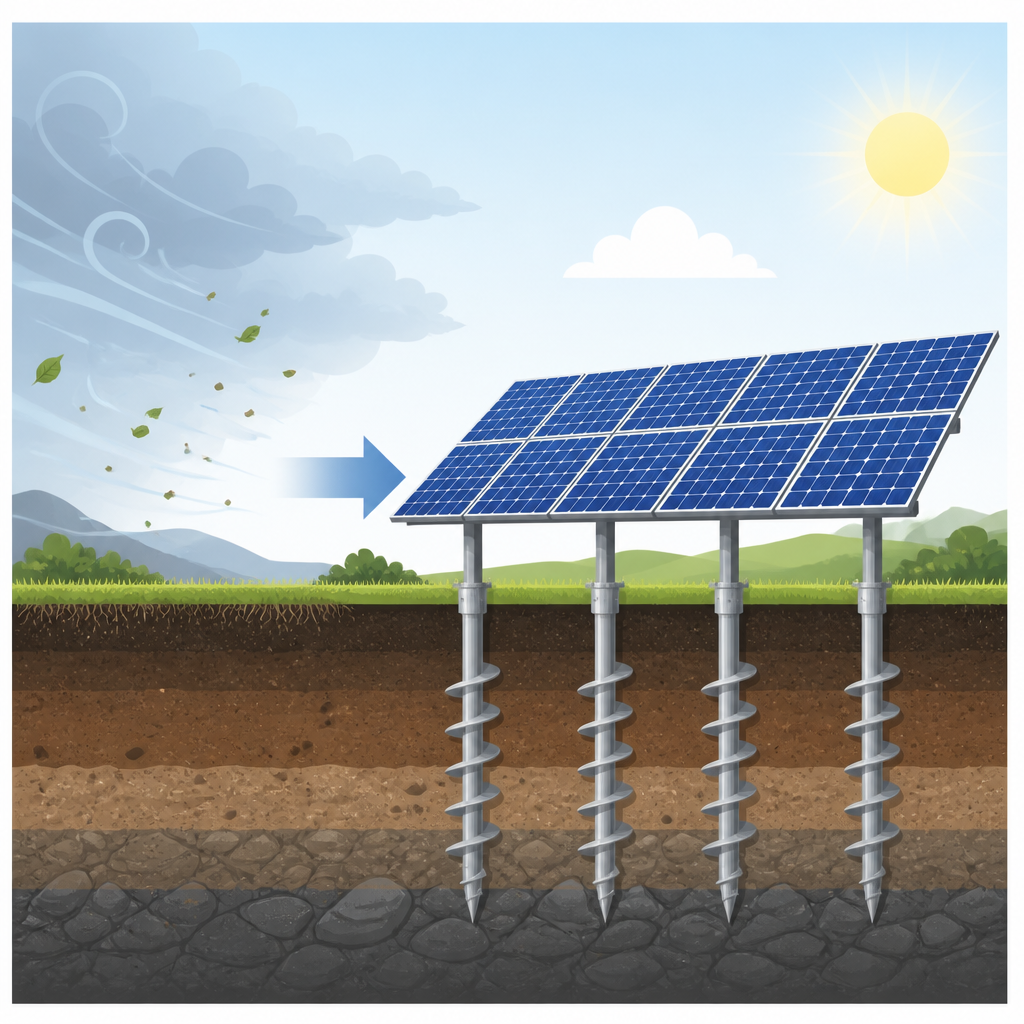
A new type of spiral foundation
Traditional spiral piles look like a steel shaft with one or more flat plates, rather like a giant screw. The circular helicoid pile replaces discrete plates with a continuous spiral surface wrapped around the shaft. This shape can be twisted more or less tightly and installed either by rotation, by pressing, or by a mix of both. Field projects in Japan, China, and South Korea have shown that circular helicoid piles can carry much higher downward and upward loads than simple straight piles. Yet most previous research was done in laboratory sand tanks, leaving open questions about how real soils with clay, cohesion, and varying stiffness affect their performance.
Virtual testing in realistic ground
To explore these questions, the authors built a detailed three dimensional computer model of a single circular helicoid pile surrounded by soil. They used industrial software to represent the steel pile as an elastic material and the ground as a common geotechnical model that includes both strength and deformation. The simulated pile was installed and then pulled upward in stages, mirroring full scale field tests carried out in volcanic ash and marine clay. When the team compared the calculated load versus displacement curves with seven sets of on site measurements, the match was close, giving confidence that the virtual pile behaved like the real one. 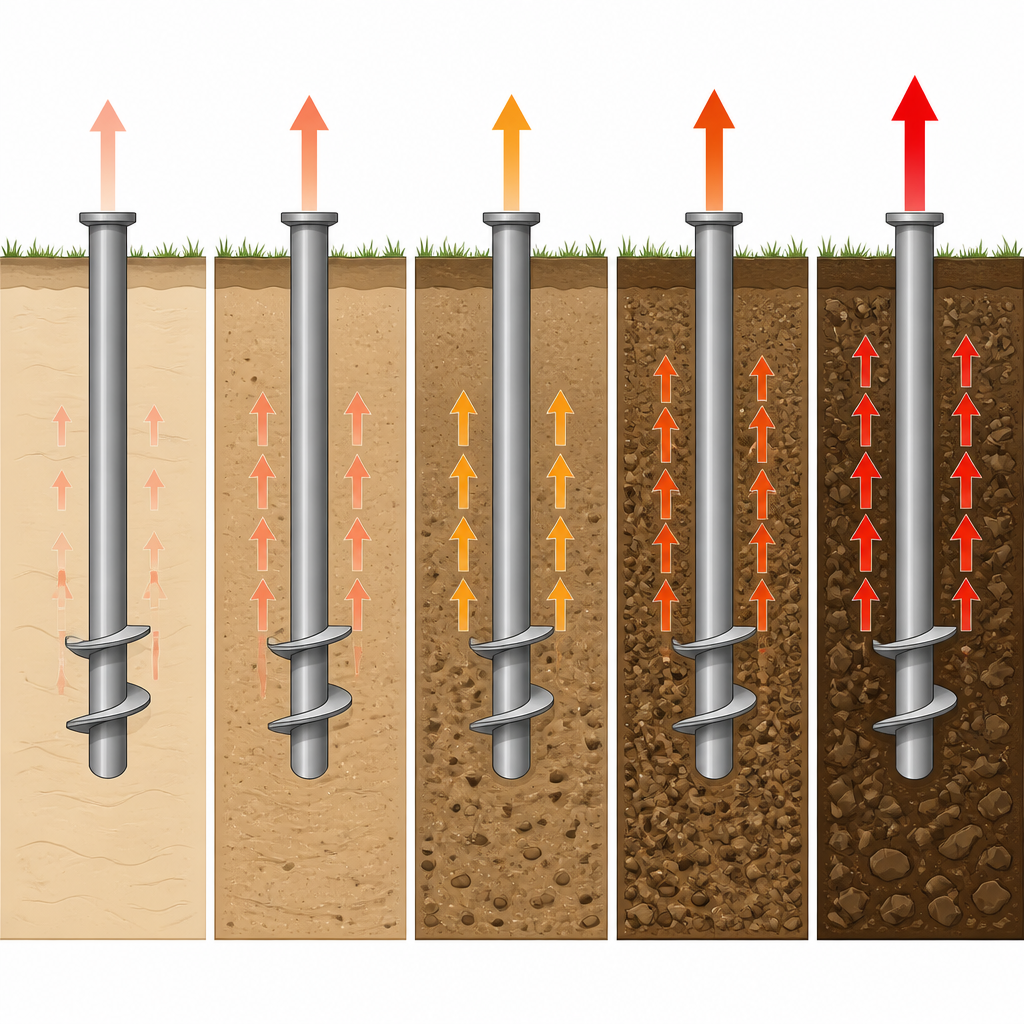
How the pile mobilizes its strength
Both the tests and the simulations showed that uplift resistance does not suddenly peak and then drop. Instead, the force needed to keep pulling the pile rises smoothly as the head moves upward, with the increase gradually slowing. There is no sharp failure point. For design, this means the ultimate capacity cannot be read from a single maximum value; it must be defined using agreed displacement levels or curve fitting. The study examined several practical choices and found that when the pile reaches its ultimate state, the upward movement at the head is about one tenth of the pile diameter. The load at this displacement closely matches the value given by a widely used curve intersection method, so taking the force at one tenth of the diameter as the ultimate uplift capacity is a reasonable shortcut.
Which soil properties matter most
Having validated their model, the researchers systematically varied key soil properties across realistic ranges for solar farm sites. They changed soil stiffness, how much it contracts sideways when compressed, its internal bonding strength, its frictional resistance, and the roughness of contact between pile and soil. For each case they pulled the pile to several displacement levels and recorded the resisting force. Across all scenarios, stronger or stiffer soil always increased uplift capacity. However, not all properties were equally important. Using several complementary sensitivity methods, including simple one factor changes, structured test plans, and statistical similarity measures, they consistently found that soil cohesion was the dominant control, followed by stiffness and friction angle. The sideways contraction property and the direct pile soil surface friction had much smaller influence.
Guidance for safer solar foundations
In plain terms, this work shows that circular helicoid piles grip the ground more firmly when the soil itself is well bonded and reasonably stiff, and that their ultimate strength is reached after a modest but not tiny uplift movement. For engineers designing photovoltaic supports, the results highlight which soil tests matter most and suggest a practical target displacement that can stand in for a more complex failure definition. By focusing on cohesion first, stiffness and friction second, and treating other parameters as secondary, designers can better manage uncertainty in ground conditions and make more efficient use of this promising pile type in the expansion of solar energy.
Citation: Wang, K., Zhang, R., Yasufuku, N. et al. Numerical investigation of soil parameter effects on the axial uplift bearing capacity of novel photovoltaic circular helicoid piles. Sci Rep 16, 15641 (2026). https://doi.org/10.1038/s41598-026-46197-3
Keywords: circular helicoid pile, uplift bearing capacity, photovoltaic foundations, soil parameter sensitivity, finite element analysis