Clear Sky Science · en
Disorder suppression and tunable localization in ultrathin SrIrO3 films via SrTiO3 capping
A Thin Coat That Tames Quantum Chaos
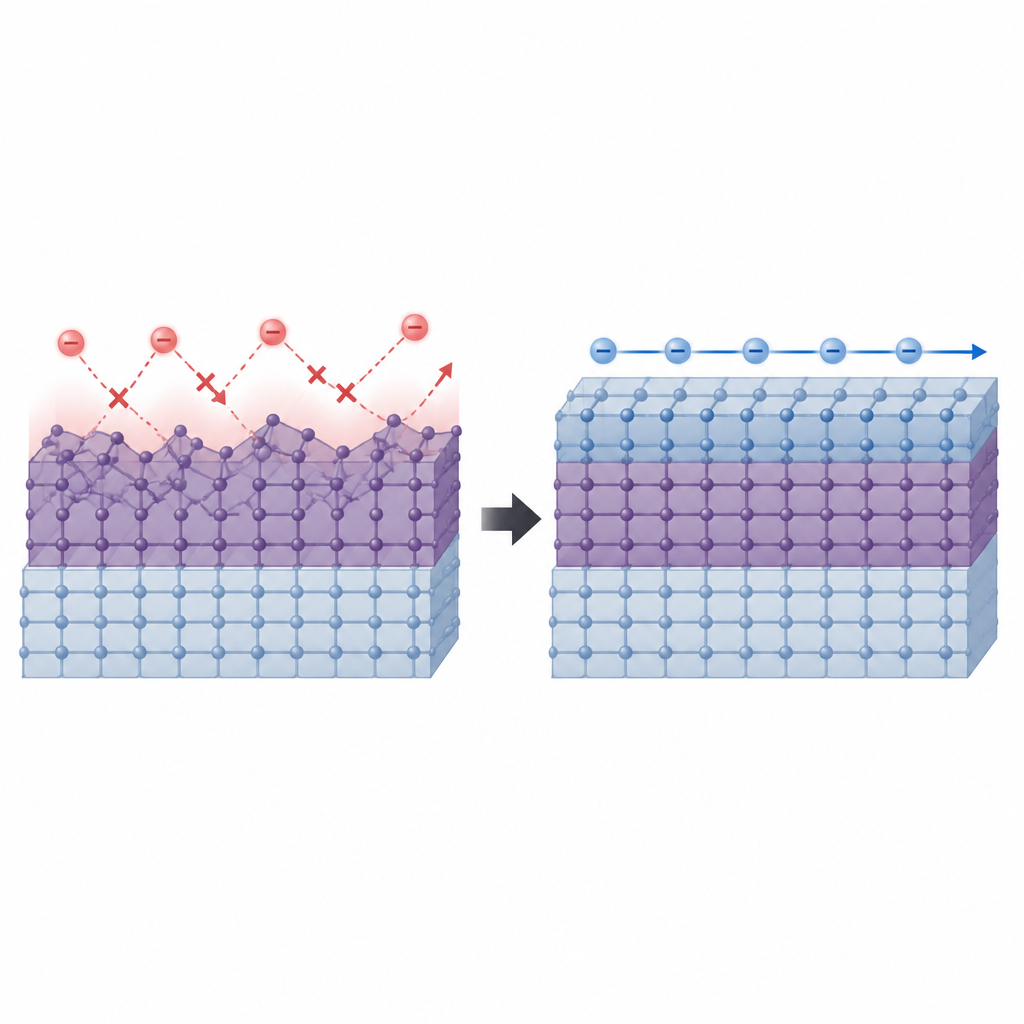
Modern electronics increasingly rely on materials only a few atoms thick, where tiny imperfections can completely change how electricity flows. This study shows that adding a very thin “cap” layer to an already ultrathin oxide film can calm structural disorder inside the material and turn an insulating state back into a conducting one, offering a simple way to design future low-power and quantum devices.
Why These Oxides Are So Delicate
The researchers focus on a complex oxide called strontium iridate, which belongs to a family of materials known for strong interactions between electron motion and the electron’s internal spin. In bulk crystals, this compound sits on the verge between metallic and insulating behavior. When it is grown as an ultrathin film, only a few atomic layers thick, that delicate balance becomes even more sensitive to small changes in structure and imperfections. Earlier work showed that nominally similar films could behave either more like metals or more like insulators, suggesting that slight shifts in crystal arrangement and disorder strongly influence how electrons move.
Watching Conductivity Vanish in Ultrathin Films
To probe this sensitivity, the team fabricated perfectly aligned films of strontium iridate on strontium titanate substrates and gradually reduced the film thickness. They prepared two series of films: one that showed insulator-like behavior from the start and one that was more metal-like. As they thinned the insulator-like films, the resistance suddenly shot up when only seven atomic layers remained, and thinner samples became so resistive that the instruments could no longer measure current. Analysis of how resistance changed with temperature revealed that electrons had become trapped in a strongly localized, two-dimensional state, consistent with a picture where structural disorder blocks long-range motion.
How a Simple Cap Revives Electron Flow
The key twist in the story comes from placing a thin strontium titanate capping layer on top of the iridate films. With this cap in place, the same insulator-like films now stayed conducting even when shrunk to just three unit cells in thickness. Instead of abrupt insulating behavior, their resistance changed smoothly with thickness, and many samples showed metal-like trends over the entire temperature range. A similar transformation appeared in the initially metal-like films: without a cap they turned insulating at three unit cells, but with the cap the insulating threshold shifted down to two unit cells. Tests ruled out simple explanations such as current flowing through the cap itself or extra conduction paths provided by oxygen defects, pointing instead to a more subtle structural effect.
Calming the Lattice to Reduce Disorder
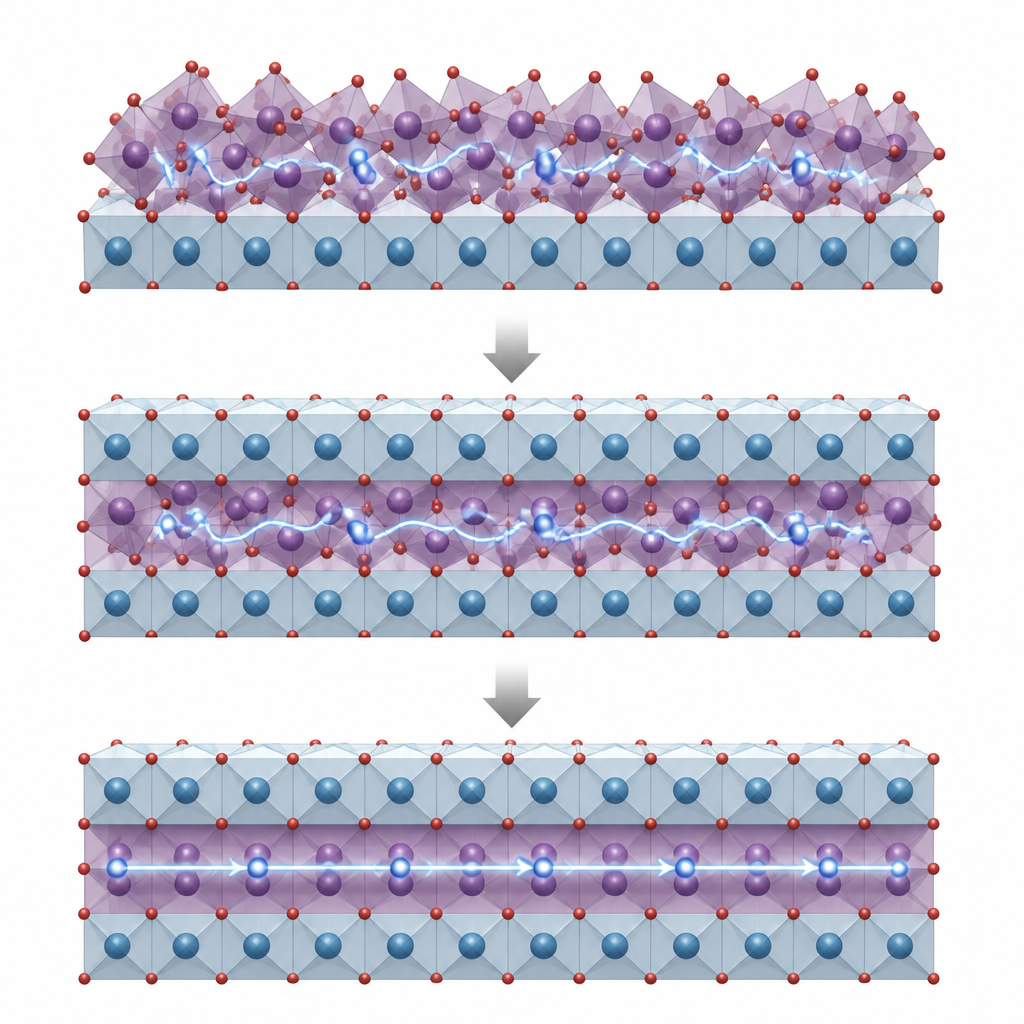
High-resolution X-ray measurements provided a structural fingerprint of what the cap does. While the in-plane spacing of atoms was locked in by the underlying substrate, the spacing perpendicular to the surface changed when the cap was added. In the insulator-like films, the capped samples showed a slightly shorter out-of-plane lattice constant, matching values previously associated with cleaner, less disordered films that behave more like metals. This suggests that the cap relaxes distortions and rotations of the atomic building blocks near the surface, gradually propagating inward and smoothing out the landscape through which electrons travel. As a result, disorder-driven localization is suppressed, and the material remains conducting down to smaller thickness.
What This Means for Future Devices
In practical terms, the study demonstrates that simply adding an appropriate oxide cap can tune how ultrathin correlated materials conduct electricity by quietly rearranging their internal structure. Rather than relying on chemical substitution or heavy processing, engineers could use such interface design to shift the boundary between metallic and insulating states at the scale of a few atomic layers. This level of control is vital for next-generation electronics that exploit quantum effects, showing that sometimes the most effective way to fix a fragile material is to give it a carefully chosen protective coat.
Citation: Maeng, J., Hwang, S., Choi, J. et al. Disorder suppression and tunable localization in ultrathin SrIrO3 films via SrTiO3 capping. Sci Rep 16, 15541 (2026). https://doi.org/10.1038/s41598-026-46195-5
Keywords: ultrathin oxide films, SrIrO3, SrTiO3 capping, metal insulator transition, interface engineering