Clear Sky Science · en
First-principles study of phenol sensing properties on β-arsenic phosphide monolayers
Why cleaner air and water matter
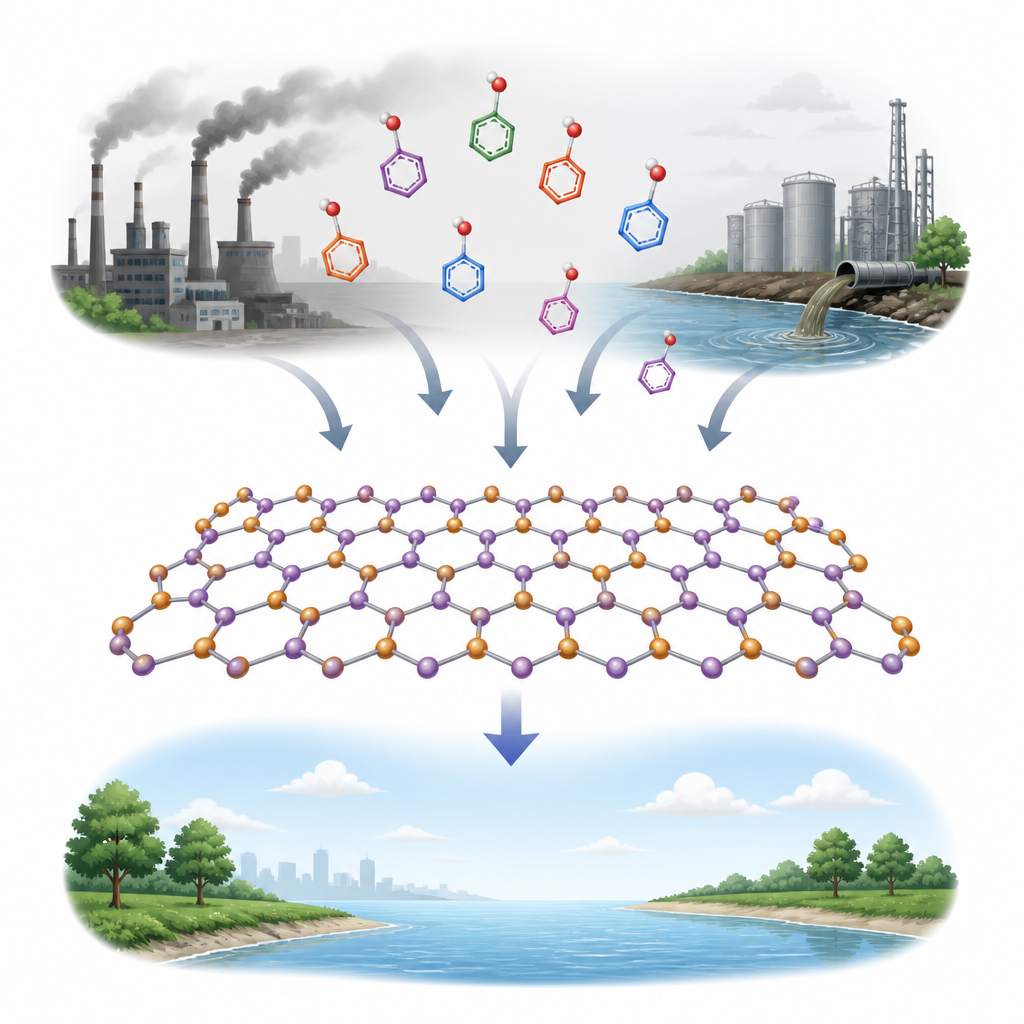
Phenolic chemicals from factories, dyes, fuels, and everyday products can seep into air and water, where they harm fish, wildlife, and people. Detecting these small but toxic molecules quickly and accurately is vital for monitoring pollution and keeping communities safe. This study explores a new ultra-thin material that could act as a tiny electronic nose for some of the most concerning phenolic pollutants.
A new ultra-thin sheet for sensing
The researchers focus on a single-atom-thick sheet made of arsenic and phosphorus atoms arranged in a neat honeycomb pattern, known as a beta arsenic phosphide monolayer. Using advanced computer simulations grounded in quantum physics, they first check whether this sheet is structurally sound and stable at everyday and higher temperatures. Their calculations show that the lattice holds together well, vibrates without signs of collapse, and behaves as a semiconductor, meaning it can carry electrical signals in a controlled way. This combination of robustness and tunable conductivity makes the sheet a promising base for future sensors.
How the sheet meets toxic molecules
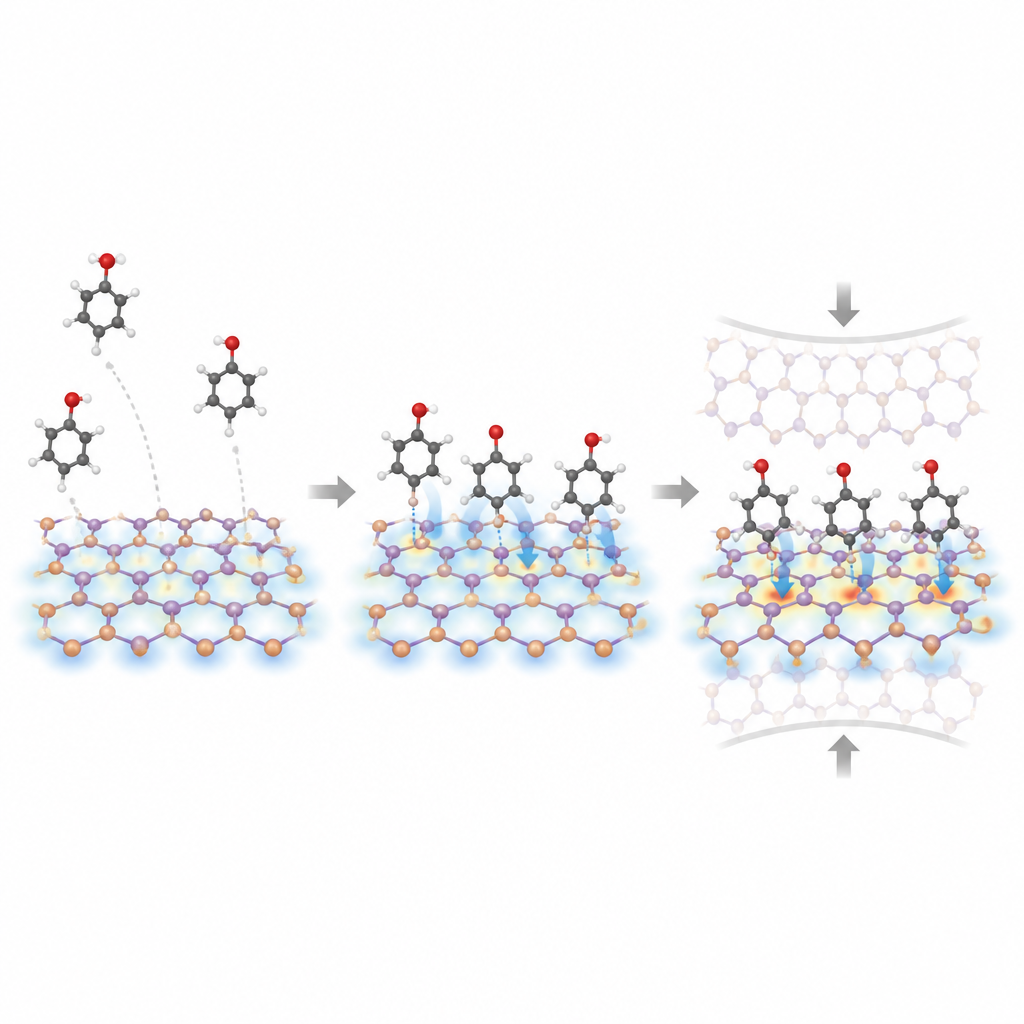
Next, the team studies how five common phenolic pollutants interact with the sheet: phenol, methyl phenol, dimethyl phenol, chlorophenol, and nitrophenol. In their models, these ring-shaped molecules settle gently above the surface, lying roughly parallel to it. The attraction between molecule and sheet is mainly through weak forces rather than strong chemical bonds, a regime known as physisorption. Even so, there is clear movement of electrons from the molecules to the sheet. This charge transfer is helped by the way the cloud of electrons in the aromatic ring lines up with lone electrons on atoms in the sheet, creating a stable but reversible attachment.
Turning adsorption into an electrical signal
For a practical sensor, it is not enough that molecules stick; their presence must also change an electrical property that can be measured. The simulations show that when phenols sit on the surface, the energy gap that controls how easily electrons move in the sheet shifts. All five pollutants cause some change, but phenol and chlorophenol stand out, creating noticeable new electronic states and larger shifts in the gap. These changes imply a stronger adjustment of electrical conductivity when those two molecules are present, which translates into a clearer sensing signal. The work function, a measure of how easily electrons can leave the surface, also shifts in a distinct way for each pollutant, offering another knob for detection and selectivity.
Speed of reset and the role of strain
A useful sensor must also recover quickly once the pollutant is removed so it can be reused. The authors estimate how long each molecule would take to detach from the sheet at room temperature and at a higher temperature. Phenol and chlorophenol not only alter the electronic properties strongly but also let go relatively quickly, especially when the material is warmed, suggesting that a device based on this sheet could respond and reset on convenient timescales. The team also explores squeezing or stretching the sheet, a strategy known as applying strain. They find that moderate compression can make phenol stick a bit more strongly without compromising stability, offering a way to fine-tune sensitivity through mechanical control.
What this means for pollution sensing
In summary, the study suggests that a single-atom-thick sheet of beta arsenic phosphide can serve as a sensitive and reusable electronic platform for detecting phenol and chlorophenol in polluted air or water. By gently attracting these molecules, altering its electrical behavior in a measurable way, and then releasing them again, the material combines stability, responsiveness, and practical recovery times. While this work is theoretical, it maps out how such a nanoscale sensor could help track harmful phenolic pollutants and support efforts to protect environmental and human health.
Citation: Vijay Balaji, M., Chandiramouli, R., Bhuvaneswari, R. et al. First-principles study of phenol sensing properties on β-arsenic phosphide monolayers. Sci Rep 16, 15793 (2026). https://doi.org/10.1038/s41598-026-46191-9
Keywords: phenol sensing, 2D materials, arsenic phosphide, gas sensor, water pollution