Turning Farm Waste into Stronger, Greener Concrete
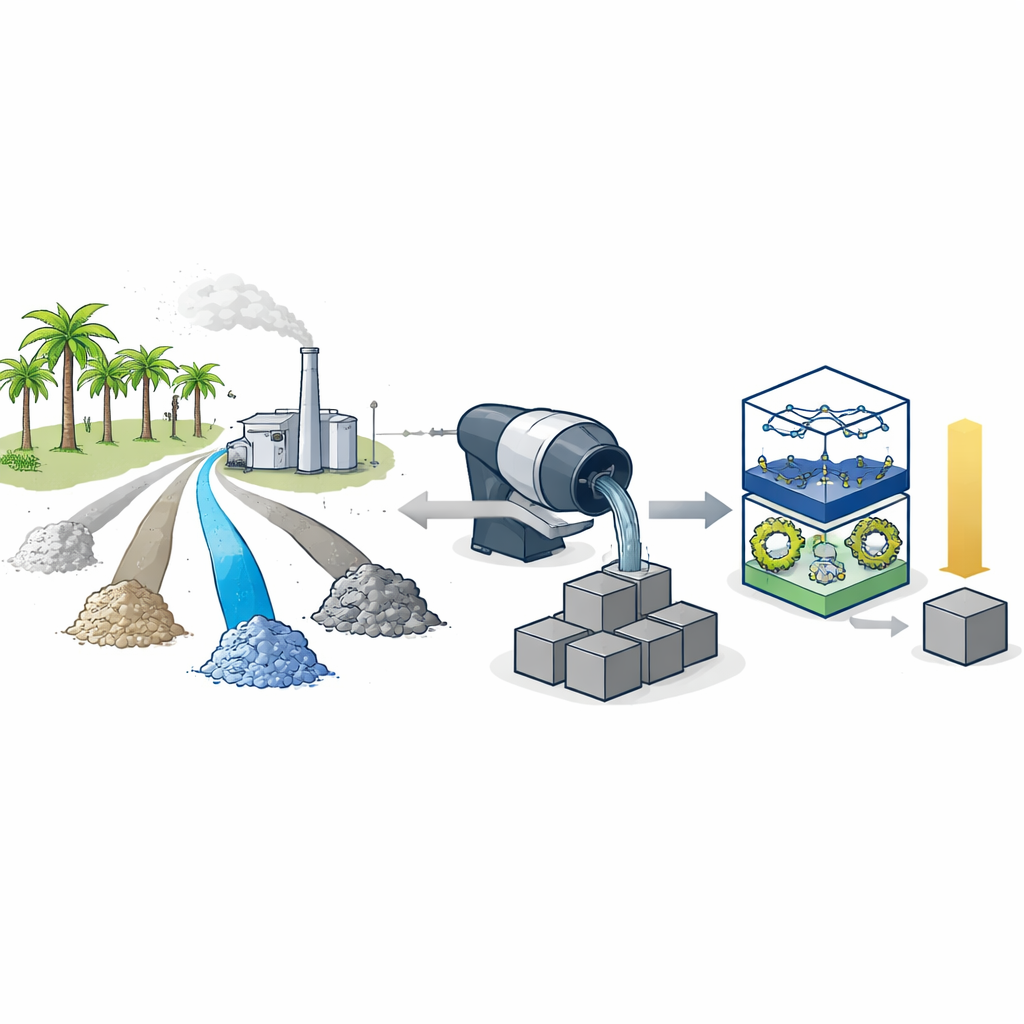
Concrete holds up our buildings, bridges, and roads, but making the cement inside it releases large amounts of carbon dioxide. At the same time, palm oil factories generate mountains of ash that are often discarded. This study explores how to turn that ash into a useful ingredient for concrete, and how smart computer programs can reliably predict how strong such “green” concrete will be before anyone pours a single batch.
Why Palm Oil Ash Matters
Palm oil fuel ash is a dusty by-product left after burning palm waste for energy. In countries that grow a lot of palm oil, it accumulates in huge quantities and can create disposal and pollution problems. Yet this ash contains reactive particles that can partly replace cement in concrete. Using it helps two causes at once: it cuts the amount of energy-hungry cement needed and recycles an agricultural waste. Previous experiments have shown that, if processed and used carefully, palm oil ash can produce concrete that is strong and durable. The challenge is that strength depends on many interacting ingredients and curing conditions, so designers need a fast and reliable way to estimate performance without running endless tests.
Letting a Smart Model Learn from Hundreds of Mixes Figure 1.
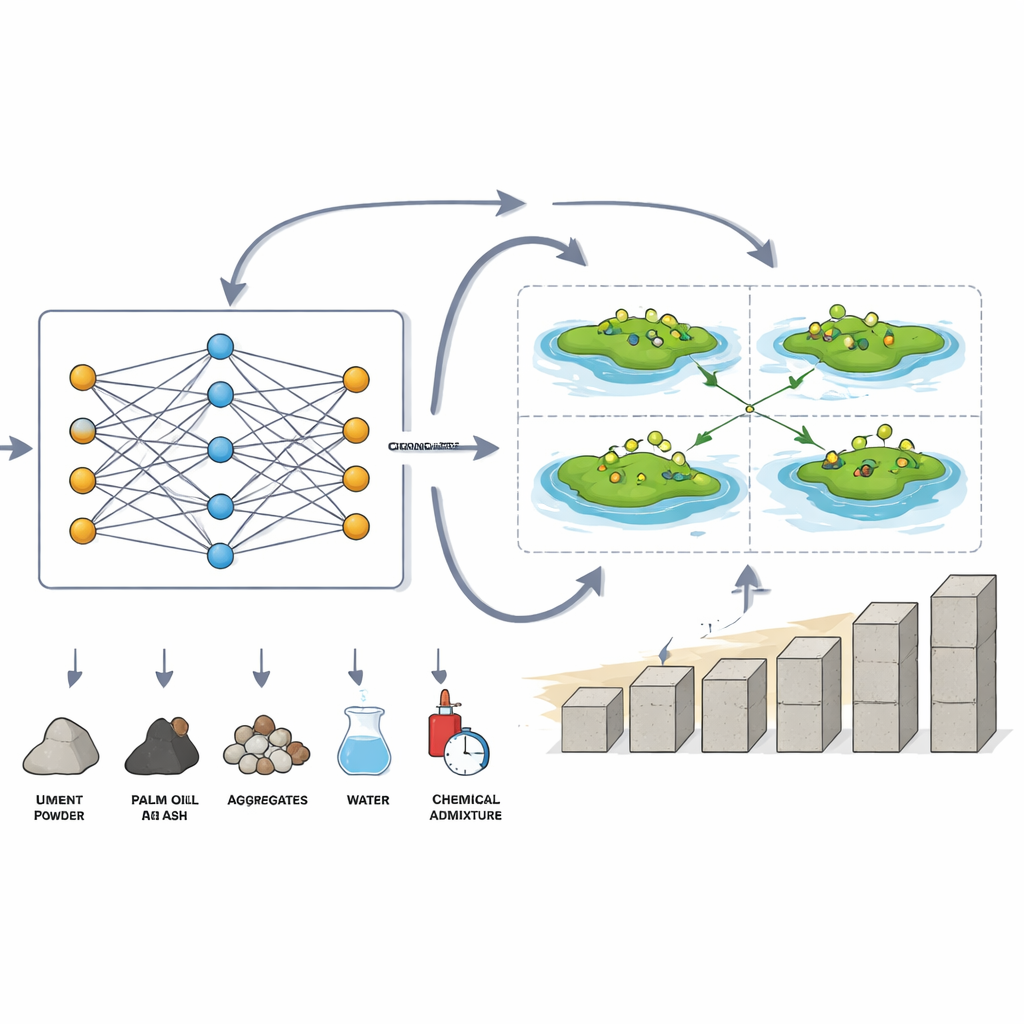
The researchers collected data from 22 published studies, ending up with 469 different concrete mixtures that all used palm oil fuel ash. For each mixture they recorded six key ingredients and conditions: how much cement and ash were used, how much chemical fluid (superplasticizer) was added, the balance between coarse and fine stones, the ratio of water to binder, and how long the concrete was cured before being tested. They then turned to artificial intelligence, building a computer model inspired by the way nerve cells connect in the brain, known as an artificial neural network. This type of model learns by example: it sees many combinations of inputs and the resulting strengths, and gradually adjusts its internal connections to mimic those outcomes.
Boosting the Brain with an Evolution-Inspired Search
On its own, a neural network can be tricky to tune. If its internal settings are poorly chosen, it can get stuck in mediocre performance. To overcome this, the team paired the neural network with a second algorithm that mimics how species spread and adapt across islands, called biogeography-based optimization. In this scheme, each “island” represents a different set of network settings. Features from successful islands migrate to weaker ones, while occasional random changes keep the search from getting stuck. Over many cycles, this hybrid approach refines the network so that it can better match the measured concrete strengths.
How Well the Hybrid Model Performs Figure 2.
To test whether their hybrid model truly earns its keep, the authors divided the 469 mixes into separate groups for training, tuning, and independent testing, and also used cross-checking methods that repeatedly reshuffle the data. They compared the hybrid network against a standard neural network and against earlier models from the literature. The hybrid version consistently predicted compressive strength more accurately: over 60% of its predictions were within 5% of the measured values, compared with about 39% for the conventional model. Its overall error was smaller, and its predictions were more stable when the data were resampled in different ways. Analysis of the trained model also revealed which factors mattered most, highlighting curing time and the water-to-binder ratio as the strongest drivers of strength.
What This Means for Greener Construction
For engineers and planners, the study offers a practical tool: given a candidate mixture that includes palm oil fuel ash, the hybrid model can swiftly estimate how strong the resulting concrete is likely to be, within the range of mixtures it has seen. That can save time, reduce costly trial batches, and encourage broader use of waste-based materials that lower cement use and emissions. While the model is still limited by gaps and differences in the underlying experimental studies, it shows that combining learning-from-data with evolution-inspired search can help tame the complexity of modern sustainable concretes and bring greener construction a step closer to everyday practice.
Citation: Kazemi, R., Pour, M.A. & Gandomi, A.H. Hybrid machine learning approach for predicting compressive strength of sustainable concrete incorporating palm oil fuel ash.
Sci Rep16, 14033 (2026). https://doi.org/10.1038/s41598-026-46190-w