Clear Sky Science · en
Patient-derived intestinal organoids as a model for site-specific mucosal bacterial interactions in paediatric inflammatory bowel disease
Why tiny gut replicas matter for kids with bowel disease
Inflammatory bowel disease can strike children and teenagers, bringing pain, poor growth and lifelong health worries. Doctors know that gut bacteria and the gut lining play a central role, but it is hard to study what happens right at the diseased sites inside a child’s intestine. This study uses miniature 3D replicas of a child’s gut, grown from their own tissue, together with bacteria taken from the same spot, to watch these close-up battles unfold in the lab.
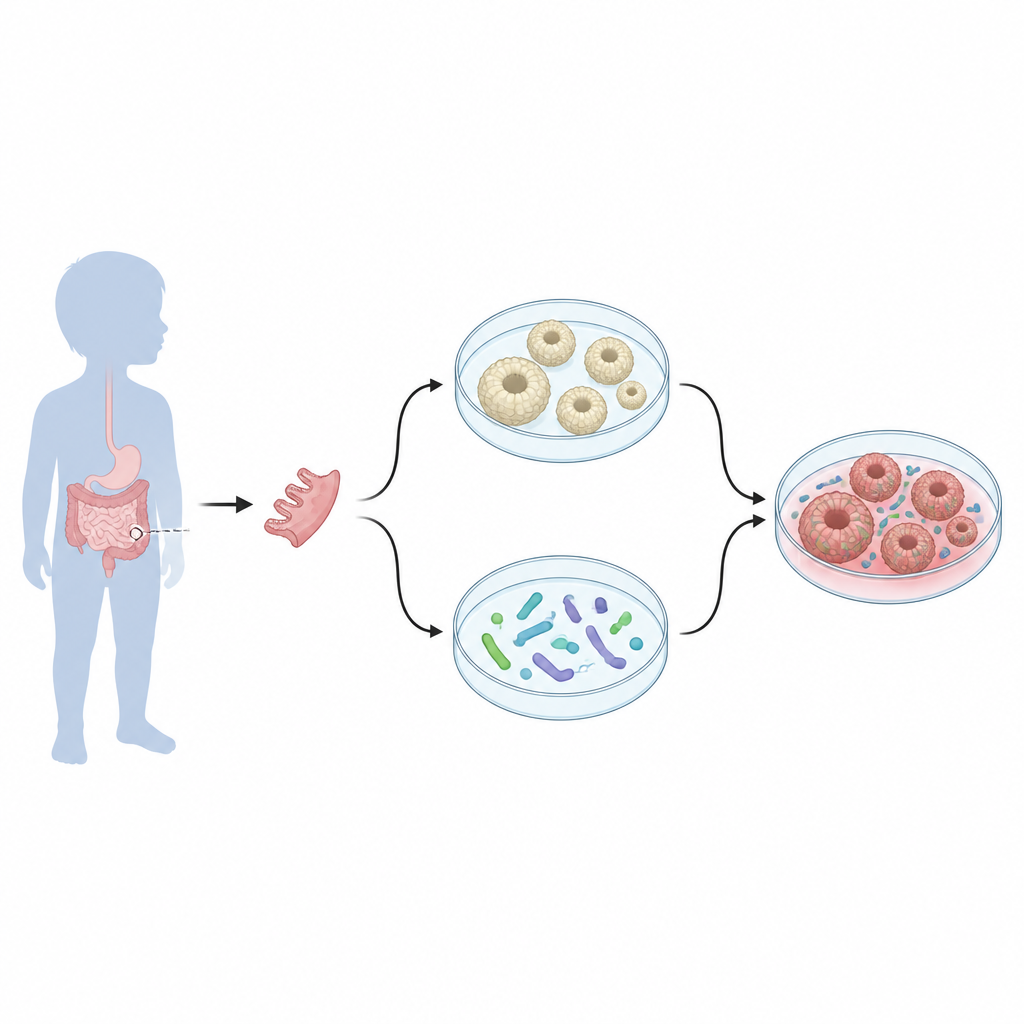
Building mini guts and capturing local bugs
The researchers recruited children who were undergoing gut examinations because of symptoms, some with newly diagnosed inflammatory bowel disease and some without the condition. During routine procedures, they collected tiny biopsies from two regions of the small intestine. From each sample, they split the tissue: one part was used to grow hollow spheres of gut tissue, called organoids or mini guts, and the other to culture the bacteria clinging to the gut surface. This dual approach created a bank of 49 organoid lines and more than 500 bacterial isolates from 27 young patients.
Mapping differences in the gut lining
Next, the team compared gene activity in organoids from children with Crohn’s disease, ulcerative colitis and controls. They found that mini guts mostly clustered by their location in the intestine rather than by diagnosis, underlining how different each region of the gut is. Still, organoids from children with ulcerative colitis showed clear changes in genes linked to immune signaling and the integrity of the cell barrier, even when grown far from overtly inflamed areas. In particular, genes involved in presenting immune signals and in maintaining tight connections between cells were altered, hinting that subtle barrier problems and immune priming may extend beyond visibly diseased sites.
Putting patient bacteria back into patient mini guts
To test how individual microbes influence the gut lining, the researchers chose pairs of closely related bacterial strains, each pair including one strain from a child with inflammatory bowel disease and one from a control child. Using fine glass needles, they microinjected these bacteria directly into the hollow center of matched organoids, mimicking how bacteria contact the inner gut surface. They confirmed that both oxygen-sensitive and more tolerant strains could survive this procedure and grow within the mini guts, allowing them to track how the host cells responded over time.
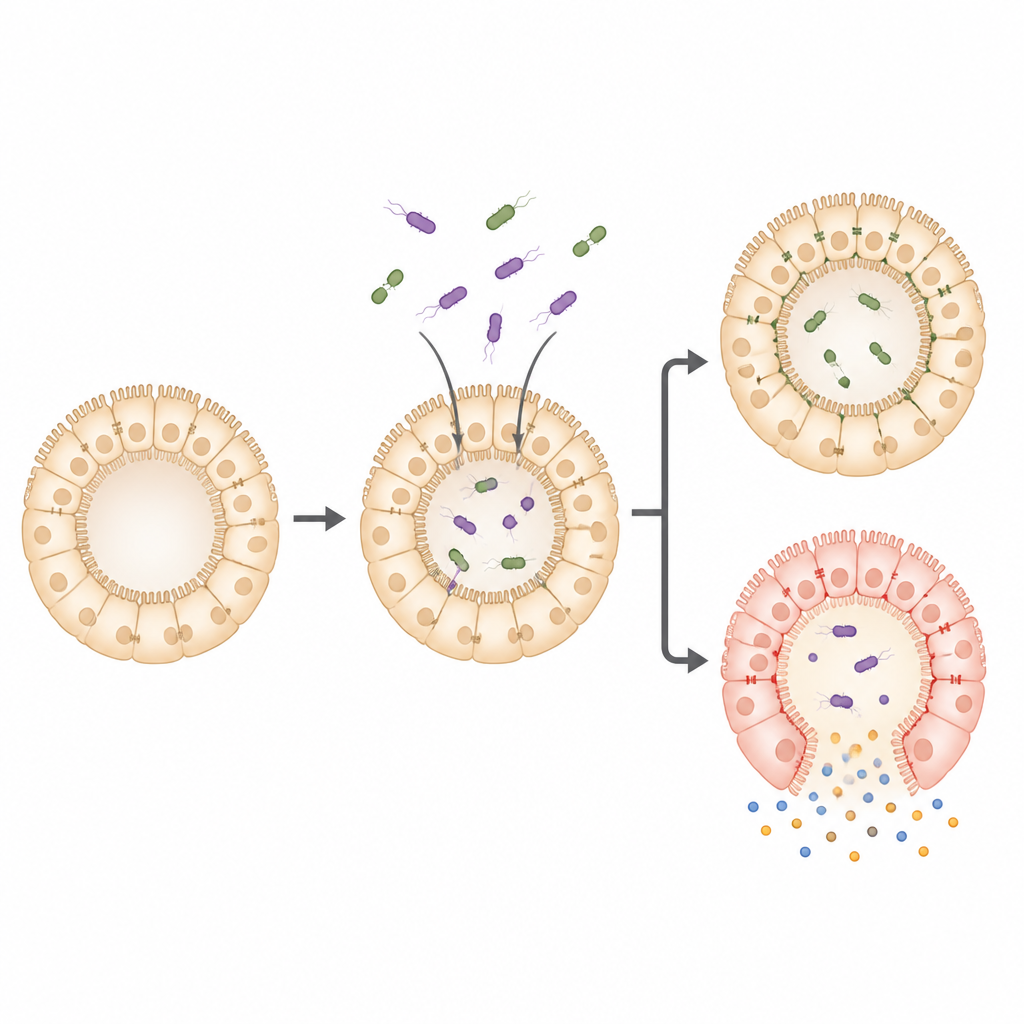
Same family of bacteria, very different reactions
Surprisingly, organoids reacted very differently to two near-twin strains from the same bacterial family. One strain, originally isolated from a control child, strongly switched on inflammatory signaling pathways in both control and inflammatory bowel disease organoids, including molecules commonly linked to gut immune responses. The closely related strain from an inflammatory bowel disease patient did not trigger this same burst of signaling. In a separate test of barrier function, a different strain from the same family increased leakiness of the organoid wall, allowing small dye molecules to escape from the lumen, while another strain did not, even though both were able to persist inside the mini guts.
What this means for future personalised care
This work shows that it is feasible to grow mini guts and isolate local bacteria from the same tiny biopsy in children, then reunite them in the lab to study their interactions. The results reveal that even closely related bacterial strains can have sharply different effects on gut cells, from activating inflammatory pathways to weakening the barrier. For families and clinicians, the message is that inflammatory bowel disease is shaped not just by “good” or “bad” species, but by specific strains and where they live. In the long run, such personalised models could guide microbiome-based treatments that are tuned to an individual child’s own gut lining and resident microbes.
Citation: Chan, E., Chan, W.H., Kerr, G. et al. Patient-derived intestinal organoids as a model for site-specific mucosal bacterial interactions in paediatric inflammatory bowel disease. Sci Rep 16, 15359 (2026). https://doi.org/10.1038/s41598-026-46184-8
Keywords: inflammatory bowel disease, paediatric gut, intestinal organoids, microbiome, host microbe interactions