Clear Sky Science · en
How the influence of cingulate-lingual interactions on event segmentation changes from early to late adolescence
Why everyday moments feel different as teens grow up
When you watch a movie or walk through your day, your mind automatically chops continuous experience into “episodes” — like scenes in a film. This quiet mental editing helps you follow what is going on and remember it later. The featured study asks how this event-cutting ability changes during adolescence, and what is happening in the brain as teens learn to balance what they see right now with what they already know from past experiences.
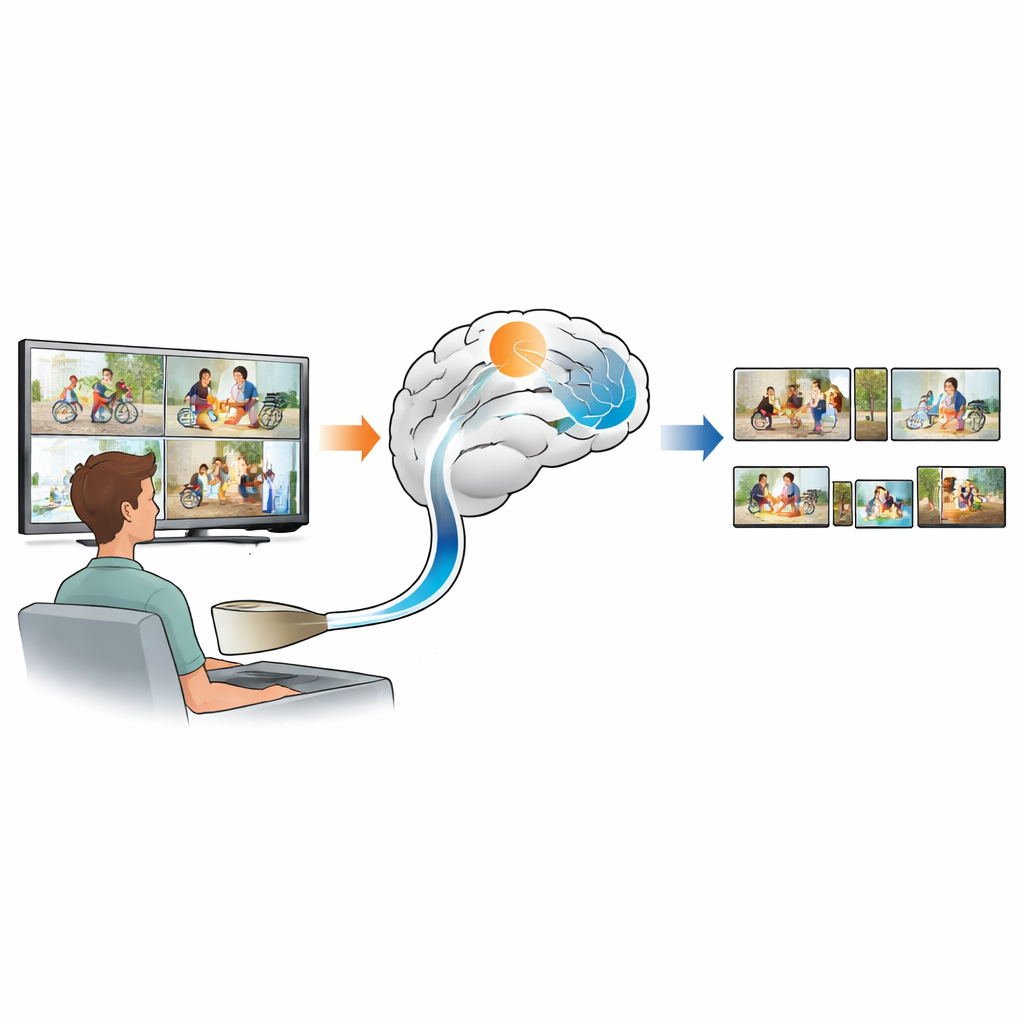
How the brain cuts life into scenes
Psychologists call this process event segmentation. Instead of treating life as a blur, the brain builds a “working event model” of what is happening now and what is likely to come next. It draws on two main ingredients: current sights and sounds, and stored knowledge about how similar situations usually unfold. When the incoming information no longer fits the running story, the brain updates its model and marks a new event boundary — much like a film editor choosing a cut. Earlier work suggested that adolescents are less likely than adults to mark these boundaries, perhaps because they have fewer life scripts to rely on and their control systems are still maturing.
Watching a movie inside the lab
To probe this development, the researchers recorded the brain activity of 72 healthy adolescents aged 10 to 16 while they watched the classic short film “The Red Balloon.” The teens were asked to press a key whenever they felt that “something had ended and something new was about to begin.” The film had been carefully coded into hundreds of brief intervals, each containing zero or more situational changes, such as new characters entering, shifts in location, or changes in action. This allowed the team to quantify how strongly each teen’s button presses followed the actual changes on screen — a measure of how sensitive they were to meaningful shifts in the story.
Brain rhythms and key communication lines
While the teens watched the film and marked boundaries, their brain activity was captured using EEG, a method that tracks electrical signals from the scalp. The team focused on three common brain rhythms: theta, alpha, and beta. They used advanced source localization and connectivity tools to estimate where in the brain these rhythms came from, and how strongly different regions influenced one another. Across the group, all three rhythms dipped around the moments when teens pressed the key, pointing to widespread adjustments in brain activity at event boundaries. But when it came to predicting individual differences in behavior, only beta activity — a rhythm often linked to updating mental models — stood out.
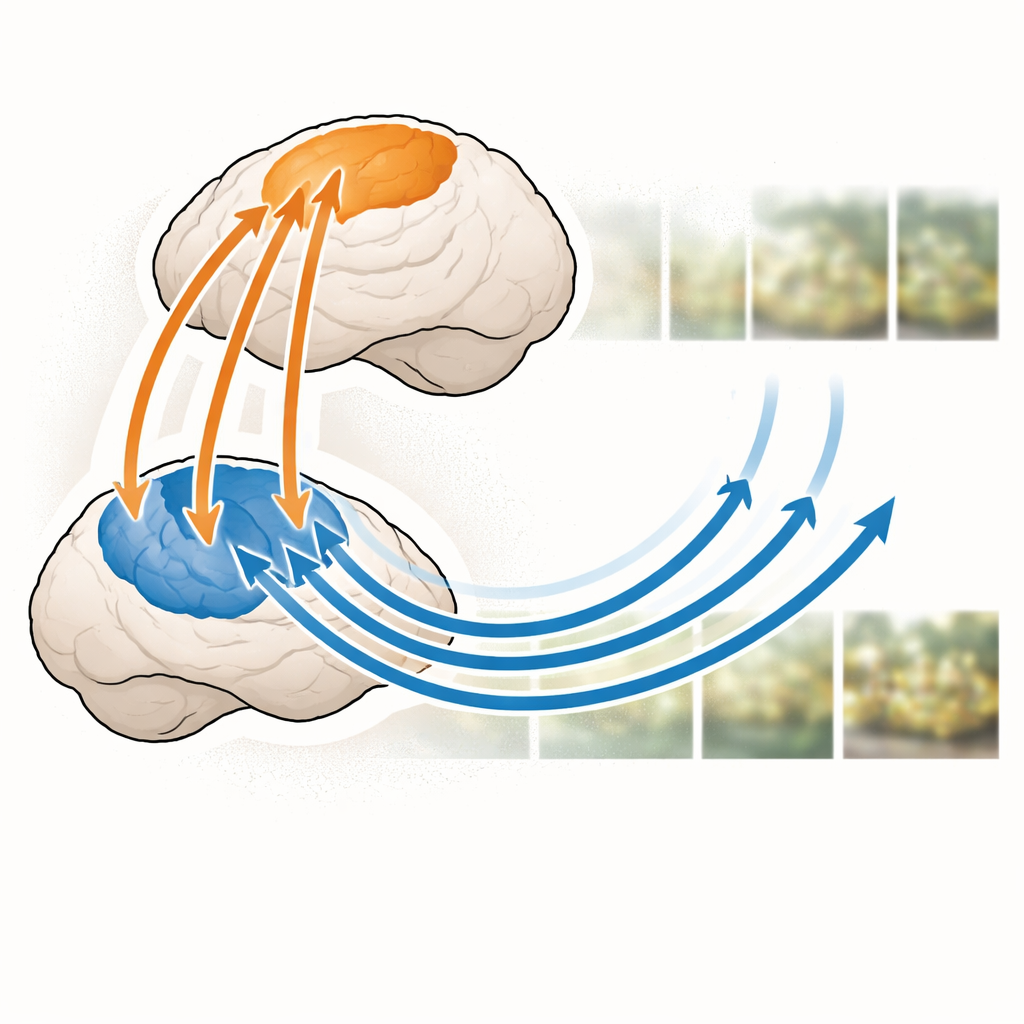
A shifting balance between control and perception
Two regions were especially important in the beta band. One lay deep along the midline, in the cingulate cortex and nearby motor-planning areas, often associated with monitoring and updating ongoing behavior. The other was a visual region at the back of the brain called the lingual gyrus, tied to detailed visual processing and visual memories. The researchers examined directed communication between these two regions, separating simple (linear) influences from more complex (nonlinear) ones. They found that, particularly in older adolescents, the strength of complex signals flowing from the cingulate region down to the visual region was linked to how tightly event marking followed situational changes in the movie.
What changes from early to late adolescence
For younger teens, connectivity between these regions did not clearly shape how they cut the movie into events. But starting around age 14 and a half, a pattern emerged: those with weaker nonlinear influence from the cingulate cortex to the lingual gyrus were more responsive to actual changes on screen, placing boundaries more in line with the unfolding visual story. In contrast, stronger top-down signals from the cingulate region were associated with a reduced sensitivity to situational changes, as if an internal script was overriding fresh sensory evidence. The authors interpret this as a developmental tuning of balance: as the brain matures, efficient event segmentation seems to depend on letting visual input from the environment and memory-based expectations share control, rather than allowing high-level control signals to dominate.
Why this matters for growing minds
These findings suggest that a key part of adolescent brain development is learning to blend what we see now with what we have learned before when we carve experience into meaningful units. In late adolescence, reduced over-control from midline “manager” regions to visual areas may actually help teens track the world more accurately, supporting better organization of everyday information and stronger memories. Understanding this subtle rebalancing of brain communication could shed light on why some teenagers struggle more than others with following complex situations — and may eventually guide ways to support healthy cognitive development.
Citation: Prochnow, A., Zhou, X., Ghorbani, F. et al. How the influence of cingulate-lingual interactions on event segmentation changes from early to late adolescence. Sci Rep 16, 11377 (2026). https://doi.org/10.1038/s41598-026-46182-w
Keywords: adolescent brain development, event segmentation, EEG connectivity, beta brain rhythms, visual memory