Clear Sky Science · en
Enhancing COVID-19 forecasts with a lightweight multi-head depthwise separable convolution network
Why better pandemic forecasts still matter
The COVID-19 pandemic has shown how hard it is to predict how an outbreak will rise and fall in different places. Governments and hospitals rely on these forecasts to decide when to add beds, order vaccines, or tighten public health rules. Yet real-world data are messy and often limited, especially early in an outbreak. This paper introduces a new computer model that aims to make short-term COVID-19 forecasts more accurate and more efficient, even when only small, noisy datasets are available.
A fresh take on reading epidemic curves
Most early COVID-19 forecasts were based on classical math formulas that split the population into groups such as susceptible and infected, or on simple statistical tools that extend past trends into the future. More recently, deep learning methods have joined the toolbox because they can capture complex shapes in data that older methods miss. Among these, combinations of two popular neural network families, convolutional networks and recurrent networks, have done particularly well. However, these mixed models can be heavy, slow, and prone to overfitting when there are not many data points, a common situation during local outbreaks or in smaller countries.
A lightweight model built for thin data
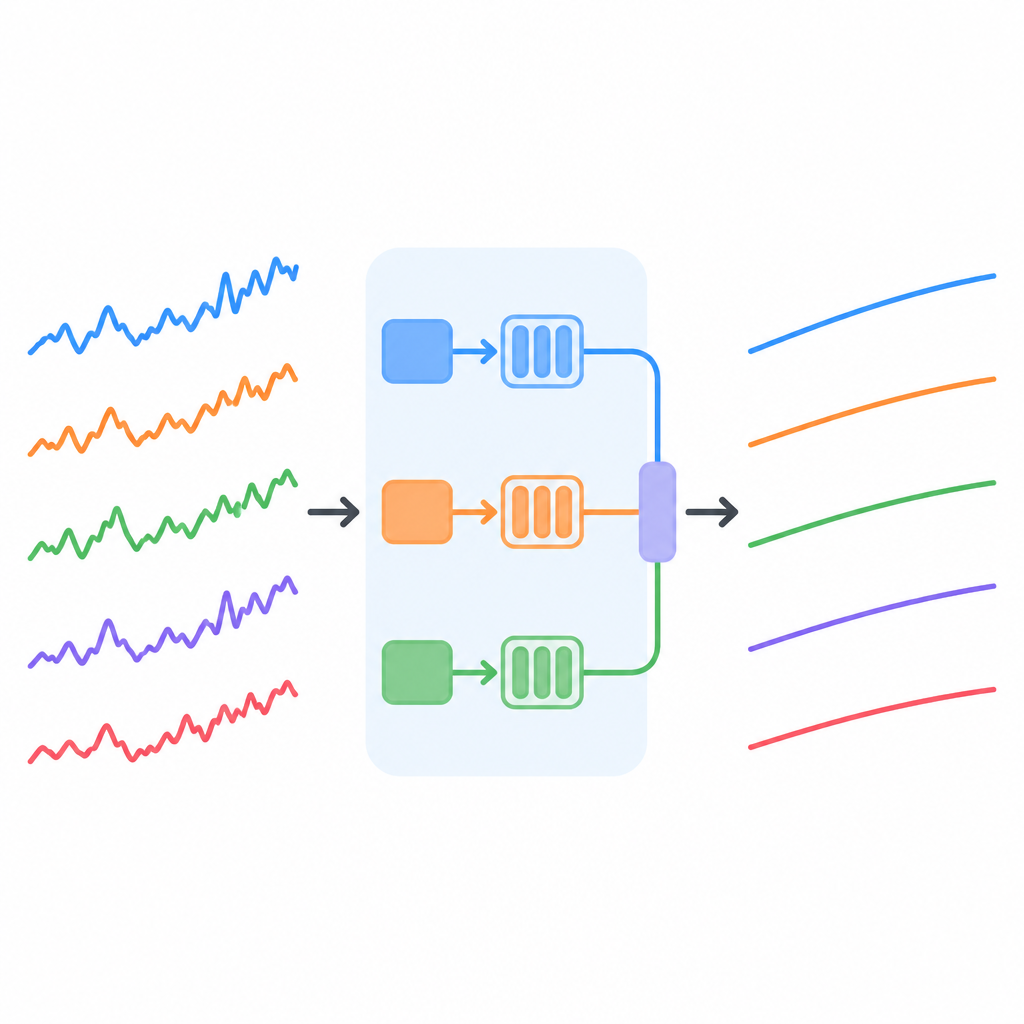
The authors propose a new model called CDSCnet that tries to keep what works in modern deep learning while trimming away unnecessary complexity. Instead of repeatedly looping through time like a recurrent network, CDSCnet relies on a series of fast filters that slide along the time axis. It splits each input sequence into three overlapping chunks, processes each chunk along its own path, and then brings them back together. Within these paths, a special kind of filter called a depthwise separable convolution breaks the computation into small pieces that reuse information efficiently. Extra tricks, such as copying the last data point rather than padding with zeros and using gentle averaging steps, help the model focus on the most informative parts of the curve without exploding in size.
Putting the new approach to the test
To see whether this design pays off, the researchers compared CDSCnet with a range of rival models, including several versions of the widely used CNN–LSTM approach. They used official COVID-19 case and death counts from seven countries spread across different continents, drawing on both smoother time series and very noisy ones. Across eleven distinct forecasting tasks, CDSCnet usually produced the smallest errors, sometimes cutting typical mistakes in half compared with the best reproduced CNN–LSTM results, as in the Spain case study. The model remained competitive even when the data were highly irregular, such as daily numbers from Switzerland and Croatia, and its advantage grew when the authors first smoothed those jagged records with a simple weekly averaging step.

Speed, simplicity, and what the numbers say
Beyond accuracy, the team examined how many adjustable knobs, or parameters, each model needed and how much computation they consumed. CDSCnet required far fewer parameters than several popular baselines, including a deep CNN–LSTM that used dozens of times more. Despite this compact footprint, CDSCnet still matched or exceeded the others in accuracy. A closer look showed that replacing standard filters with depthwise separable ones was key to shrinking the model, and that keeping the three-path structure fixed, rather than expanding it layer by layer, helped keep both memory use and running time in check.
What this means for future outbreaks
In plain terms, this study suggests that it is possible to build COVID-19 forecasting tools that are both accurate and frugal with data and computing power. CDSCnet reads past case curves, teases out short-term and longer-term patterns, and turns them into more reliable short-term forecasts, all while using a relatively small and transparent design. The authors caution that adding information about vaccines, policies, or movement patterns and exploring longer-range predictions will be important next steps. Still, their results indicate that carefully tuned, lightweight models like CDSCnet can offer practical decision support when data are limited, noisy, and urgently needed.
Citation: Lan, H., Ni, S. Enhancing COVID-19 forecasts with a lightweight multi-head depthwise separable convolution network. Sci Rep 16, 15825 (2026). https://doi.org/10.1038/s41598-026-46170-0
Keywords: COVID-19 forecasting, epidemic modeling, deep learning, time series prediction, lightweight neural network