Clear Sky Science · en
Impact of gap anisotropy of Polar and Anderson-Brinkman-Morel p-wave superconductors on thermoelectric properties of quantum dot hybrids
Turning Heat into Electricity with Exotic Superconductors
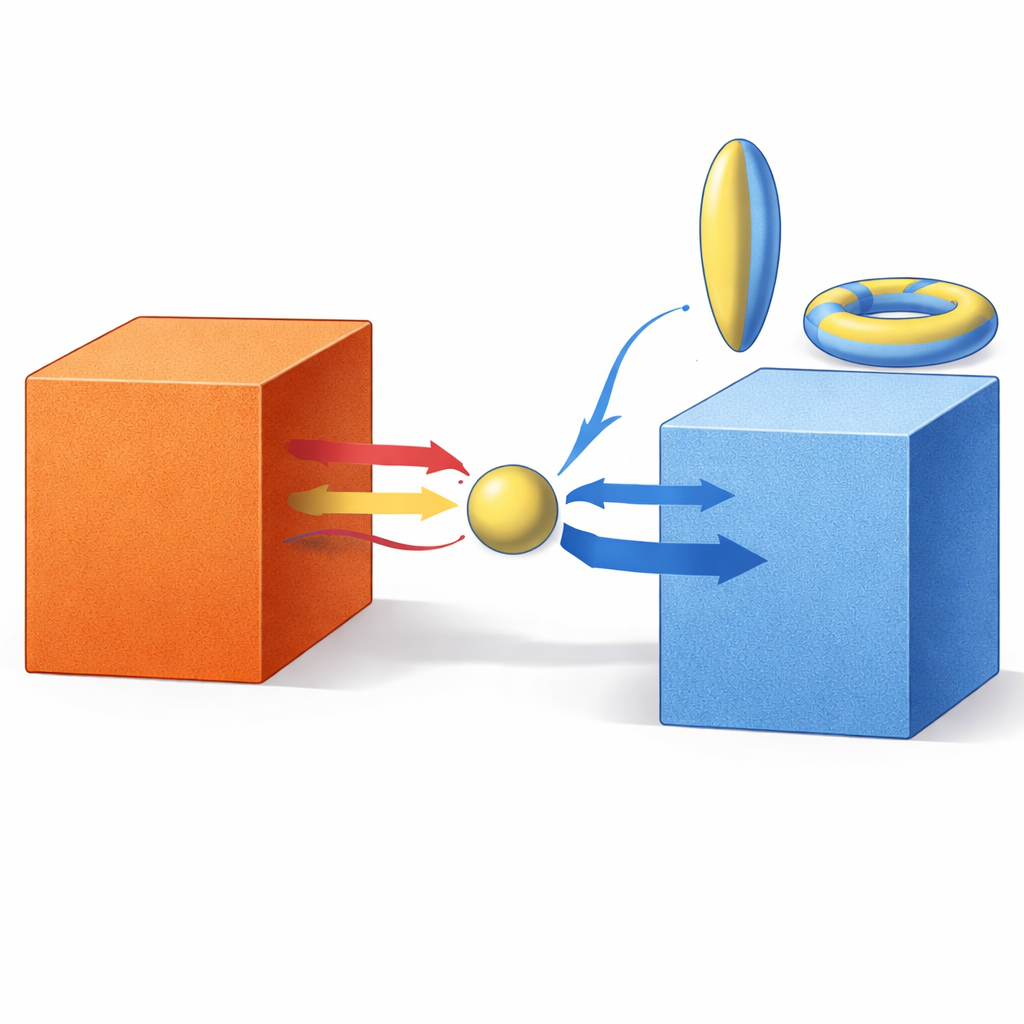
Imagine a tiny island for electrons, so small that it behaves more like a single atom than a piece of metal. Now connect this island to one lead that prefers one electron spin over the other and to another lead made of an unusual superconductor. This study explores how such a nanoscale device could turn heat into electricity more efficiently, and at the same time reveal hidden features of a rare class of superconductors thought to host exotic quasiparticles like Majorana modes.
A Tiny Bridge Between Two Very Different Worlds
The system at the heart of the work is a quantum dot – a nanoscale "artificial atom" – coupled on one side to a ferromagnetic metal and on the other side to a p-wave, spin‑triplet superconductor. In the ferromagnet, electrons with one spin direction are more common than the other, while in the triplet superconductor electrons pair up with parallel spins and with a strongly direction‑dependent energy gap. The authors focus on two classic p‑wave patterns: the Polar state, where the energy gap is largest along one axis and vanishes along a ring, and the Anderson‑Brinkman‑Morel (ABM) or chiral state, where the gap is largest in an equatorial band and drops to zero at two poles. Because the quantum dot acts as a single tunable energy level, it provides a very clean way to see how these directional gaps affect the flow of charge and heat.
Why Direction Matters for Electron Pairs
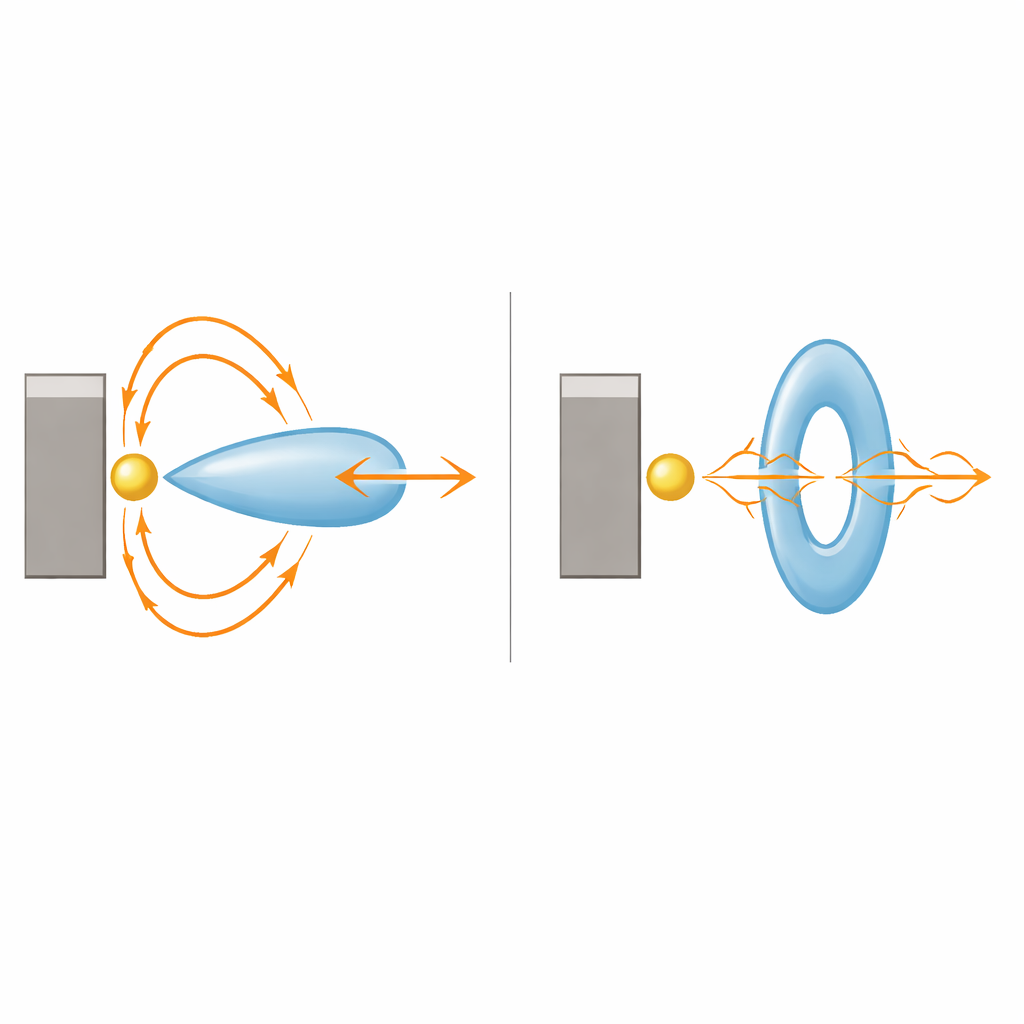
In ordinary superconductors, the energy gap is the same in every direction, so simplified models often ignore detailed momentum effects. For p‑wave superconductors this is no longer possible: the gap depends strongly on the direction of an electron’s motion, leading to nodal regions where the gap vanishes. To capture this, the authors introduce an angle‑dependent "weight" into the coupling between the quantum dot and the superconductor. By effectively favoring electrons that enter the superconductor within a narrow cone of directions, they can mimic a cleaner, more oriented interface. They then compare two geometries: one where the main symmetry axis of the superconductor is aligned with the tunneling direction (parallel), and another where it is perpendicular. This orientation control turns out to be a powerful knob for switching different transport channels on or off.
Competing Paths for Charge and Heat
Electrons can cross the device in two main ways. One is ordinary quasiparticle tunneling: a single electron passes through the dot into available states in the superconductor. The other is Andreev reflection, in which an electron from the ferromagnet is converted into a hole that goes back, while a pair of electrons (a Cooper pair) enters the superconductor. In this setup, those pairs are spin‑triplet. Using a Green’s‑function approach in the linear‑response regime, the authors compute electrical conductance, thermopower (voltage generated by a temperature difference), thermal conductance, and the thermoelectric figure of merit ZT. They show that the relative importance of quasiparticle flow and triplet Andreev reflection is extremely sensitive to both the gap pattern (Polar versus ABM) and the mutual orientation of crystal axes and tunneling direction.
Switching Andreev Reflection with Crystal Orientation
A key result is that small changes in angular weighting and orientation can either boost or almost completely suppress triplet Andreev reflection. In the Polar state with the symmetry axis parallel to transport, tightening the angular spread around that axis turns on a strong mid‑gap Andreev peak, while in the perpendicular orientation, symmetry forces the net Andreev contribution to cancel out. For the ABM state, the situation is reversed in a striking way: in the parallel configuration, the internal swirling phase of the gap leads to destructive interference that kills Andreev reflection, whereas selective azimuthal weighting in the perpendicular configuration restores it. These symmetry effects mean that simply rotating the superconducting crystal relative to the quantum dot can act as a control knob for spin‑polarized supercurrents.
Enhanced Heat Flow and Thermoelectric Efficiency
Because both Polar and ABM states have low‑energy quasiparticles even inside the superconducting gap, the device can carry heat much more efficiently than a comparable structure with a conventional s‑wave superconductor. The authors find that thermal conductance can be enhanced by several orders of magnitude, and that the thermoelectric figure of merit ZT can reach sizable values, especially for the ABM phase. However, there is a trade‑off: conditions that maximize pure triplet Andreev transport often reduce ZT, since dissipationless pair currents do not directly carry heat in linear response. Optimal thermoelectric performance is achieved when the quantum‑dot level is tuned away from the strongest Andreev region, and the ABM state generally surpasses the Polar state in efficiency.
What This Means for Future Quantum Devices
Overall, the study shows that the directional character of the p‑wave gap and its alignment with a nanoscale junction strongly shape both electrical and thermal transport. By engineering the crystal orientation, interface quality and spin polarization of the ferromagnetic lead, experimentalists could use simple thermoelectric measurements – conductance, thermopower and heat flow – as sensitive probes of whether a superconductor is in a Polar or ABM‑like state and where its nodes lie. At the same time, these effects offer practical design rules for spin‑based, low‑dissipation thermoelectric devices built from triplet superconductors and quantum dots, where one can choose between maximizing spin‑pure supercurrents or maximizing heat‑to‑electricity conversion depending on the application.
Citation: Sonar, V., Trocha, P. Impact of gap anisotropy of Polar and Anderson-Brinkman-Morel p-wave superconductors on thermoelectric properties of quantum dot hybrids. Sci Rep 16, 13629 (2026). https://doi.org/10.1038/s41598-026-46160-2
Keywords: p-wave superconductors, quantum dot hybrids, triplet Andreev reflection, thermoelectric transport, gap anisotropy