Clear Sky Science · en
Regional tissue oxygenation during high-intensity exercise following voluntary isocapnic hyperpnea versus inspiratory threshold loading in endurance–trained individuals: a randomized controlled trial
Breathing Better to Go Harder
When we push ourselves in a hard workout, our lungs and breathing muscles work just as furiously as our legs. Many athletes now use special breathing drills, hoping to boost performance by strengthening these muscles and improving how oxygen is delivered around the body. This study asked a simple but important question: do two popular forms of breathing training actually change how much oxygen reaches the brain, breathing muscles, and leg muscles during an all‑out cycling effort?
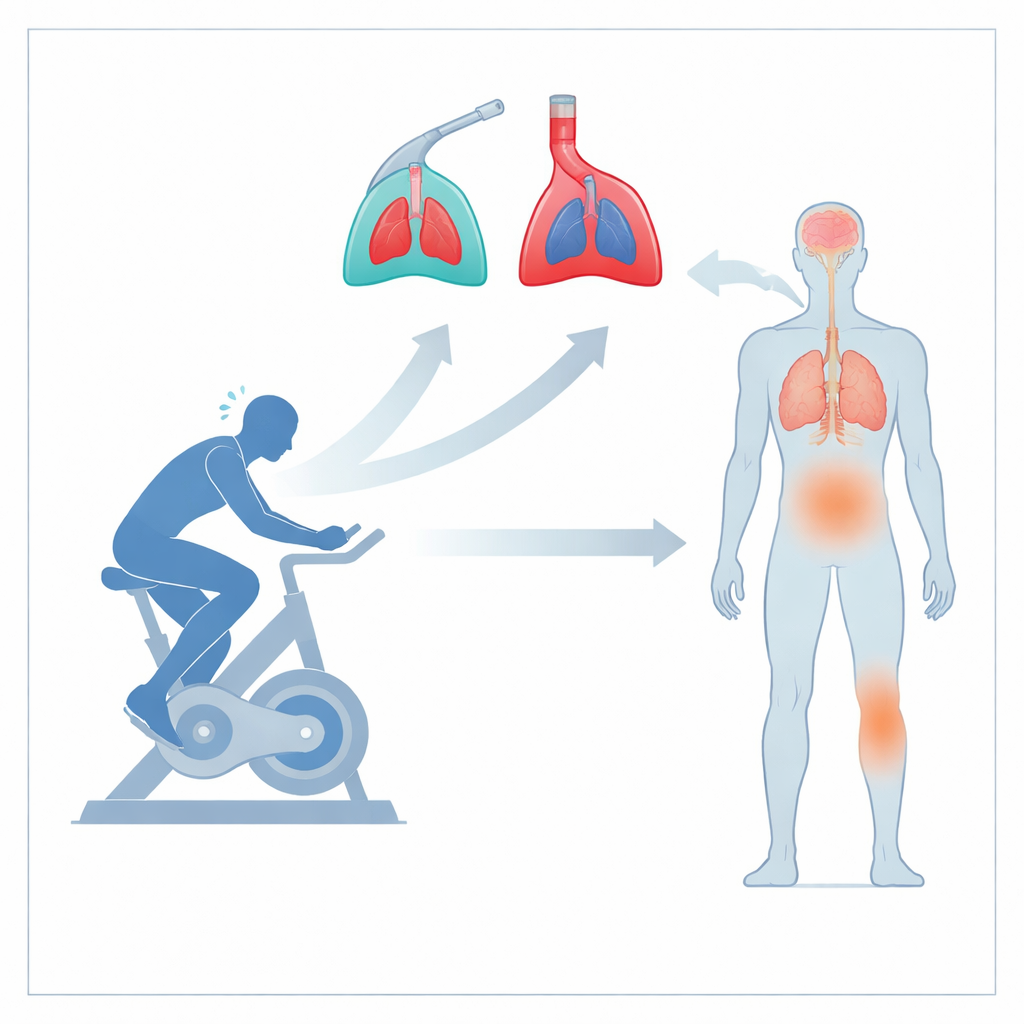
Two Ways to Train the Breath
The researchers focused on endurance‑trained runners, cyclists, and triathletes in their 20s and 30s. All were already fit and accustomed to regular training. The team compared two common breathing routines over five weeks. One, called voluntary isocapnic hyperpnea, has people breathe rapidly and deeply for several minutes using a special device that recycles some of the air. This drills the breathing system for endurance—many quick, relatively light breaths. The other, inspiratory threshold loading, makes people suck air in against a strong resistance, like lifting weights with the breathing muscles, building strength more than endurance. Both programs were carefully matched so that athletes completed the same total number of breaths each week.
Putting Athletes Through a Tough Ride
Before and after the five‑week program, all athletes completed demanding cycling tests in the lab. First, a ramp test determined each person’s peak power and oxygen‑uptake. Then, on a separate day, they rode at 80 percent of that peak power—an effort that feels close to racing—until they could no longer maintain the required cadence. During this constant‑load test, the scientists used near‑infrared light sensors on the forehead, between the ribs, and on the thigh to track how blood and oxygen levels changed in the prefrontal region of the brain, the breathing muscles, and the main working leg muscle. This approach allowed them to see, second‑by‑second, whether training shifted how oxygen was shared around the body under stress.
What Changed and What Stayed the Same
The two breathing programs produced clearly different fitness adaptations. The rapid‑breathing routine improved how much air athletes could move in and out of their lungs, raised their breathing rate and breath size at maximum effort, and led to a modest rise in peak oxygen‑uptake—signs that their breathing system had become more efficient. The resistance‑based routine, in contrast, sharply increased the maximum pressure the inspiratory muscles could generate, showing that they had become much stronger, but did not noticeably change overall aerobic capacity. Surprisingly, despite these distinct gains, the way oxygen levels behaved in the brain, breathing muscles, and thigh muscles during the hard cycling test was largely unchanged after either kind of training.
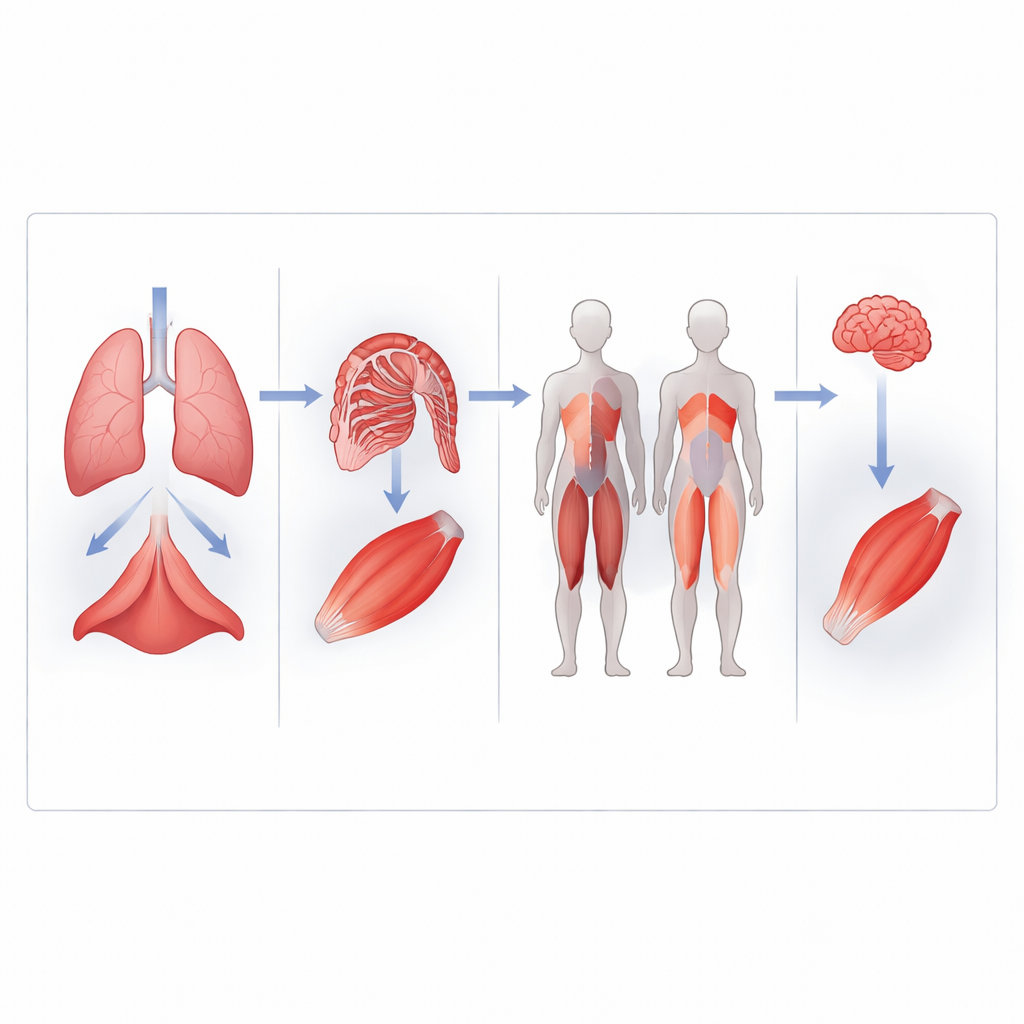
Oxygen Patterns During Hard Effort
As expected, intense cycling caused notable drops in oxygen levels in both the breathing and leg muscles, while total blood in those areas stayed relatively stable—evidence that the muscles were simply extracting more oxygen to meet the high demand. In the frontal part of the brain, blood volume and oxygen‑carrying molecules rose over time, and overall saturation stayed steady, suggesting that the brain continued to receive adequate oxygen even as the effort felt harder. After five weeks of training, these patterns looked essentially the same in both groups. The only hint of change was a small, roughly three‑percentage‑point rise in a measure of oxygen saturation in the thigh muscle, seen in athletes from both training programs. Because this shift was small and within the normal measurement noise of the technique, the authors caution against reading too much into it, especially since it did not translate into longer cycling time to exhaustion.
What This Means for Athletes
For trained endurance athletes, short breathing programs can indeed strengthen the breathing system—either by boosting its endurance or its strength—but that does not automatically mean that the body will redistribute oxygen in a new way during very hard exercise. In this study, the brain and working muscles showed robust, almost unchanged oxygen patterns after five weeks of training, and performance in the constant‑load test did not improve. The results suggest that, at least in already fit people over a relatively short period, breathing drills may fine‑tune the respiratory system without dramatically altering where oxygen goes during intense efforts. Longer training periods, different types of athletes, or combined approaches may be needed before meaningful shifts in muscle and brain oxygenation—and perhaps performance—begin to appear.
Citation: Ramos–López, D., Caulier–Cisterna, R., Vega–Moraga, A. et al. Regional tissue oxygenation during high-intensity exercise following voluntary isocapnic hyperpnea versus inspiratory threshold loading in endurance–trained individuals: a randomized controlled trial. Sci Rep 16, 10732 (2026). https://doi.org/10.1038/s41598-026-46153-1
Keywords: respiratory muscle training, endurance exercise, muscle oxygenation, cycling performance, near infrared spectroscopy