Clear Sky Science · en
Enhancement of the piezoelectric response of corona charged Ag/P(VDF-TrFE) nanocomposites for energy harvesting devices
Turning Everyday Motion into Power
Imagine charging small electronics simply by walking, breathing, or moving your wrist. This paper explores a flexible plastic material that can do just that, turning tiny mechanical movements into electricity. By sprinkling in ultra-small silver particles and using a special charging treatment, the researchers significantly boosted how much electrical charge this plastic can produce when pressed or bent, pointing the way toward lighter, cheaper, and more wearable energy-harvesting devices. 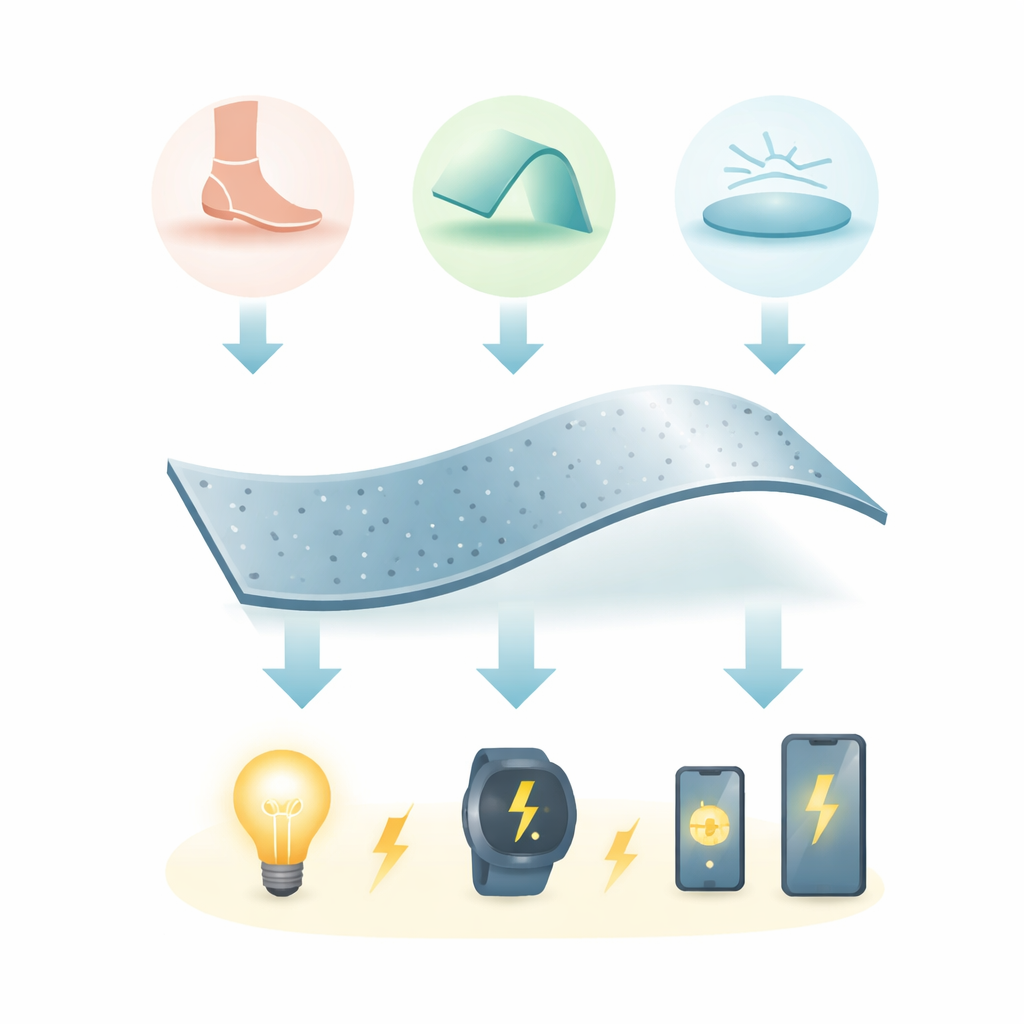
Why a Flexible Plastic Matters
Traditional materials that convert motion into electricity are often brittle ceramics, better suited to rigid sensors than to clothing, skin patches, or soft gadgets. In contrast, the plastic studied here—known as P(VDF-TrFE)—is light, flexible, and can be processed from solution like ordinary polymers. On its own, it already has some ability to generate electricity when squeezed, thanks to tiny built-in electric dipoles in its structure. The challenge is to coax as many of these dipoles as possible into an active, highly ordered arrangement, without losing the mechanical softness and durability that make plastics so attractive.
Adding Tiny Silver Helpers
The team tackled this challenge by embedding silver nanoparticles—grains of silver about 17 nanometers across—directly inside the plastic while it was being cast into thin films. They then used a high-voltage “corona” treatment to align the internal dipoles, a process somewhat like combing tangled hair with an electric comb. Structural measurements using X-ray diffraction and infrared spectroscopy showed that the added silver particles acted as tiny seeds that encouraged the polymer chains to pack into a more ordered, “electroactive” form known as the beta phase. This phase is the most efficient at turning mechanical stress into electrical charge, and its fraction increased as modest amounts of silver were added, especially around 0.28 weight percent of silver. 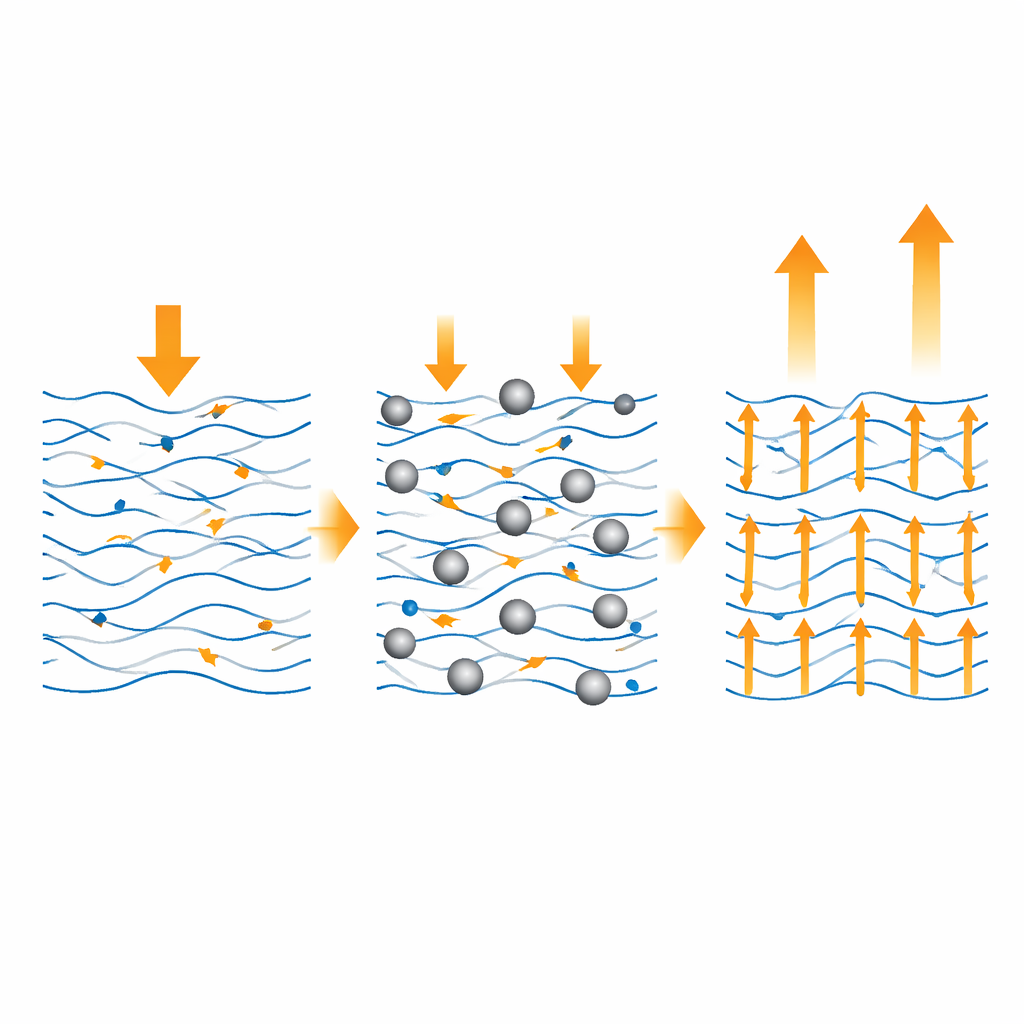
Peeking Inside with Light and Heat
To understand how these changes affect the material’s inner landscape, the researchers probed the films with ultraviolet-visible light and with a technique that tracks how frozen-in electric charge is released when the material is reheated. The optical tests revealed that the energy needed to excite electrons in the material decreased when silver nanoparticles were present, indicating the creation of new electronic states and a more ordered, less disordered structure. Thermal depolarization measurements showed that the temperature at which the material changes from a ferroelectric (strongly polar) state to a more ordinary state shifted slightly downward when silver was added. This suggests that the dipoles could reorient more easily, a useful trait for a material that must repeatedly respond to everyday motions.
From Lab Films to Real-World Force
The most practical test was whether all this structural tuning actually improved the device-relevant electrical response. After corona charging, the films were pressed with controlled forces at different temperatures, and the researchers measured the charge produced. The key performance number, called the piezoelectric coefficient d33, climbed as both pressure and temperature increased, and it rose sharply with silver content up to the optimal 0.28 weight percent. At a typical operating stress, d33 jumped from 11.7 picocoulombs per newton in the pure plastic to 38.3 picocoulombs per newton in the silver-containing composite—more than a threefold gain. Beyond this silver level, the response declined, likely because too many particles disrupt the delicate ordering that they initially helped to create.
What This Means for Future Devices
In everyday terms, the study shows that by carefully mixing a small amount of silver nanoparticles into a flexible plastic and applying a clever high-voltage treatment, scientists can make a thin film that produces much more electricity when bent or pressed. This enhanced response comes from nudging the material’s internal building blocks into a highly active arrangement and making it easier for their electric dipoles to flip under stress. Such optimized films could serve as the heart of bendable sensors, self-powered wearable electronics, and tiny generators that harvest energy from body motion, machinery vibrations, or environmental movements—helping to power the growing world of small, distributed devices without relying solely on conventional batteries.
Citation: Hassan, A., Habib, A., Fahmy, T. et al. Enhancement of the piezoelectric response of corona charged Ag/P(VDF-TrFE) nanocomposites for energy harvesting devices. Sci Rep 16, 13031 (2026). https://doi.org/10.1038/s41598-026-46151-3
Keywords: piezoelectric polymer, energy harvesting, silver nanoparticles, flexible electronics, nanocomposite films