Clear Sky Science · en
O-band DWDM data transmission with quantum dot mode-locked comb laser and semiconductor optical amplifier
Why Faster Data Links Matter
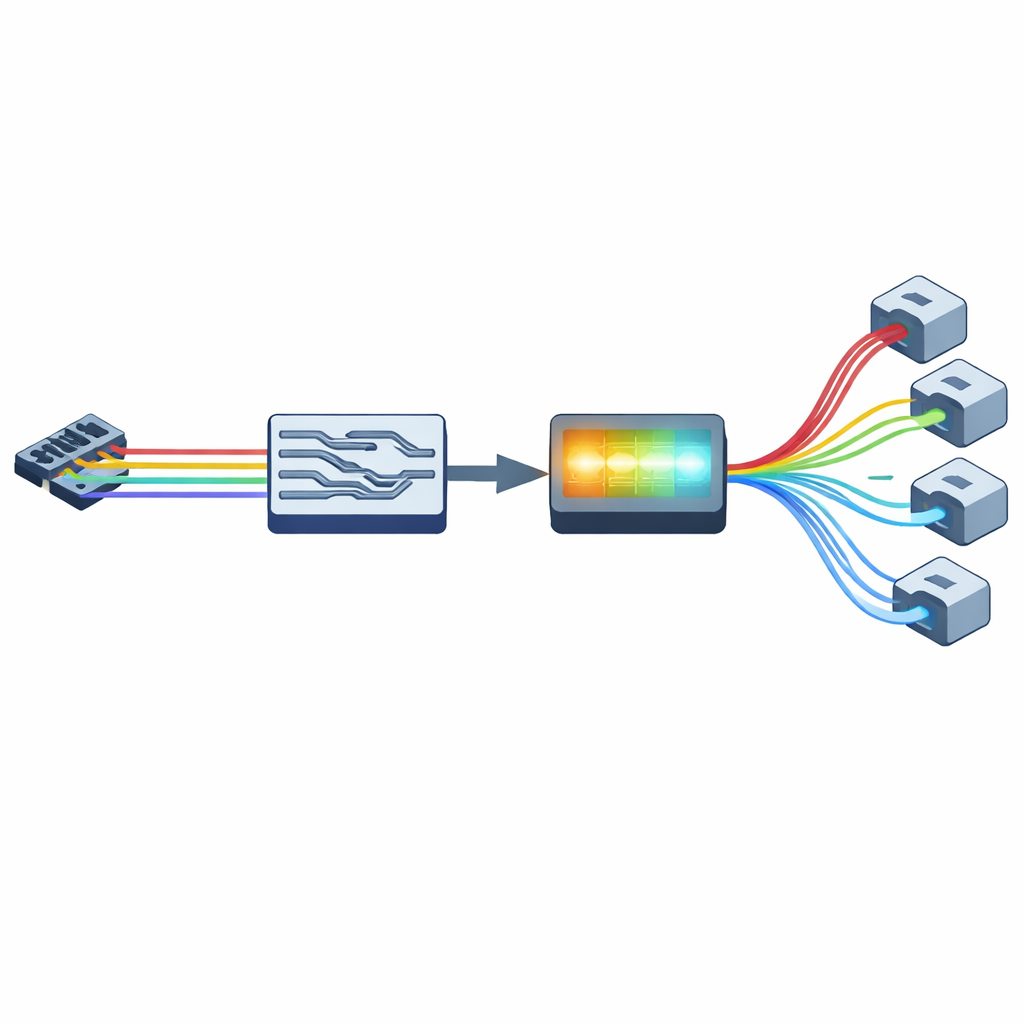
Modern cloud services, streaming, and especially artificial intelligence rely on connecting huge numbers of computers with extremely fast data links. These links increasingly use light rather than electrical signals, sending many colors of laser light through a single hair-thin glass fiber. But today’s approach—using one separate laser per color—becomes bulky, power-hungry, and expensive as data demands grow. This study explores a way to replace a whole bank of lasers with a single compact chip and amplifier that can feed dozens of high‑speed data channels at once in a key telecom window called the O‑band, promising simpler and more efficient connections inside data centers.
One Tiny Chip, Many Colors of Light
The core idea is a “comb laser,” a semiconductor chip that naturally emits many evenly spaced colors of light, like the teeth of a comb in the frequency domain. Instead of carefully building and aligning sixteen or more individual lasers, engineers can use one chip whose internal structure produces multiple stable colors simultaneously. In this work, the authors use quantum dots—tiny islands of semiconductor material only nanometers across—as the light‑generating medium inside the chip. By carefully designing the length of the laser cavity and adding a special section that enforces synchronized operation, they create a source with 11 to 23 clean color lines, each separated by 100 gigahertz, suitable for modern dense wavelength‑division multiplexing (DWDM) systems in the O‑band.
Keeping the Signals Clean and Strong
For each color to carry a fast data stream, its brightness must be stable and its power high enough to be detected after traveling through optics and fiber. A key challenge for comb lasers has been noise: in ordinary multimode devices, the individual colors fluctuate strongly. Here, the team operates the laser in a mode‑locked regime where all colors are phase‑locked to each other, dramatically suppressing intensity noise on each line. They measure both the relative intensity noise and the bit error rate for data streams encoded on individual colors and find that the errors follow a Gaussian noise pattern closely tied to the optical power of each line. Brighter lines show lower error rates, reaching levels as low as one error in ten billion bits for the strongest modes.
Boosting Dozens of Channels with One Amplifier
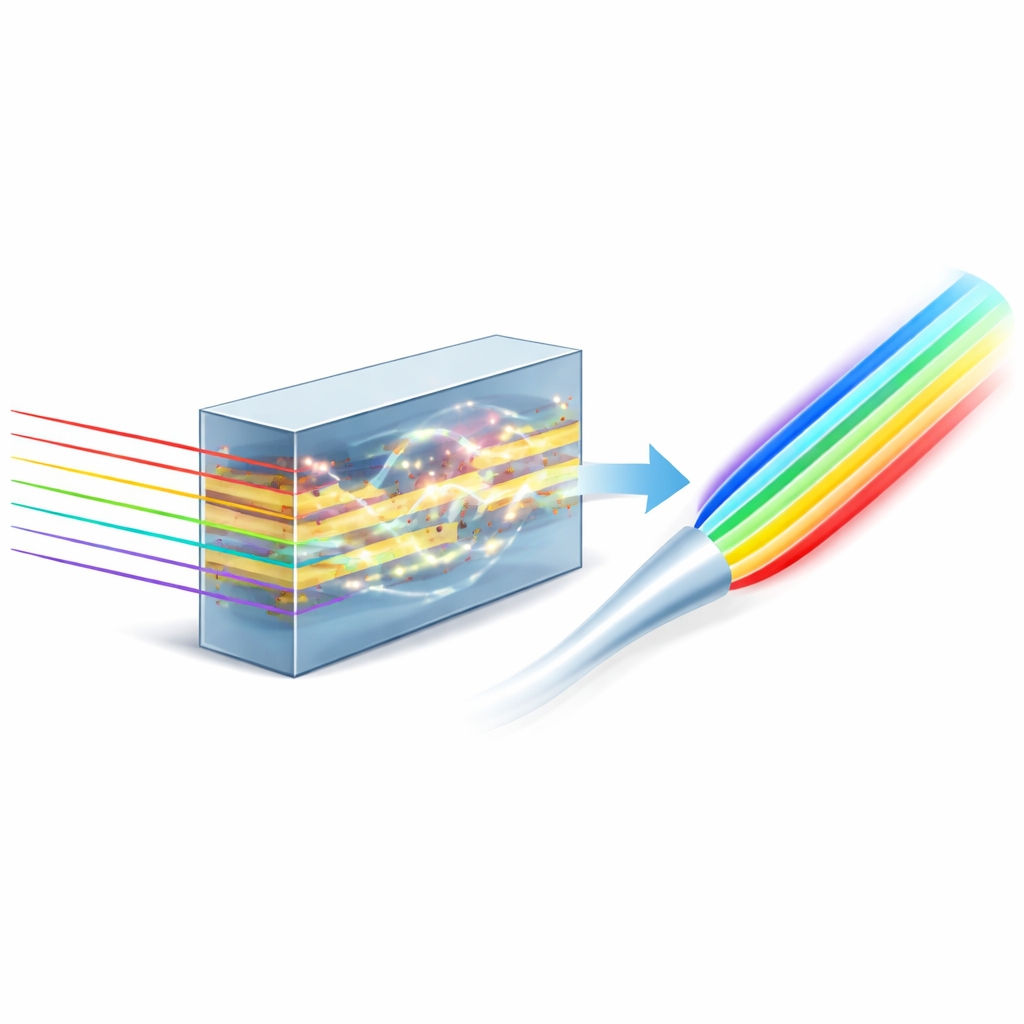
Another bottleneck is that light passing through a photonic integrated circuit—where the signals are split, modulated with data, and recombined—can lose tens of decibels of power. Traditional optical amplifiers that could restore this power in the O‑band tend to be bulky or noisy. The authors address this with a compact quantum‑dot semiconductor optical amplifier on a chip. They show that more than twenty comb lines, weakened after the photonic circuit, can be simultaneously re‑amplified by a single low‑noise amplifier. In laboratory tests, they modulate all lines with a 106‑gigabaud four‑level pulse amplitude (PAM4) format, send the combined signal through kilometers of fiber to mimic independent data streams, and then boost it again with a second amplifier before detection. Depending on how many lines and how strongly they are used, the total data rate reaches up to 2.3 terabits per second while staying within the limits where modern error‑correction codes can fully recover the information.
Adapting to Future Network Hardware
Today’s mass‑produced photonic chips are optimized for relatively coarse spacing between colors, and using very closely packed lines can cause crosstalk. To align with existing and emerging hardware, the researchers also prototype shorter comb lasers whose cavity lengths are trimmed to increase the spacing between colors to 138, 163, and 216 gigahertz. As the spacing grows, fewer low‑noise lines fit under the gain curve, but the remaining lines still support high‑speed data transmission with acceptable error rates. The study discusses how improving the laser’s gain or mirror reflectivity—or using more advanced mode‑locking geometries—could further increase spacing without sacrificing performance.
What This Means for Future Data Centers
In simple terms, the authors show that one tiny quantum‑dot comb laser chip, paired with an equally compact semiconductor amplifier, can replace a whole rack of individual lasers in short‑reach fiber links. Their system delivers many clean colors of light, each able to carry 106‑gigabit‑per‑second streams, and maintains error rates low enough for standard correction schemes to clean up the remaining mistakes. By simplifying the light source and amplification stages, this approach could reduce power consumption, cost, and physical complexity in future data‑center interconnects, helping keep pace with the exploding data needs of AI and cloud computing while keeping hardware compact and efficient.
Citation: Belykh, V.V., Buyalo, M.S., Rautert, J. et al. O-band DWDM data transmission with quantum dot mode-locked comb laser and semiconductor optical amplifier. Sci Rep 16, 12744 (2026). https://doi.org/10.1038/s41598-026-46147-z
Keywords: optical communications, frequency comb lasers, data center interconnects, semiconductor optical amplifiers, dense wavelength division multiplexing