Clear Sky Science · en
Mechanical properties and microscopic features of LBM-GGBS solidified saline soil in seasonally frozen areas
Why frozen salty ground matters
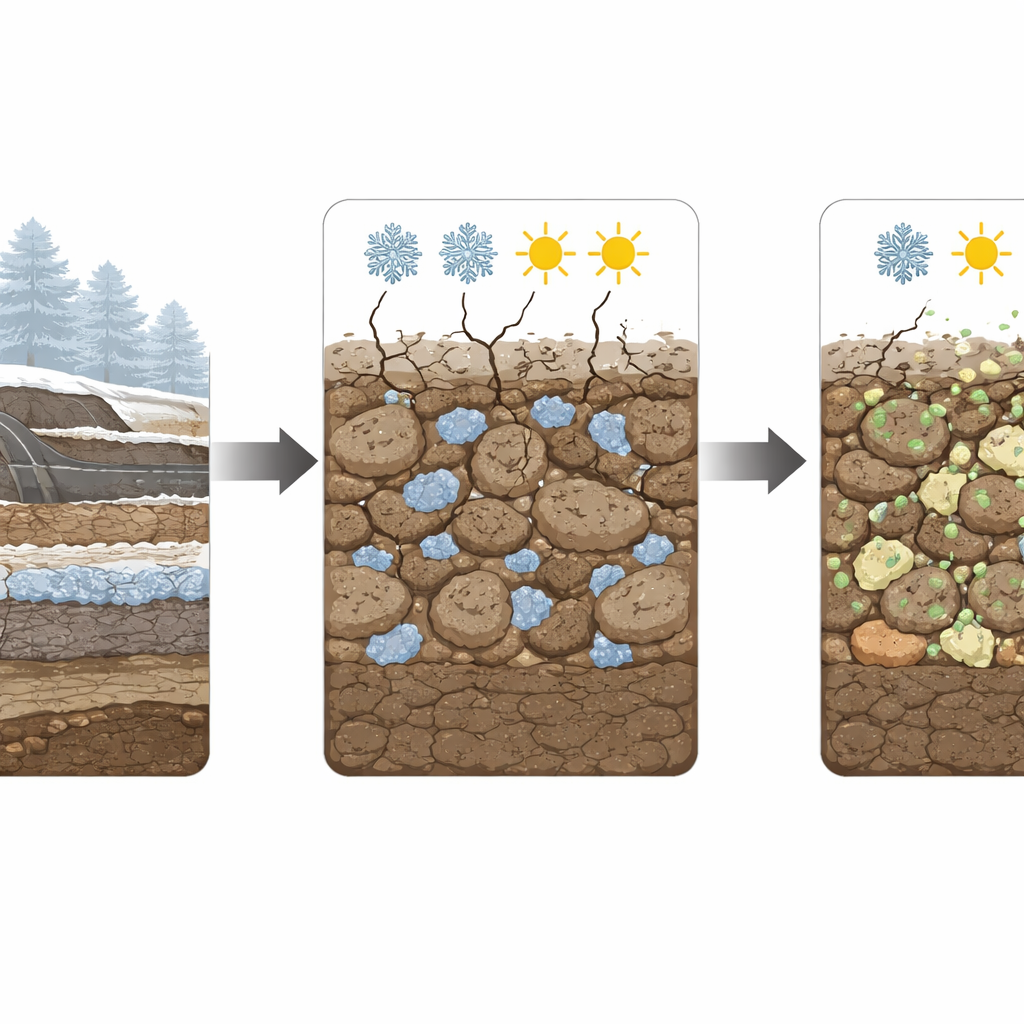
Across the world’s dry regions, huge areas of land contain salty soils that expand, crack and sink as they freeze in winter and thaw in spring. In places like northwestern China, roads and railways must cross this unstable ground, leading to bumps, mud pumping and costly repairs. Engineers normally strengthen soil with ordinary cement, but it is energy-intensive and can perform poorly in very salty conditions. This study explores a cleaner alternative binder made from industrial by‑products to see whether it can keep salty soil strong and safe through many freeze–thaw cycles.
A new way to strengthen salty soil
The researchers focused on a mixture of two powders: ground granulated blast furnace slag, a by‑product from steelmaking, and light‑burned magnesia, a reactive form of magnesium oxide. When mixed with water and soil, these materials can harden around the grains, somewhat like a low‑carbon cement. The team collected chloride‑rich saline soil from a seasonally frozen area in Shaanxi Province, China, then blended in different amounts and ratios of the slag–magnesia binder. They shaped the mixtures into small cylinders, cured them for four weeks, and then exposed them to repeated freezing at about minus 20 degrees Celsius and thawing at room temperature to mimic several winters.
How strong and tight the soil remained
After 0, 2, 4, 6, 8 and 10 freeze–thaw cycles, the team measured how much squeezing force the samples could withstand before breaking, how easily water could pass through them, and how much chloride washed out. As expected, all samples lost some strength in the first two cycles, when ice growth and salt movements damage the internal structure. But specimens with higher binder content, especially those containing 12 percent binder with a slag‑to‑magnesia ratio of 7 to 1, still remained impressively strong. This optimal mix kept a strength of about 3 megapascals after ten cycles—four times the requirement for the upper base layer of a highway. Water flow through the treated soil stayed low and changed little with cycling, especially in richer mixes, showing that the hardened network stayed reasonably dense and crack‑resistant.
What happens inside at the tiny scale
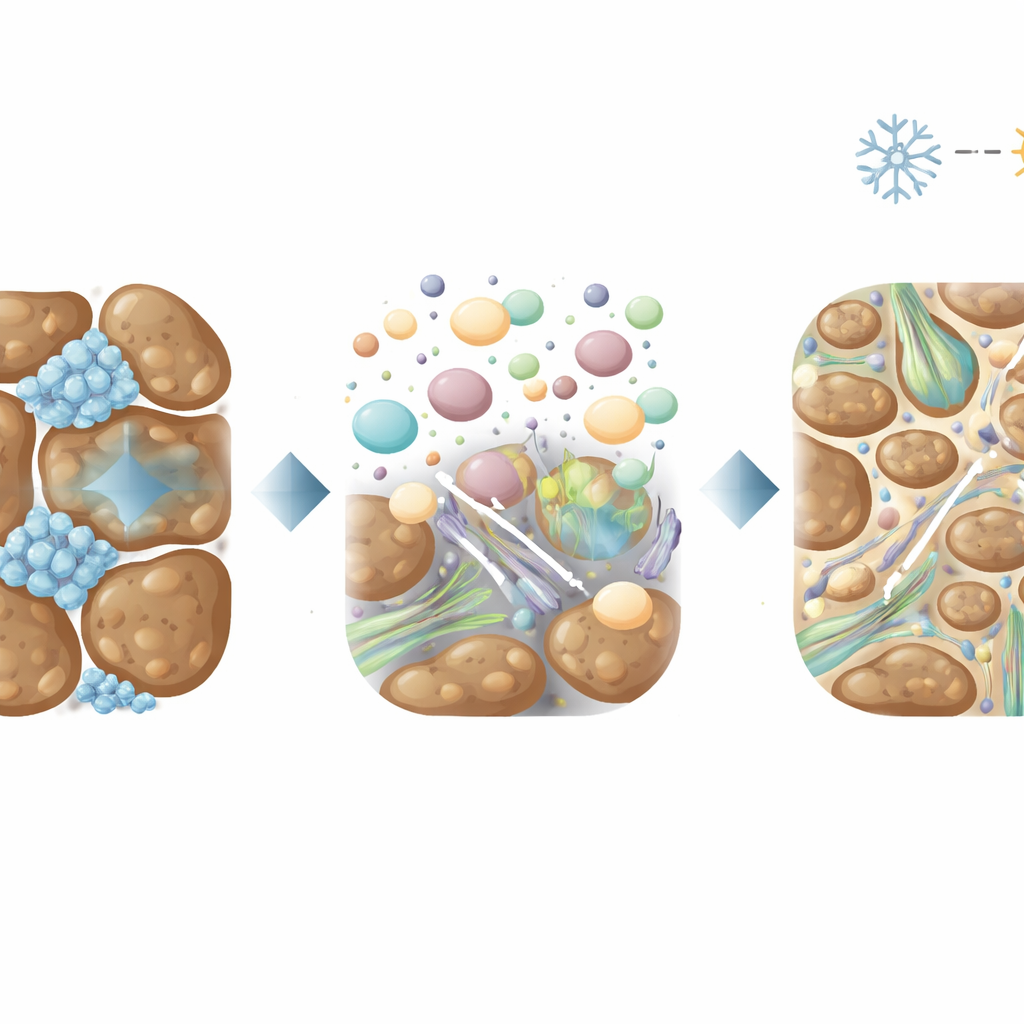
To see why the treated soil endured freezing so well, the researchers examined its inner structure using electron microscopes and pore‑size measurements. They found that the slag and magnesia reacted with water and dissolved ions in the soil to create several new mineral gels and crystals that knit the grains together. These included dense, web‑like layers that wrapped soil particles and filled fine cracks, as well as needle‑ and plate‑shaped crystals that bridged gaps. Over freeze–thaw cycling, some small pores merged into slightly larger ones, but the overall pore volume changed only modestly. The hardened framework remained mostly intact, limiting the growth of damaging ice lenses and keeping the soil from crumbling.
Trapping salt instead of letting it roam
The salty soil originally contained a high level of chloride that could easily dissolve and move with water, worsening frost damage and threatening nearby structures or groundwater. After treatment with the slag–magnesia binder and curing, the amount of chloride that leached out dropped by about 43 percent. Microscopic and chemical analyses showed that much of the chloride became locked into newly formed crystals that also contain calcium, aluminum and sulfate. These minerals remained stable even after many freeze–thaw cycles, so further cycling did not release extra chloride. In effect, the binder both strengthened the soil and captured much of its most troublesome salt.
What this means for cold‑region building
For non‑specialists, the message is straightforward: by recycling steelmaking slag and using a reactive magnesia powder, engineers can turn problematic salty ground into a tougher, less leaky and more environmentally friendly foundation material, even in places that freeze and thaw all winter. The right mix—about 12 percent of this binder with more slag than magnesia—kept the soil strong well beyond road‑building standards, restricted water movement, and tied up roughly three‑quarters of the chloride. This approach could help expand safe construction in cold, arid regions while reducing reliance on conventional cement and making good use of industrial waste.
Citation: Chen, S., Ren, P., Wang, J. et al. Mechanical properties and microscopic features of LBM-GGBS solidified saline soil in seasonally frozen areas. Sci Rep 16, 10928 (2026). https://doi.org/10.1038/s41598-026-46145-1
Keywords: saline soil, freeze–thaw durability, ground improvement, industrial by‑product binder, chloride stabilization