Clear Sky Science · en
Accurate classification and prediction of knee osteoarthritis based on Al-Biruni Earth Radius metaheuristic optimizer and LSTM classifier
Why This Matters for Aching Knees
Knee pain from osteoarthritis affects hundreds of millions of people and can eventually lead to joint replacement. Today, doctors still rely heavily on their eyes to read X-ray images, which can miss early disease and depend on individual judgment. This study shows how a carefully designed artificial intelligence (AI) system can read knee X-rays with striking accuracy, offering a faster, more consistent way to spot trouble early and help patients avoid severe disability.
Understanding Wear and Tear in the Knee
Knee osteoarthritis is a long-term breakdown of the smooth cartilage that cushions the joint, followed by changes in the underlying bone. It is especially common in older adults, women after menopause, and people with obesity or prior knee injuries. Many patients are diagnosed only after the damage is already advanced, when pain and stiffness make daily tasks difficult and joint replacement may be the only option. Existing methods, which combine symptoms, physical examination, and visual inspection of X-rays or MRI scans, are imperfect and often detect the disease relatively late in its course.
How AI Learns to Read Knee X-Rays
The researchers built a multi-step AI pipeline that takes raw knee X-ray images and gradually turns them into a simple decision: osteoarthritis or normal. First, they used large, pre-trained image-recognition networks—AlexNet, VGG19, and GoogleNet—to automatically extract visual patterns from each X-ray. These networks, originally trained on everyday photographs, can recognize subtle shapes and textures such as joint space narrowing and small bony outgrowths that are hard to quantify by eye. Among these options, GoogleNet produced the most informative image features for distinguishing diseased from healthy knees. 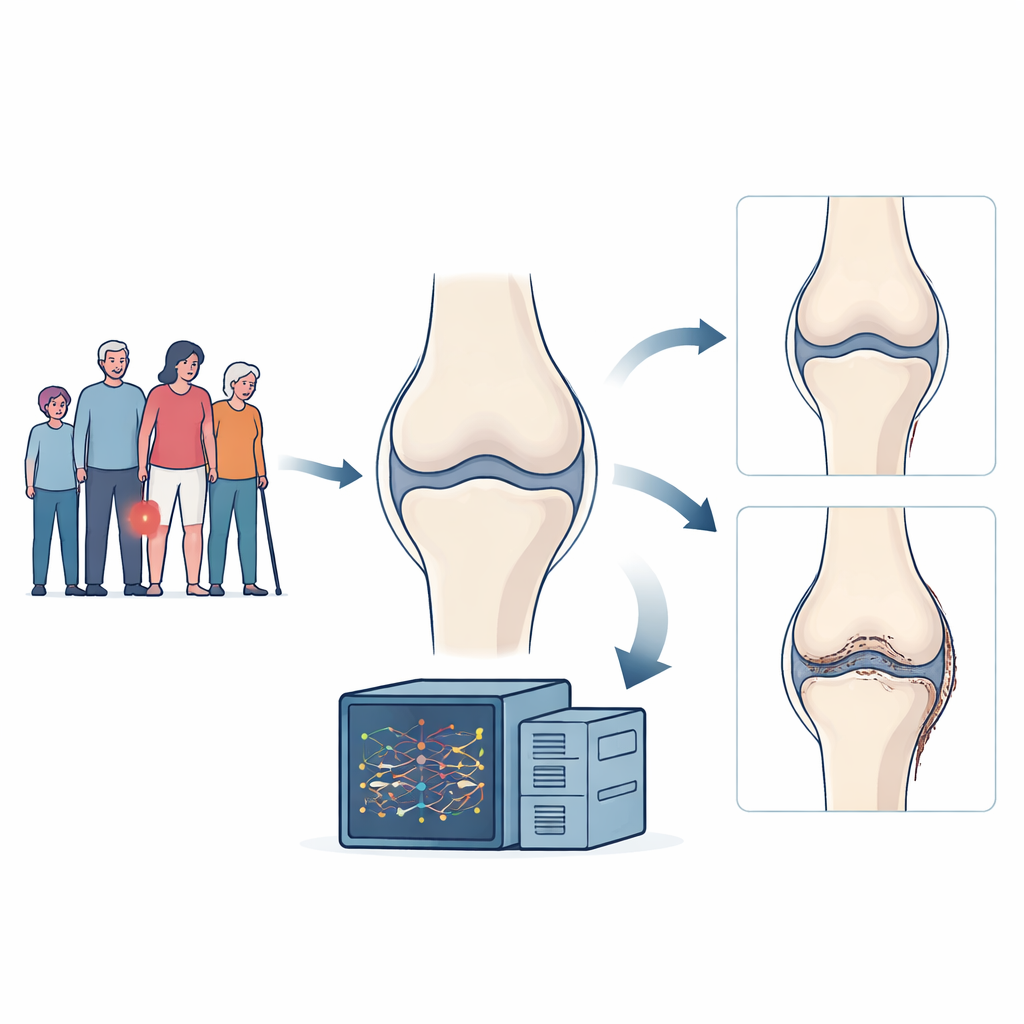
Letting a Smart Filter Pick the Most Telling Clues
Modern image networks can generate thousands of numerical features from a single picture, but not all of them are useful. Feeding everything into a classifier can add noise, slow computation, and even reduce accuracy. To solve this, the authors used a search strategy called the Al-Biruni Earth Radius (BER) optimizer in a binary form. This algorithm behaves like a swarm of digital explorers that continually split their efforts between scanning new regions of the “solution space” and refining promising ones. Here, each explorer represents a different subset of image features. Over many rounds, the algorithm learns which combinations of features best separate normal from osteoarthritic knees and discards redundant or unhelpful information.
Turning Features into a Diagnosis Over Time-Like Steps
Once the most relevant features are selected, they are passed to a type of neural network known as long short-term memory (LSTM). Although LSTMs are usually used for time series, in this study the feature values are arranged like a sequence. The LSTM processes this ordered list step by step, deciding at each stage which information to retain and which to forget. In effect, it acts as a powerful filter that captures higher-level relationships among features, rather than looking at each number in isolation. The BER optimizer is then used a second time to fine-tune the internal settings of the LSTM, balancing how quickly it learns, how complex it becomes, and how well it generalizes to new X-rays.
How Well Does the System Perform?
The authors trained and tested their system on 3,835 labeled knee X-rays from a public dataset, split into separate groups for training, validation, and final testing. They compared several combinations of optimizers and classifiers, including multilayer perceptron networks and LSTMs guided by different search methods such as particle swarm and Harris hawks optimization. The winning design—GoogleNet features filtered by the binary BER method and classified by a BER-tuned LSTM—achieved about 99.5% accuracy on the test set. It also showed very high sensitivity and specificity, meaning it rarely missed diseased knees and seldom misclassified healthy ones. Statistical tests (ANOVA and Wilcoxon signed-rank) confirmed that these gains were not due to chance.
Speed, Efficiency, and Reliability
Beyond accuracy, the team analyzed computing cost and robustness. They measured how much processing power, memory, and time each optimization method required. The BER-based approach reached top performance while using fewer resources and converging faster than other techniques. The model also handled the natural imbalance between normal and osteoarthritic images well: its balanced accuracy nearly matched its overall accuracy, showing that it did not simply favor the more common class. Additional checks with repeated runs, confidence intervals, and visual diagnostics of errors indicated that the system’s behavior was stable and reproducible. 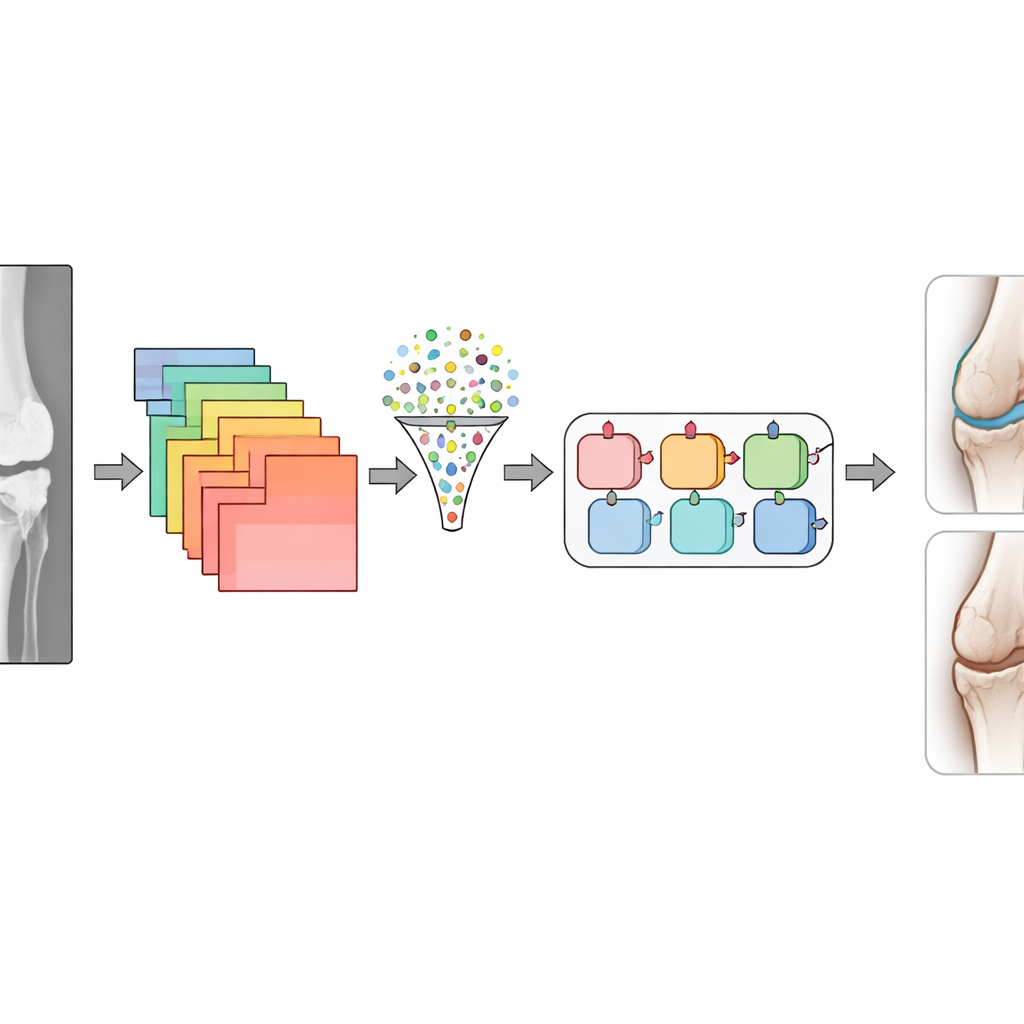
What This Could Mean for Patients
In plain terms, this work demonstrates that an AI system can examine standard knee X-rays and decide, with very few mistakes, whether osteoarthritis is present. By smartly choosing which image details to trust and carefully tuning its decision-making steps, the method outperforms many existing AI approaches in the field. While the study is based on a single dataset and still needs testing across hospitals, age groups, and imaging devices, it points toward future clinics where a computer could quickly flag early joint damage for doctors, helping them intervene sooner and potentially delay or avoid knee replacement surgery.
Citation: Diab, A.G., El-Kenawy, ES.M., Areed, N.F.F. et al. Accurate classification and prediction of knee osteoarthritis based on Al-Biruni Earth Radius metaheuristic optimizer and LSTM classifier. Sci Rep 16, 13013 (2026). https://doi.org/10.1038/s41598-026-46131-7
Keywords: knee osteoarthritis, medical imaging AI, deep learning, X-ray analysis, metaheuristic optimization