Clear Sky Science · en
ENSO-modulated heat source and moisture sink of Asian monsoon and its impact on rice production
Why Oceans and Winds Matter for Your Rice Bowl
Rice is the daily staple for billions of people, especially across Asia. Yet this familiar grain depends on a delicate balance of heat, wind, and moisture in the atmosphere. This study explores how giant, slow-moving air systems over the oceans and continents, together with the El Niño–Southern Oscillation (ENSO), shape the Asian monsoon and, in turn, the success or failure of rice harvests. By separating the effects of climate from those of modern farming technology, the authors reveal when nature truly helps rice production—and when rising yields are masking growing climate risks.
Big Weather Engines Above Land and Sea
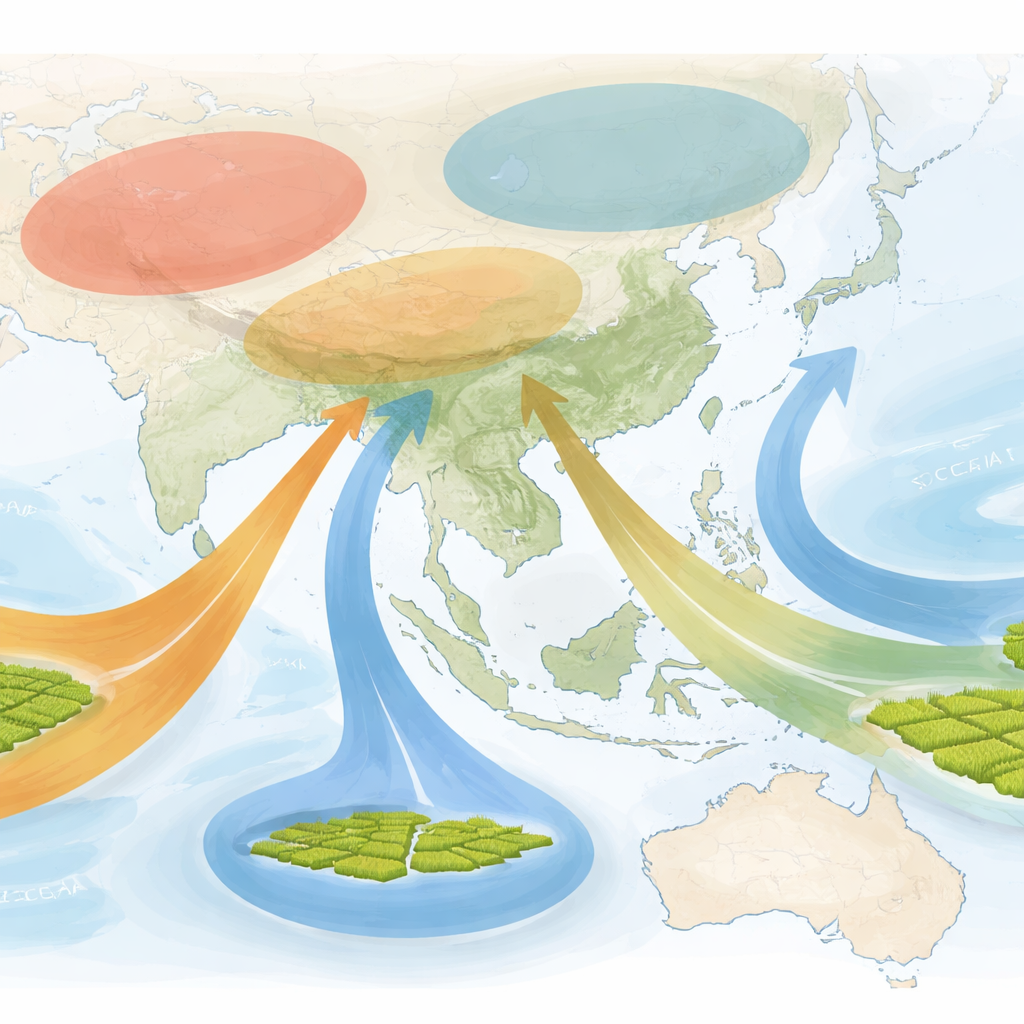
The monsoon is not just a seasonal rainstorm; it is driven by several vast high-pressure systems that steer heat and moisture. Over the high Tibetan Plateau, a warm air dome acts as a heat source and moisture sink that helps pull moist air toward Asia in summer. Far to the south in the Indian Ocean, the Mascarene High supplies moisture, while over the western Pacific another high guides humid air toward East and Southeast Asia. In winter, the frigid Siberian High becomes a major source of cold, dry air. This study looks at six decades of data to see how temperature and pressure in these regions have changed and how those changes relate to rice yields in Asia, China, and India.
Rising Temperatures and Shifting Monsoons
Analyses of climate records from 1961 to 2023 show that oceans and land in these key regions have been steadily warming, and surface pressures have generally increased. Warmer seas in the southern Indian Ocean and western Pacific and higher pressures over the Tibetan and Siberian regions point to stronger and reorganized circulation patterns. These shifts can bring earlier monsoon onset, different rainfall paths, and milder winters. Over the same period, rice yields have climbed sharply: roughly from 2 to 5 tons per hectare across Asia, with China more than tripling its yields thanks to irrigation and technology, and India improving more slowly because of its heavier dependence on rainfall. At first glance, it appears that warming and rising yields go hand in hand.
Untangling Climate from Technology
To see whether climate itself is helping or hurting rice, the authors used statistical tools that examine relationships between groups of variables. They related rice yields in Asia, China, and India to temperatures and pressures in the four high-pressure regions, treating summer and winter separately. They also removed long-term yield trends due to better seeds, irrigation, and management, leaving behind “residuals” that mainly reflect climate. The results show that in summer, rice production is tightly linked to ocean-driven conditions: sea temperatures and pressures in the Mascarene and West Pacific regions strongly shape monsoon moisture reaching the fields. In winter, land-based systems, especially the Siberian High and continental pressures, play a larger role, showing a clear shift from ocean control in summer to land control in winter.
El Niño, La Niña, and Hidden Risks
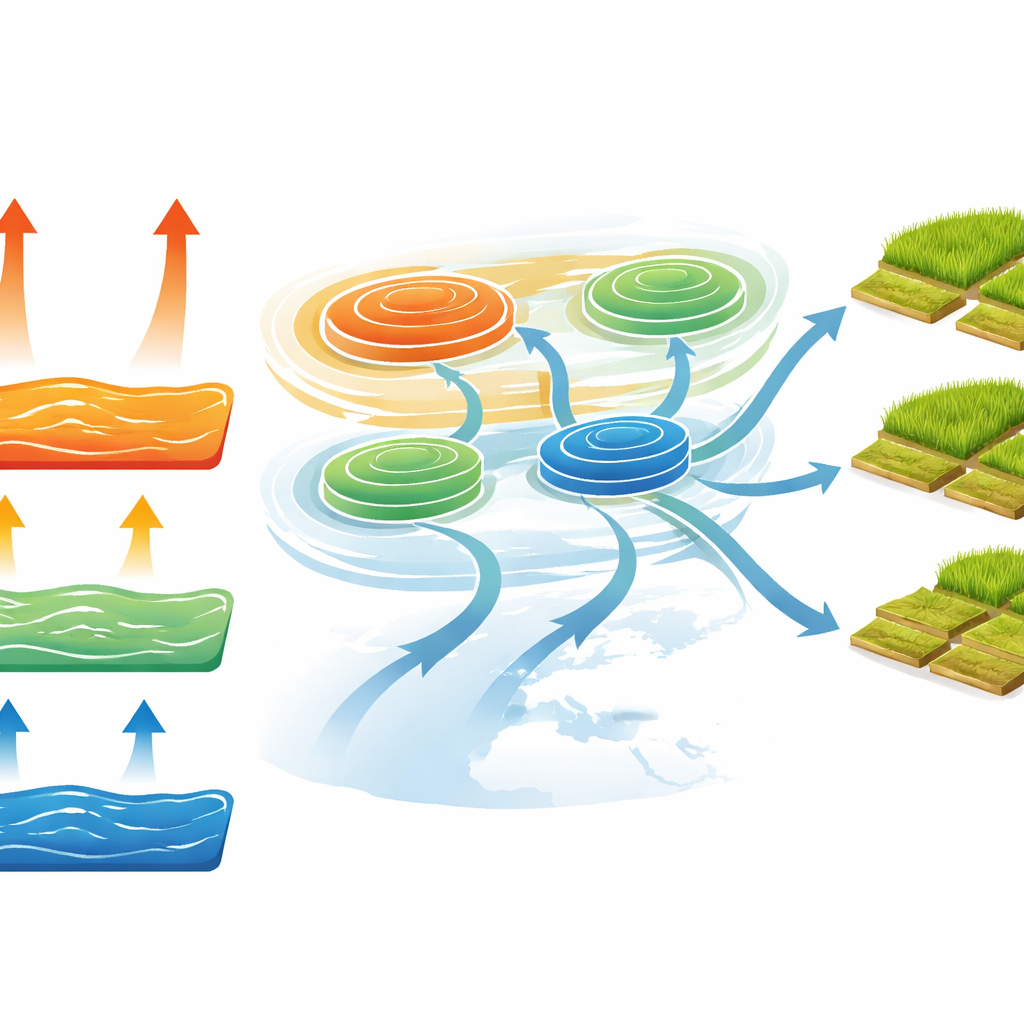
The team then focused on how different ENSO phases—El Niño, La Niña, and neutral years—change this picture for the summer growing season. During El Niño, total rice yields kept rising, but once technological trends were removed, the remaining climate-driven part of yield actually declined. In other words, farmers and new technology have been compensating for unfavorable El Niño conditions, which tend to weaken the monsoon and add heat stress. Neutral years showed weak and often insignificant links between climate and rice yields, suggesting that local management matters more. La Niña years stood out: both total yields and the climate-driven component increased, with strong connections between pressure over the Tibetan Plateau and western Pacific, ocean warmth, and higher rice output. Only during La Niña does the climate system itself reliably boost production across Asia, independent of technology.
What This Means for Future Harvests
For non-specialists, the key message is that not all good harvests are created equal. Many recent gains in rice production come from human innovation rather than kinder weather. This study shows that the natural climate provides a consistent helping hand only during La Niña years, when ocean and atmospheric patterns align to strengthen the monsoon and favor rice growth even after accounting for technology. El Niño and neutral years, by contrast, often hide their negative or weak influence behind steady improvements in farming. As the climate continues to warm, understanding these subtle patterns can help planners and farmers anticipate risk, make better use of seasonal forecasts, and protect the staple crop that feeds nearly half the world.
Citation: Sinha, M., Jha, S. & Kumar, A. ENSO-modulated heat source and moisture sink of Asian monsoon and its impact on rice production. Sci Rep 16, 10955 (2026). https://doi.org/10.1038/s41598-026-46128-2
Keywords: Asian monsoon, ENSO, rice yields, climate variability, high-pressure systems