Clear Sky Science · en
Ultrasound biomechanical indices in carotid artery disease: evaluation of shear modulus, circumferential stress, longitudinal stress, and stiffness index—a cross-sectional study
Why this matters for heart and brain health
A stroke or heart attack often starts quietly, years before any warning signs. One early clue is how stiff and stressed our neck arteries become as fatty deposits build up. This study shows that routine ultrasound scans can do more than just measure how narrow an artery has become; they can also reveal how the artery wall itself is holding up under pressure, offering doctors a richer picture of risk and treatment options.
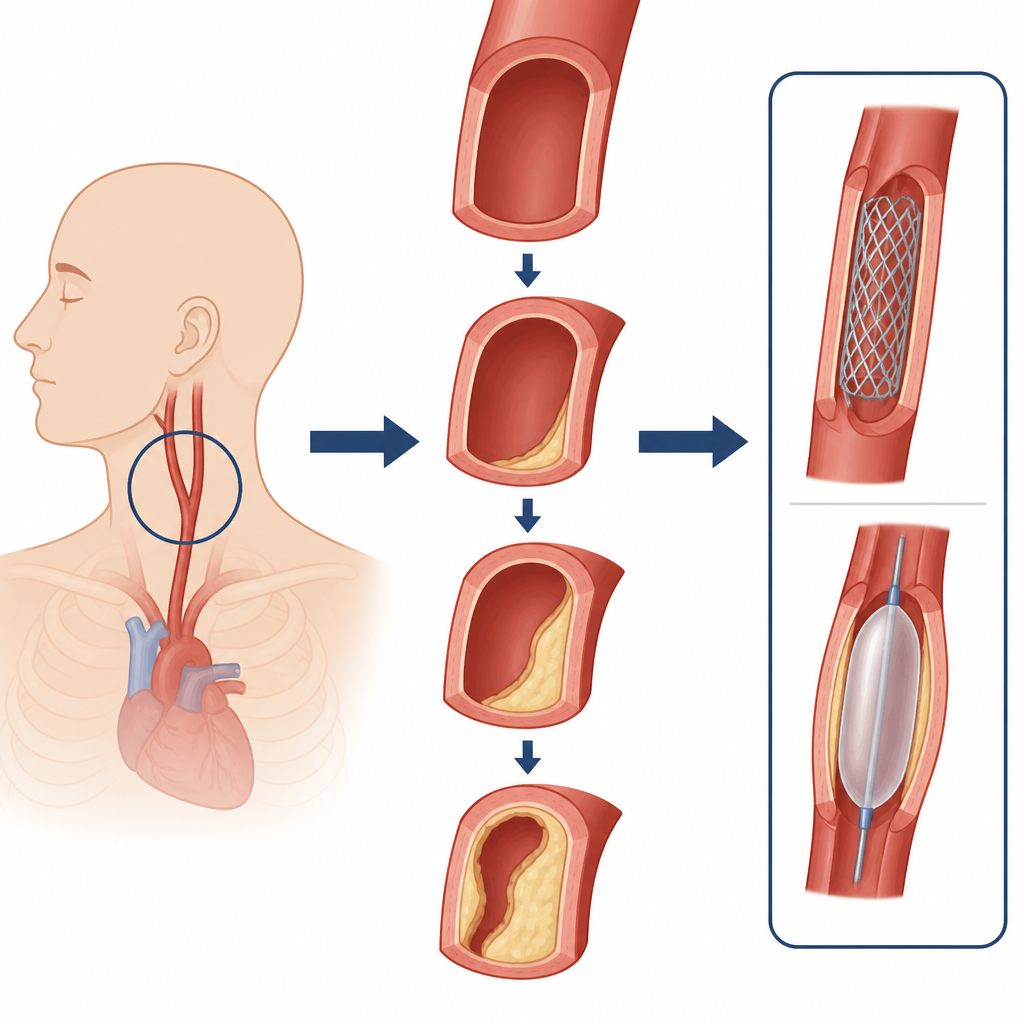
Looking inside the necks of volunteers
The researchers focused on the left common carotid artery, a major blood vessel in the neck that is easy to see with ultrasound and closely linked to stroke risk. They studied 136 men between 40 and 60 years old, splitting them into four groups: healthy controls and patients with mild, moderate, or severe narrowing of this artery. All volunteers underwent careful ultrasound exams in a controlled lab setting, with heart rate and arm blood pressure recorded before imaging to keep conditions as steady and comparable as possible.
Turning moving pictures into numbers
Instead of relying on manual, ruler-like measurements from ultrasound images, the team built computer programs to track the artery wall frame by frame over several heartbeats. These tools automatically detected the inner and outer edges of the vessel, measured wall thickness, and followed tiny up-and-down and along-the-vessel motions. They also pulled blood flow speeds from Doppler ultrasound. Using these building blocks plus blood pressure, the researchers calculated several biomechanical numbers: how stiff the artery wall was, how much stress it felt around its circumference and along its length, and how resistant it was to being sheared or distorted.
What happens as disease gets worse
The results showed a clear pattern. From healthy subjects through mild, moderate, and severe disease, the artery wall grew thicker and all of the stress and stiffness measures rose steadily. The stiffness index, circumferential stress, longitudinal stress, and a measure called the shear modulus were all significantly higher in more advanced disease. These four numbers moved together: when the shear modulus was higher, so were the other three stresses, suggesting that they capture related aspects of how the diseased wall bears the heavy mechanical load of each heartbeat.
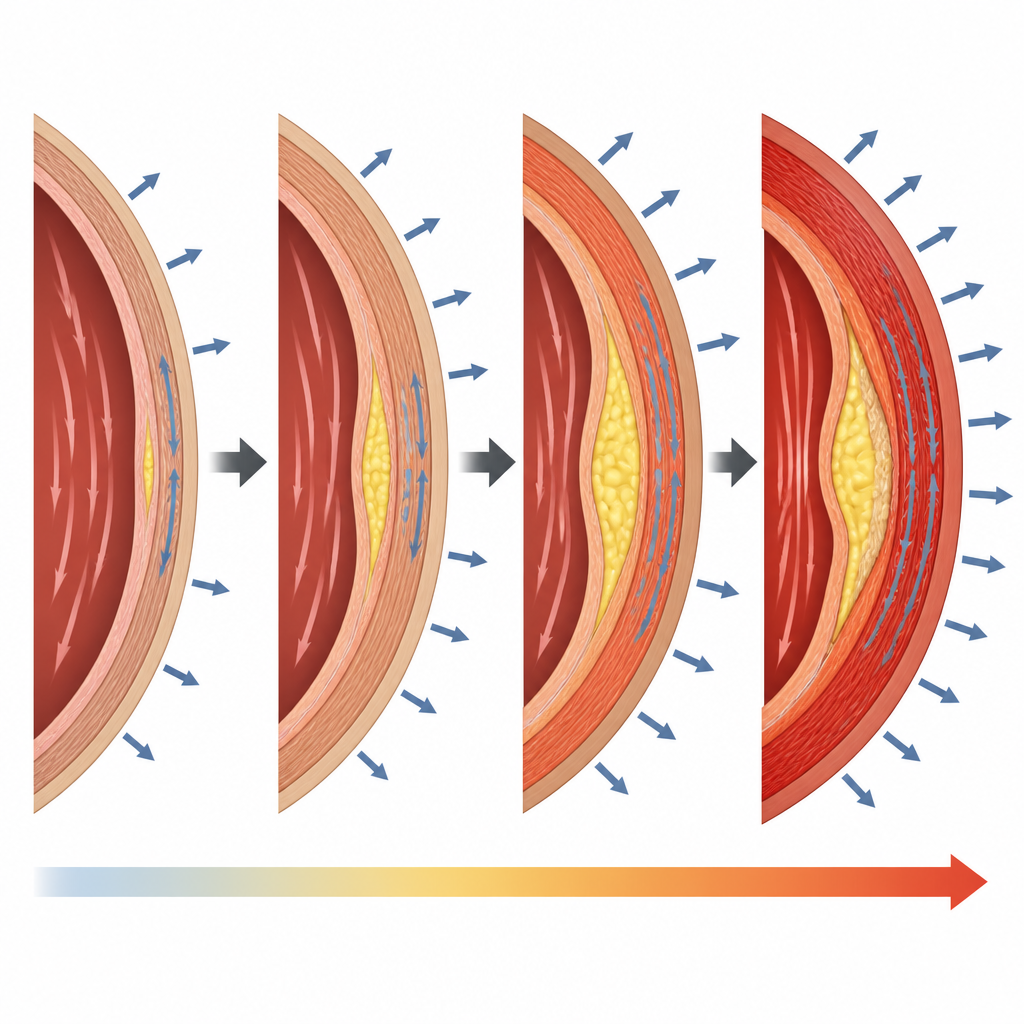
From research numbers to bedside choices
Beyond spotting trends, the team tested how well these ultrasound-based measures could sort people by disease stage. Using statistical methods, they showed that each index alone could distinguish healthy from diseased arteries, and could separate mild, moderate, and severe narrowing with respectable accuracy. The shear modulus performed slightly better than the others, but all four contributed useful information. Importantly, these measures were reproducible between different observers and repeated scans, a key requirement if they are to inform real clinical decisions rather than remain a research curiosity.
How this could guide future treatments
In plain terms, this work suggests that doctors may one day use standard ultrasound not only to see whether a carotid artery is blocked, but also to understand how fragile or stiff the artery wall is at that spot. Knowing where the wall is most stressed and least resilient could help choose safer locations for balloon angioplasty or stent placement, and identify artery segments at higher risk of cracking or shedding dangerous debris. While the methods still need broader testing in women and more diverse populations, they offer a promising path toward more personalized stroke prevention, using information already hidden inside familiar ultrasound images.
Citation: Ghahremani, F., Mohammadi, A., Roozpeykar, S. et al. Ultrasound biomechanical indices in carotid artery disease: evaluation of shear modulus, circumferential stress, longitudinal stress, and stiffness index—a cross-sectional study. Sci Rep 16, 15142 (2026). https://doi.org/10.1038/s41598-026-46125-5
Keywords: carotid artery, atherosclerosis, ultrasound, arterial stiffness, stroke risk