Clear Sky Science · en
Technical validation of a multimodal emotion-adaptive biofeedback system for autonomic regulation using guided breathing
Why calmer breathing and mood tracking matter
Stress shows up in our bodies long before we notice it in our thoughts. Our heart, breathing, and even the sweat on our skin quietly reflect how tense or relaxed we are. This study presents a new wearable system that listens to those signals and gently guides a person’s breathing in real time, while also taking their emotional comfort into account. It aims to make stress-reducing breathing exercises easier, more personalized, and better suited for everyday digital health tools.
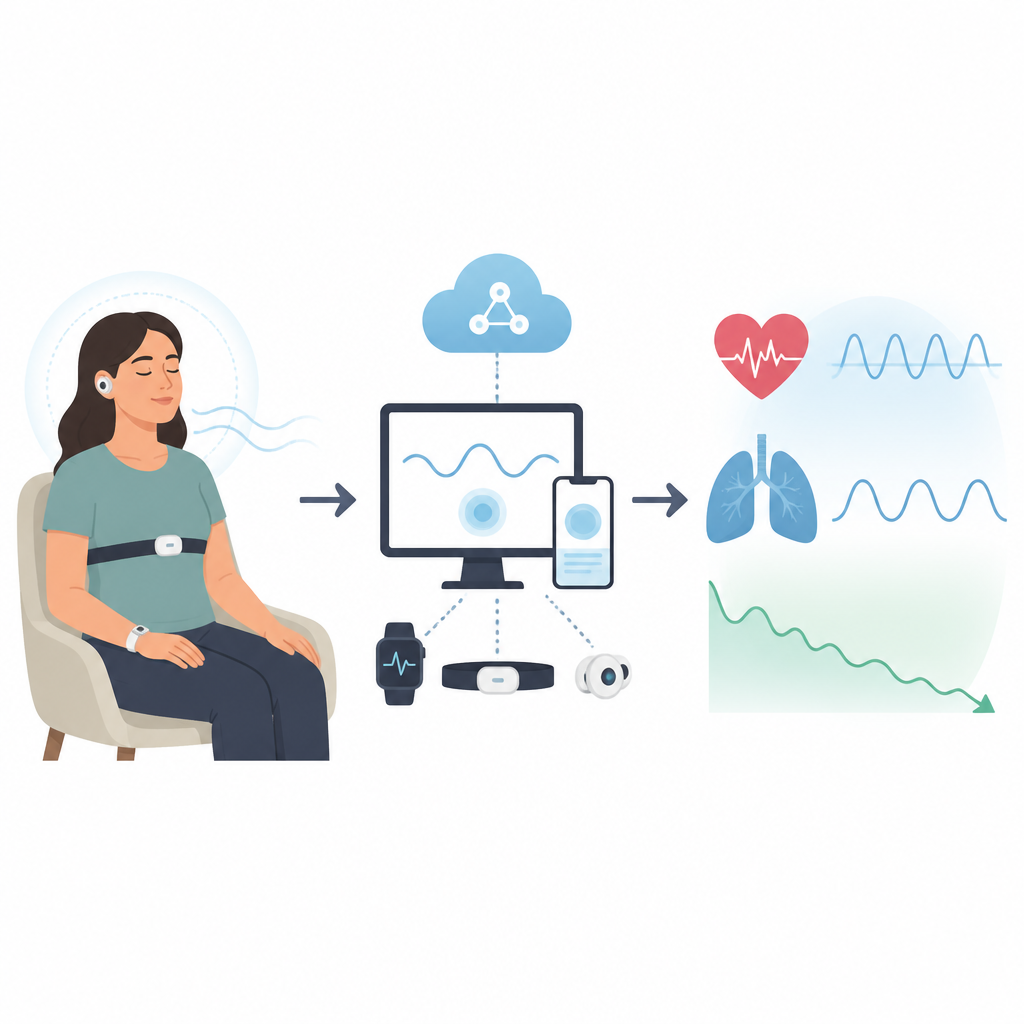
How current breathing gadgets fall short
Many popular apps and devices already offer slow breathing exercises, often by asking users to match their breath to a moving circle or a soothing sound. These tools can help, but they usually follow a fixed script and do not check how the body is actually responding. They rarely adjust to the person’s own ideal breathing speed, and they ignore signs that the pace may feel uncomfortable or emotionally stressful. As a result, people may drop out, or the exercise may not fully tap into the body’s natural calming systems.
A new all-in-one sensing and feedback system
The researchers built a multimodal biofeedback setup that pulls together several body signals at once. A small motion sensor on the chest tracks breathing; a lightweight heart monitor records the electrical activity of the heart; and a pair of skin electrodes measures tiny changes in how well the skin conducts electricity, which rises during stress. At the same time, a camera watches facial expressions and uses artificial intelligence to estimate whether the person looks calm or tense. A central computer collects all these streams, cleans up noise and motion artifacts, and summarizes how the body’s automatic nervous system is behaving moment by moment.
Breathing guidance that listens to your feelings
At the heart of the system is an adaptive breathing coach that runs during a 20 minute session. It starts from the person’s usual breathing rate and slowly nudges it toward a slower pattern known to support strong, steady swings in heart rate, a sign of healthy balance between body “gas pedal” and “brake” responses. Unlike fixed routines, this algorithm pays attention to emotional cues from the face and sweat response. If these signals suggest growing discomfort, it temporarily eases off, letting the breathing rate rise slightly before trying again. Over time, it homes in on a personalized slow breathing rate that the body can sustain comfortably and stores this setting for future sessions.
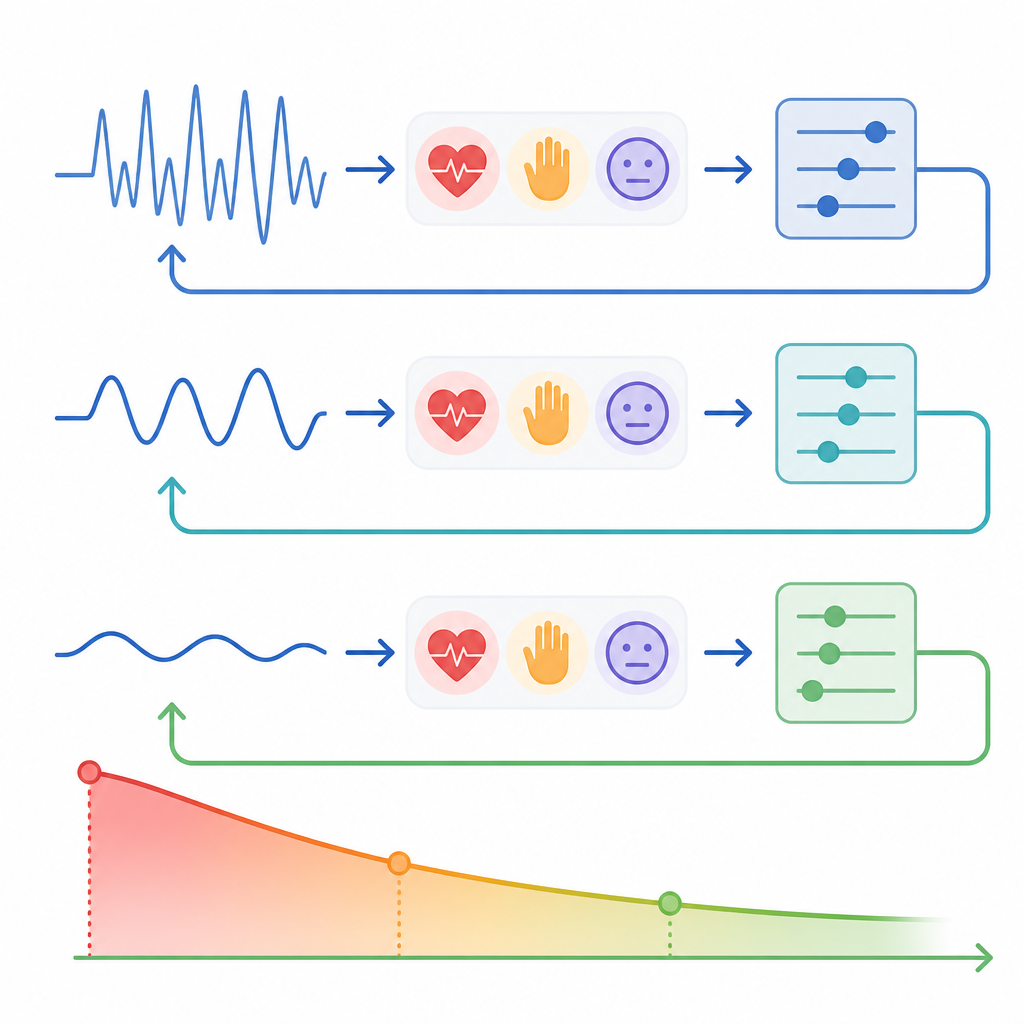
Putting the system to the test
To check whether the hardware and software work as intended, the team compared their sensors against research-grade reference devices under controlled conditions. The chest motion sensor closely matched a laboratory breathing belt, with small errors in the number of breaths per minute. The heart module agreed well with a clinical simulator on both heart rate and moment to moment variability. The skin conductance readings strongly tracked those from a commercial lab system. In a sample 20 minute session with a healthy volunteer, breathing rate roughly halved during guidance, heart rate variability increased, and skin conductance dropped, all pointing toward a calmer, more “rest and digest” state, with a smooth return toward baseline afterward.
What this means for everyday stress support
The study shows that it is technically possible to combine body signals and simple emotion tracking into a single, closed-loop breathing coach that reacts in real time. While this early test used only one participant and does not claim clinical benefits, the patterns observed match what is known about how slow, steady breathing can support the body’s calming systems. By adjusting to both physiology and comfort, this type of system could form the backbone of future personalized digital health tools for stress management, once larger and longer studies in diverse groups are completed.
Citation: Srinivasan, C.R., Kumar, P. & Meenatchi Sundaram, S. Technical validation of a multimodal emotion-adaptive biofeedback system for autonomic regulation using guided breathing. Sci Rep 16, 15327 (2026). https://doi.org/10.1038/s41598-026-46105-9
Keywords: biofeedback, guided breathing, stress, heart rate variability, digital health