Clear Sky Science · en
A novel intelligent framework for harnessing underground thermal energy through the optimization of grout and backfill thermophysical properties
Storing Heat in the Ground
As more homes and cities turn to renewable energy, one big challenge is how to store heat from one season to use in another. This study looks at a way to treat the ground beneath our feet like a giant rechargeable heat battery. By carefully choosing how we fill and surround underground pipes, and by using smart computer tools, the authors show how to get more useful heat back out of the ground while using energy more wisely.
How Underground Heat Storage Works
Underground thermal energy storage uses deep holes drilled into the ground, called boreholes, with U-shaped pipes inside. In summer or when waste heat is available, warm fluid is pumped down these pipes to charge the surrounding rock with heat. In winter, cooler fluid is sent down to pick that heat back up and deliver it to buildings. The rock acts as a huge thermal sponge, while the material that fills the gap between the pipes and the rock, known as grout or backfill, decides how easily heat can move in and out of this sponge.
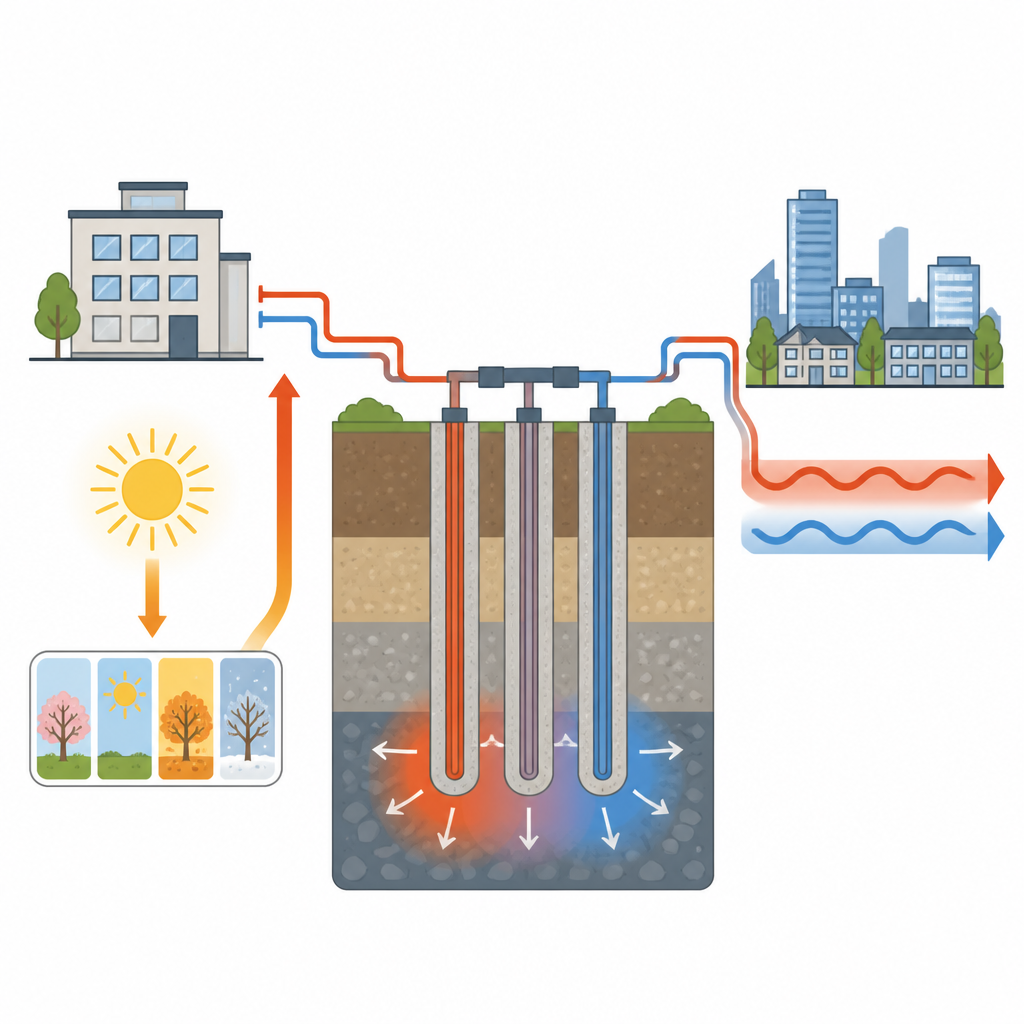
Why the Filling Material Matters
The success of such systems depends strongly on basic physical traits of both the rock and the grout, such as how well they conduct heat, how much heat they can hold, and how dense they are. If the materials conduct heat well, the system can charge and discharge quickly, but heat may also leak away into the wider ground. If they store a lot of heat, more energy can be kept underground, but it might be harder to pull it back out. The authors show that the thermal conductivity of the grout is especially important for getting heat back during the recovery phase, while rock properties control how much can be stored in the first place.
Teaching Computers to Stand In for Complex Models
Fully simulating heat flow in and around a borehole is slow and demanding on computers, especially if many design options must be tested. To get around this, the authors trained artificial neural networks to imitate a detailed numerical model of a single borehole in rock. These networks learn from a set of sample simulations and then provide very fast predictions of two key outcomes: how much heat is supplied to the ground and how much is later recovered. By carefully tuning the networks using search methods inspired by genetics and animal hunting, the team achieved very accurate predictions, with almost perfect agreement between the network and the original model.
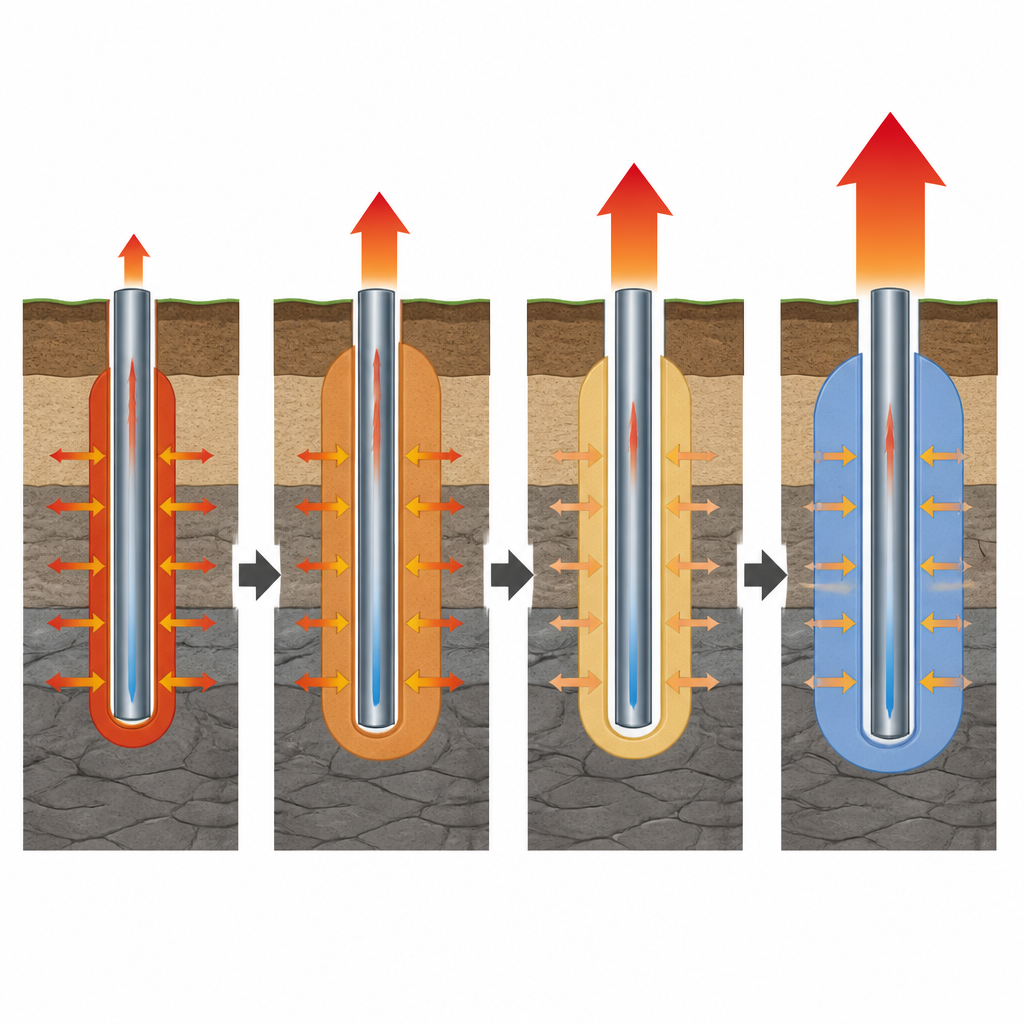
Searching for the Best Design Trade Offs
With these fast predictors in hand, the study then explores thousands of possible combinations of rock and grout properties. A multi objective search algorithm, modeled on the behavior of vultures sharing and chasing food, is used to find a series of best possible compromises. Each point on this Pareto front represents a design where improving one goal, such as getting more heat back, would automatically worsen another, such as the energy needed to charge the ground. The resulting set spans supplied energies of about 1.27 to 2.29 gigajoules and recovered energies of about 0.43 to 0.74 gigajoules, revealing clear zones where extra charging brings only small gains in recovered heat.
Choosing Real World Design Options
Engineers still need clear choices, not just a cloud of options, so the authors use a decision making method that ranks the Pareto designs according to different priorities. By changing the relative importance of low input energy versus high recovered energy, they extract seven practical scenarios. Some favor very low energy input and modest recovery, suited to small or energy limited sites, while others favor higher recovery for district heating or large buildings, accepting higher charging energy and more advanced grout. This step shows how the same underground storage concept can be tuned to fit many real world conditions.
What This Means for Future Energy Systems
In simple terms, the paper shows that underground heat batteries can be made more effective by intelligently selecting the properties of the rock like environment and the filling material around the pipes, guided by advanced data driven tools. Instead of trial and error or rule of thumb design, the proposed framework lets planners quickly see how changes in these materials affect both the energy put into storage and the heat they can realistically get back. This can help make ground based heating and cooling systems more efficient, flexible, and better matched to the needs of future low carbon energy networks.
Citation: Zandy Ilghani, N., Maleki, H. A novel intelligent framework for harnessing underground thermal energy through the optimization of grout and backfill thermophysical properties. Sci Rep 16, 15931 (2026). https://doi.org/10.1038/s41598-026-46104-w
Keywords: underground thermal energy storage, borehole heat exchanger, geothermal heating, machine learning optimization, grout thermal properties