Clear Sky Science · en
Deception in orbital games: simulation and dissimulation with a maneuverable decoy
Why hiding in plain sight in space matters
Modern life depends on satellites, from weather forecasts to communications. As more nations and companies place spacecraft in orbit, the risk of deliberate interference rises. This paper explores a subtle but powerful idea in space security: using a maneuverable decoy satellite to confuse an attacker and give a threatened spacecraft a better chance to survive. Instead of focusing only on faster engines or thicker armor, the authors ask how clever deception can tilt the odds in a deadly game of celestial hide and seek.
The basic setup of a space bluff
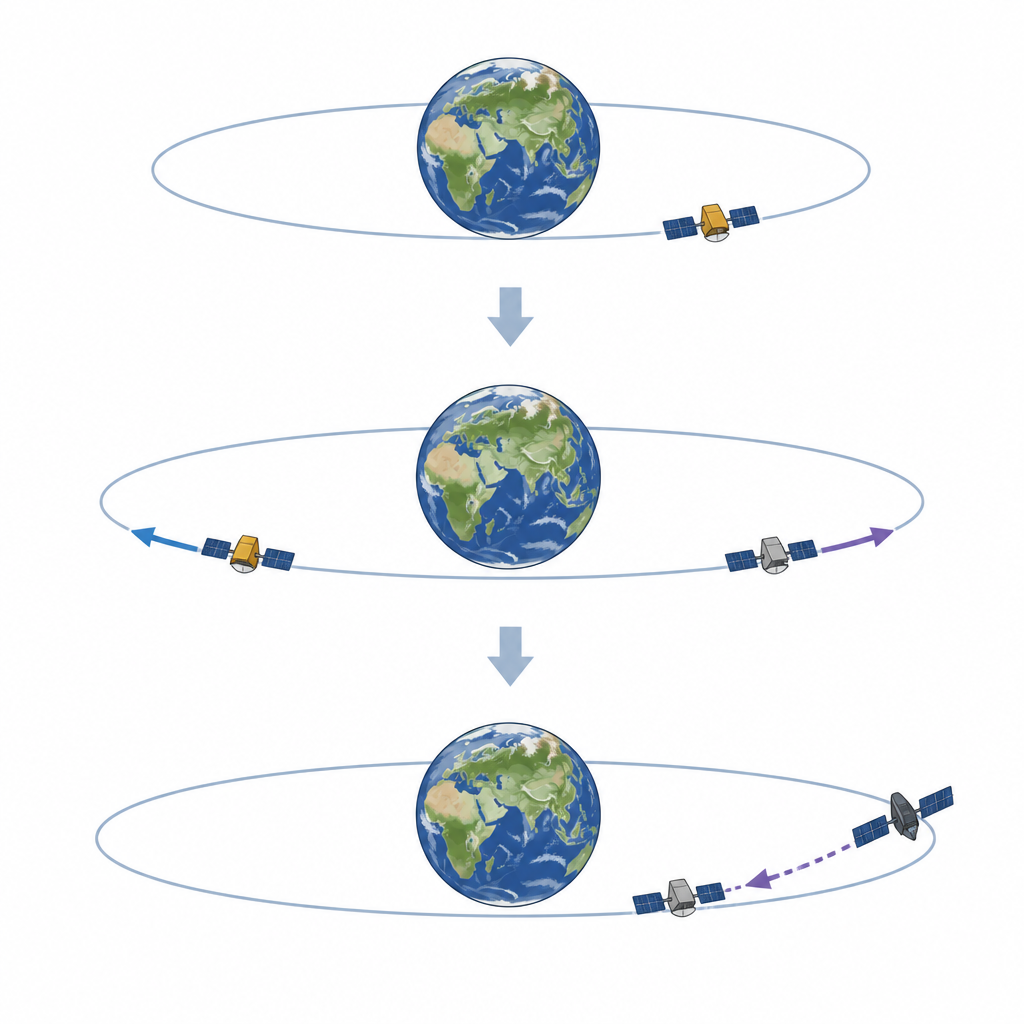
At the heart of the study is a simple scenario. A hostile “pursuer” spacecraft is closing in on a valuable “evader” satellite. Sensing danger, the evader releases a decoy that looks and moves almost the same way. The pursuer can track both objects but does not know which is real. If it chooses wrong, it wastes fuel and time chasing the decoy while the true target slips away. The authors treat this as a strategic game in which each side tries to shape the other’s expectations and force decisions under uncertainty. Instead of relying on fixed, predictable moves, both pursuer and evader must adopt mixed strategies, randomly varying their choices so they cannot be easily exploited.
From simple tricks to smart strategies
The paper distinguishes between hiding at the physical level and tricking at the cognitive level. Stealth coatings and clever lighting can make a satellite harder to see, but a decoy works by tampering with the pursuer’s belief about what it is seeing. The authors first analyze a one-move version of the game, where the evader and decoy each perform a single escape maneuver and the pursuer chooses which one to chase first. They show that a naive pursuer will always pick the target that seems cheapest to reach, and a moderately smart pursuer will guess based on an assumed probability that either object is real. A fully rational pursuer, however, must randomize its choice so that the evader cannot reliably predict or manipulate it. Likewise, the evader chooses how often to assign the “real” role to each of the two escape paths, seeking a balance where the pursuer is forced to stay undecided.
Playing the long game in orbit
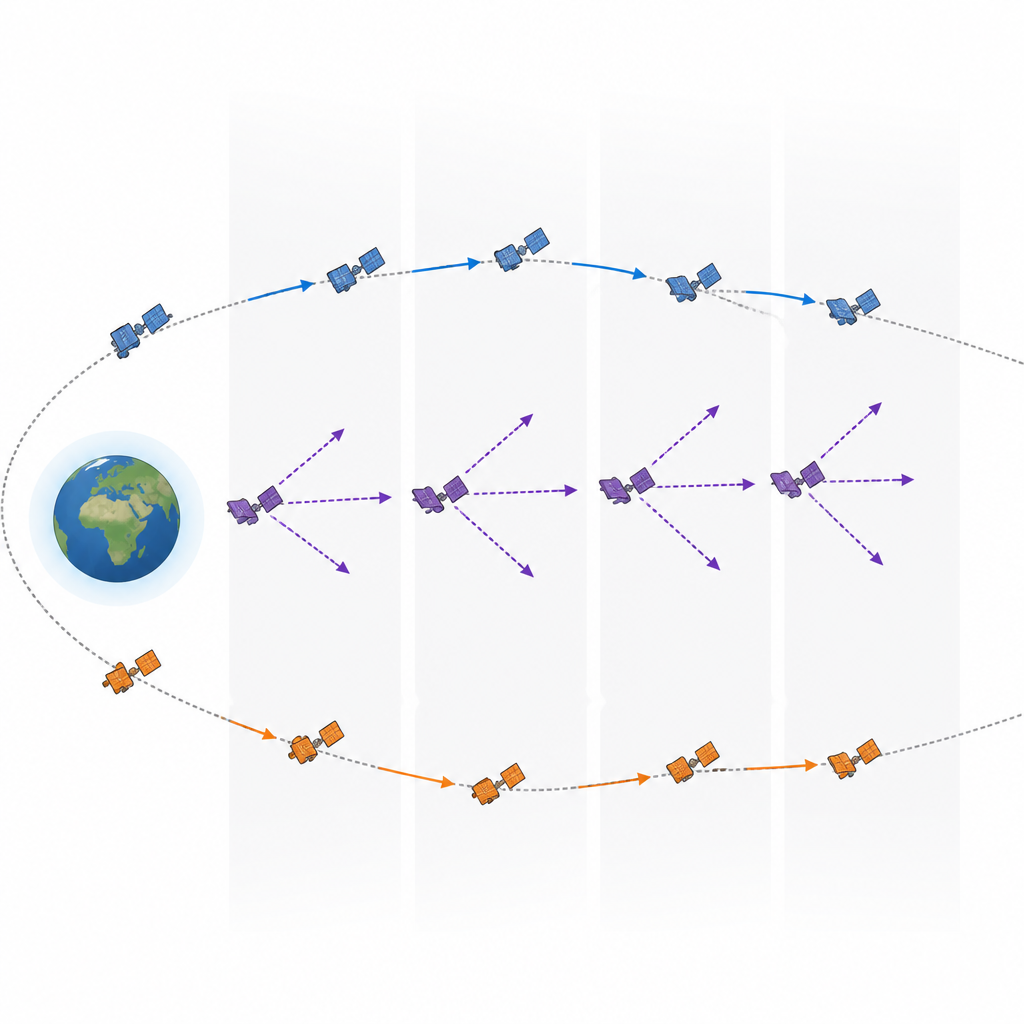
Real orbital chases often unfold over many cycles of sensing, thinking, and maneuvering. To capture this, the authors extend their model to a multi-step game where both sides periodically observe, decide, and act. The pursuer updates its belief about which target is genuine by combining fresh tracking data with past observations, using a simple form of Bayesian reasoning. At the same time, the evader and decoy continue to maneuver in different directions, trying to keep the pursuer uncertain. Because spaceflight is governed by curved paths and limited fuel, switching targets mid-chase can be costly or impossible, which makes early misjudgments particularly dangerous for the pursuer.
What the simulations reveal
Using realistic models of satellite motion in geostationary orbit, the authors run numerical experiments for both the single-step and multi-step games. They measure the pursuer’s total “cost” as a combination of fuel spent and time needed to end the chase. In the simplest case without a decoy, the pursuer can intercept the evader with modest fuel use and little doubt about the outcome. When a maneuverable decoy is added and both sides follow rational mixed strategies, the expected cost to the pursuer rises sharply. In a more demanding multi-step scenario, the pursuer is given a six-to-one maneuvering advantage, yet the presence of a decoy and well-chosen escape maneuvers boost the evader’s chance of survival from nearly zero to about 31 percent. In some runs the pursuer burns extra fuel chasing the wrong object; in others it switches targets too late or not at all.
Imperfect decoys and richer space games
The study also considers less ideal decoys that are only partly convincing. A realism factor captures how often the pursuer might correctly spot the fake based on subtle differences in signals or motion. As this factor drops, the pursuer’s best response shifts from a carefully balanced random choice toward simpler, pure strategies that ignore the decoy. The authors outline how the same logic extends beyond pure evasion. They sketch examples where attackers use decoys to feint toward one high-value satellite while striking another, and even situations where both attackers and defenders field their own decoys, turning orbital conflict into a layered contest of guesses and counter-guesses.
Why this matters for the future of space safety
To a general reader, the key message is that survival in space will not depend only on better rockets or thicker shields. It will also depend on how well spacecraft can reason under uncertainty and use deception to shape an opponent’s choices. This work shows that a relatively simple tool, a maneuverable decoy that is hard to distinguish from the real thing, can meaningfully improve the odds for a weaker satellite, even against a much stronger pursuer. As space becomes more crowded and contested, such belief-aware game models may help designers build smarter, more resilient systems that can cope with limited information instead of assuming perfect knowledge and perfect aim.
Citation: Han, H., Dang, Z. Deception in orbital games: simulation and dissimulation with a maneuverable decoy. Sci Rep 16, 15584 (2026). https://doi.org/10.1038/s41598-026-46097-6
Keywords: orbital deception, satellite decoy, pursuit evasion, space security, game theory