Clear Sky Science · en
Novel approaches for understanding and improving the effectiveness of seed biopriming
Helping Seeds Start Strong in a Changing Climate
Feeding a growing world under harsher weather will depend on crops that can germinate and grow reliably, even when conditions are far from ideal. Many of the plants that smallholder farmers rely on most—such as grass pea, forage pea, and fenugreek—are neglected by mainstream crop research, despite their hardiness and nutritional value. This study explores how to give these "orphan" legumes a better start in life by fine-tuning a seed treatment called biopriming, and introduces new imaging tools to make that process more precise and affordable for real farms.
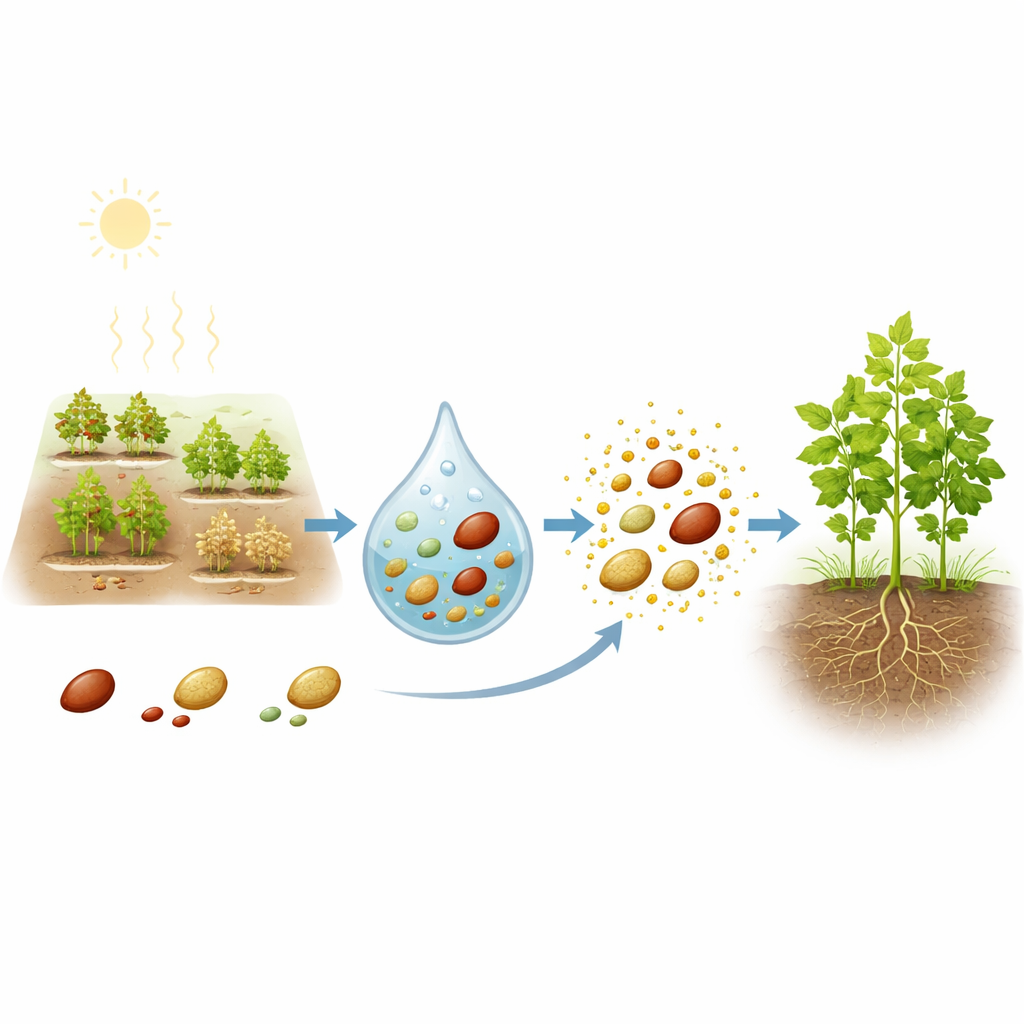
What It Means to Give Seeds a Head Start
Before a seed ever touches soil, farmers can gently "wake it up" using priming treatments that soak the seed in water or helpful solutions, then dry it again. This pre-start helps seeds sprout more quickly and evenly once planted. In this work, researchers designed an on-farm friendly "hybrid priming" recipe for three underused legumes: grass pea, forage pea, and fenugreek. The recipe combines simple water soaking (hydropriming) with a coating of hardy spores from a beneficial soil bacterium, Bacillus subtilis. The idea is that water soaking repairs and prepares the seed, while the bacterial partners support early growth and resilience after sprouting.
What the Experiments Showed in the Soil
The team treated seeds of two varieties from each species using four options: no priming, water-priming only, biopriming only, and the combined hybrid treatment. They then planted the seeds in trays of soil and monitored how quickly seedlings emerged and how well they grew. Across all three species, water-priming clearly stood out: it consistently sped up germination and, in many cases, improved early shoot or root growth. The added bacteria did not further accelerate sprouting under these comfortable test conditions, but seedlings from bioprimed seeds often had longer shoots or roots, hinting that the microbes may help more during later growth or under stress such as drought or salty soils, as other studies have suggested.
Why the Seed’s Outer Skin Matters
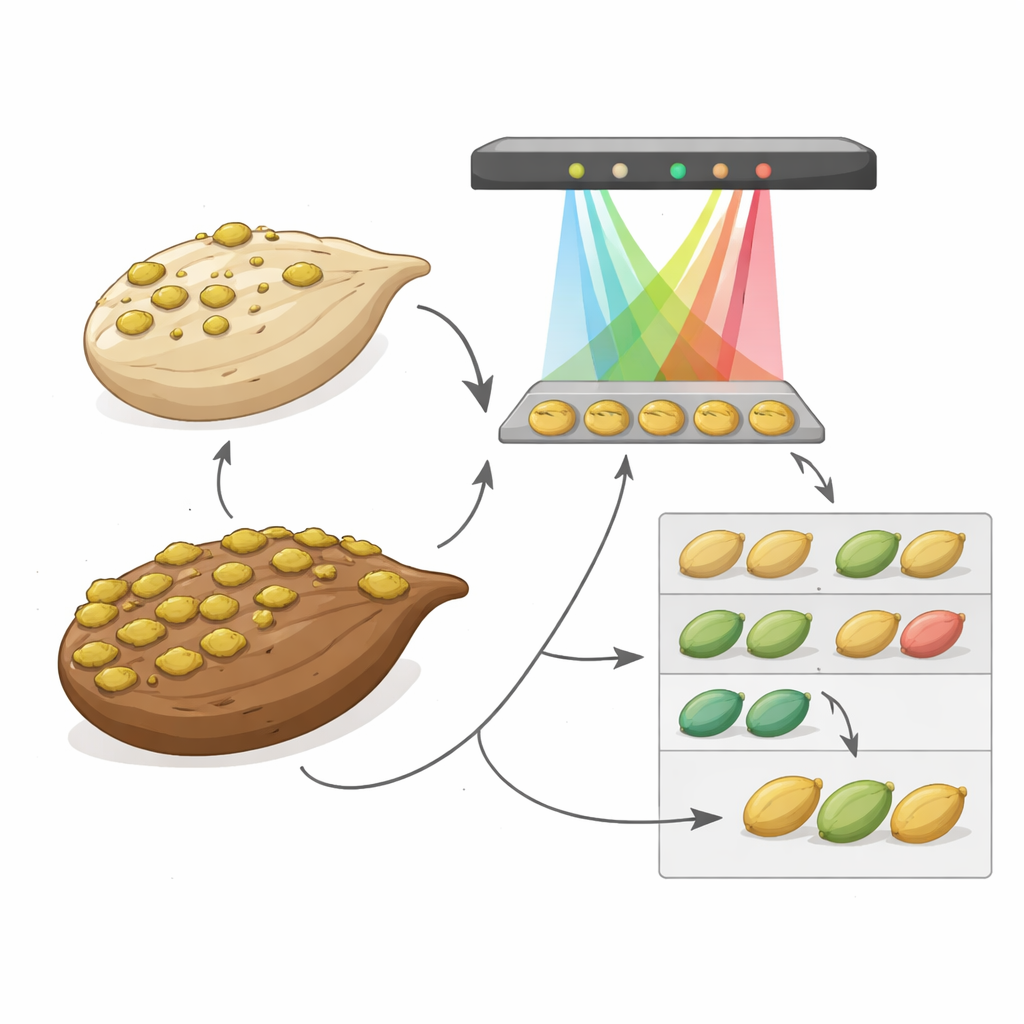
Because biopriming depends on bacteria sticking to the seed coat, the researchers asked a simple but overlooked question: does the microscopic texture of the seed surface change how well spores can attach? Using scanning electron microscopy—essentially an ultra-powerful camera—they mapped the tiny ridges and bumps on the seed coats of each variety and converted those images into 3D “landscapes.” Grass pea seeds, in particular, showed clear differences between varieties in how rough their surfaces were. Rougher surfaces scatter light more and may also catch spores differently. This suggested that not all seeds, even within one species, present the same landing pad for helpful microbes, which may explain why a single biopriming recipe does not work equally well for every variety.
Seeing Invisible Spores with Colored Light
To avoid relying on slow and costly trial-and-error, the team tested a second imaging tool: multispectral imaging. In this method, seeds are illuminated with many narrow colors of light, from violet to near-infrared, and a camera records how much light each seed reflects at each color. By examining grass pea varieties with contrasting surface textures, the scientists found that only a narrow band of red light—around 645, 660, and 690 nanometers—could reliably detect the presence of B. subtilis spores on the seed coat. Even small changes in spore dose or in the sugary "sticker" solution used to glue spores to the seed altered both surface roughness and reflectance. This allowed the researchers to read out how well seeds were coated just from their light signature, and to see that each variety produced its own characteristic pattern.
A Smarter Path to Better Seed Treatments
By linking seed surface roughness and reflectance to how spores adhere, the study proposes a new, more rational way to design biopriming protocols. Instead of blindly adjusting bacterial dose and coating recipes, technologists could first measure how rough a seed lot is, then use multispectral imaging at a few key colors to quickly test how much bacteria actually stick and stay. Over time, building such data across many crops and bacterial strains could feed machine-learning tools that suggest near-ready recipes for new seed lots. For farmers—especially smallholders growing resilient but underappreciated legumes—this could translate into simple, robust priming methods that produce stronger seedlings and more reliable harvests, even as climate pressures mount.
Citation: Dueñas, C., Pagano, A., Calvio, C. et al. Novel approaches for understanding and improving the effectiveness of seed biopriming. Sci Rep 16, 10965 (2026). https://doi.org/10.1038/s41598-026-46096-7
Keywords: seed priming, beneficial microbes, multispectral imaging, climate-resilient crops, orphan legumes