Clear Sky Science · en
Fine-scale temporal and spatial dynamics of Ae. albopictus response to larviciding with Bacillus thuringiensis israelensis in Heidelberg, Germany
Why this matters for everyday life
Across Europe, a small striped mosquito is becoming a big problem. Aedes albopictus, often called the Asian tiger mosquito, can spread diseases like dengue and chikungunya. As the climate warms, this insect is pushing north into cities that have never had to deal with it before. This study from Heidelberg, Germany, asks a very practical question: can a widely used biological treatment poured into puddles and containers really keep these mosquitoes from gaining a foothold in a modern European city, and for how long does each treatment actually work?
A growing mosquito threat in European cities
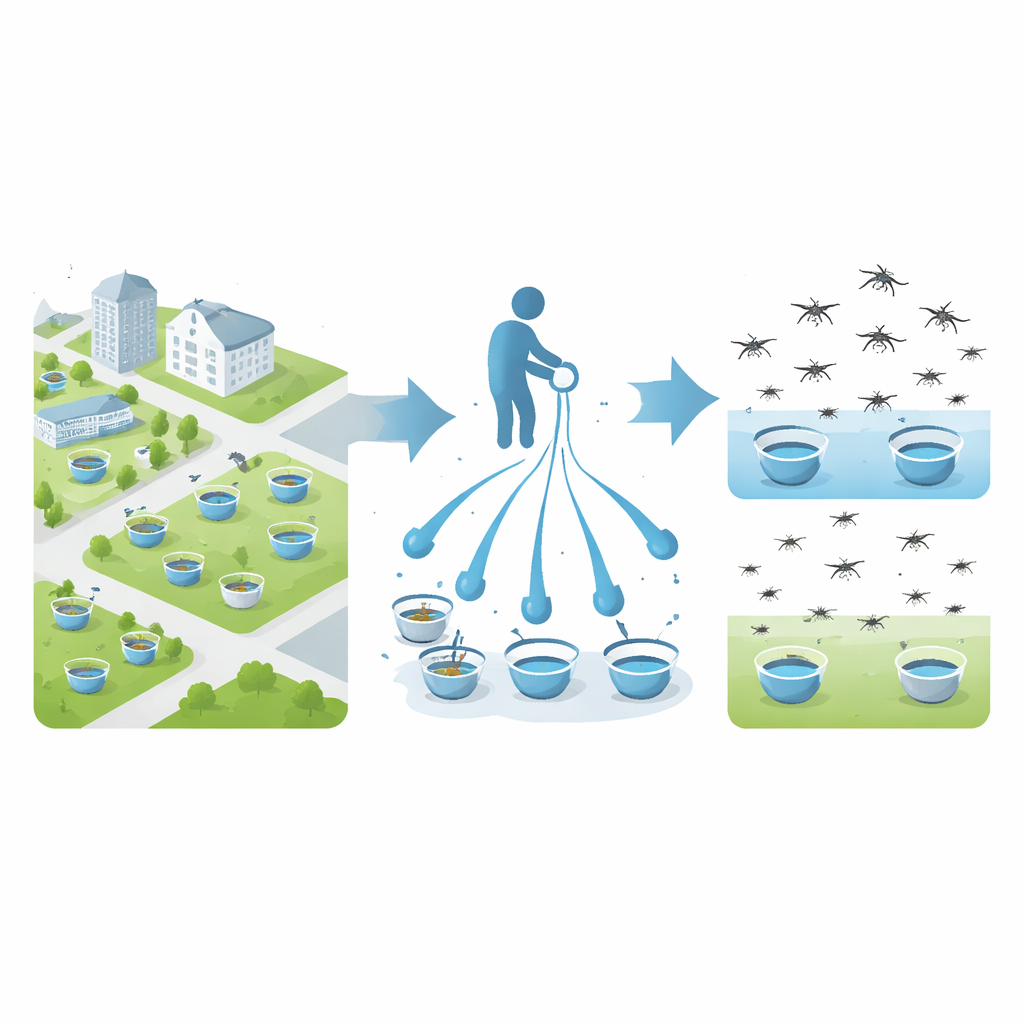
Ae. albopictus originated in Southeast Asia but has spread rapidly with global trade, travel, and rising temperatures. It is already established in many parts of Germany and has helped drive local dengue outbreaks in countries like France and Italy. Heidelberg, a relatively warm German city with about 160,000 residents, has had these mosquitoes since 2016. Local authorities have invested heavily in control programs, because once the species becomes firmly established, the risk of imported infections turning into local outbreaks rises sharply.
A natural weapon in the water
One of the main tools for stopping this mosquito is a naturally occurring bacterium called Bacillus thuringiensis israelensis, or Bti. Bti is mixed with water and poured into small pools, buckets, catch basins, and other places where mosquito larvae develop. When larvae ingest it, they die, while people, pets, and most other wildlife are unaffected. Many product labels claim Bti works for up to a month, but city streets and backyards are far messier than laboratory tanks. The Heidelberg team wanted to know, at a fine day‑by‑day and street‑by‑street scale, how long Bti really suppresses mosquito populations in an urban setting and how strongly repeated treatments can hold them down over an entire season.
Tracking eggs, treatments, and weather
The researchers focused on three Heidelberg neighborhoods where Ae. albopictus has persisted despite years of control. They monitored 195 egg traps—simple water containers lined so females would lay eggs on them—checked roughly every two to three weeks throughout the 2023 mosquito season. In total, they counted over 26,000 eggs from more than 1,300 trap checks. Meanwhile, professional teams moved through the same areas every two weeks from April to October, recording more than 4,300 Bti applications to breeding sites within 200 meters of each trap. The scientists also gathered detailed local weather and green-space data. Using a statistical framework that can capture delayed and non‑linear effects, they linked the number and timing of nearby Bti treatments to later changes in egg counts at each trap.
Short bursts of power, strong impact when repeated
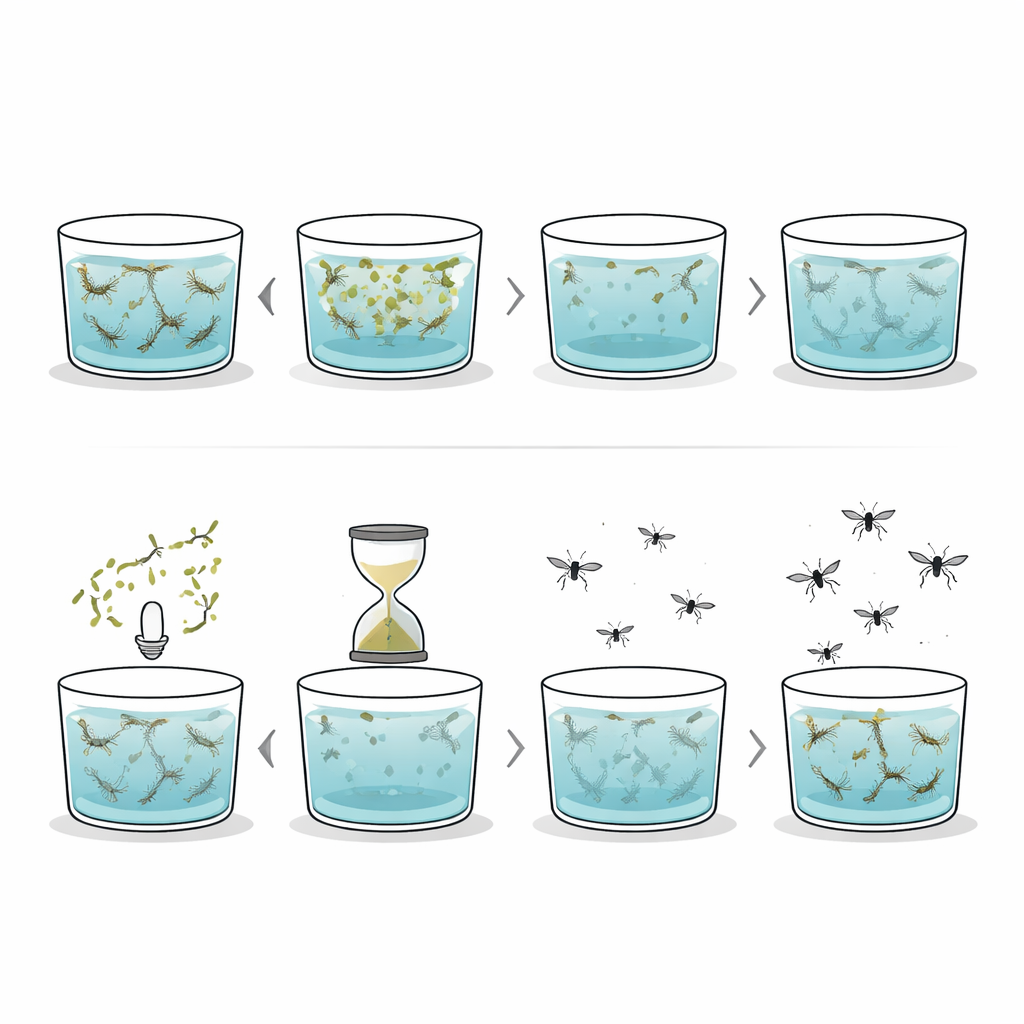
The analysis showed that Bti clearly reduced mosquito egg numbers, but only for a limited window after each application. The strongest drop in eggs appeared about 6 to 13 days after nearby breeding sites were treated. At typical treatment intensities, egg counts fell by around 10 percent in this window, and the effect faded after about two weeks unless there had been many breeding sites treated. With heavier local treatment, the protective effect could stretch close to four weeks. When the team added up these short bursts of impact across the whole season, the effect was striking: model simulations suggested Bti treatments reduced total egg production by about 42 percent, and, without them, every single trap in the study area would likely have held Ae. albopictus eggs at least once.
What this means for cities and citizens
For non‑specialists, the take‑home message is that Bti can be a powerful ally against invasive mosquitoes, but it is not a one‑time fix. In Heidelberg, frequent, carefully targeted treatments of small water sites—combined with residents learning to find and empty containers—appeared sufficient to keep the mosquito from fully taking over entire neighborhoods, even in a warming climate. However, because each dose of Bti works best for only one to two weeks under real-world conditions, cities must plan for regular, labor‑intensive rounds of treatment and sustained community participation. Well‑organized, neighborhood‑scale efforts may allow towns to hold the line against Ae. albopictus without blanket spraying, but long‑term success will depend as much on social engagement as on biological tools.
Citation: Hatfield, C.R.S., Stiles, P.C., Liyanage, P. et al. Fine-scale temporal and spatial dynamics of Ae. albopictus response to larviciding with Bacillus thuringiensis israelensis in Heidelberg, Germany. Sci Rep 16, 12031 (2026). https://doi.org/10.1038/s41598-026-46094-9
Keywords: Aedes albopictus, mosquito control, Bacillus thuringiensis israelensis, urban health, climate and disease