Clear Sky Science · en
RehabMate: an explainable framework for action detection and corrective feedback in pediatric stroke rehabilitation
Helping Children Recover Movement at Home
Pediatric stroke can leave children struggling to walk, stand, or climb stairs, often for years. Regular therapy with specialists improves recovery, but frequent hospital visits are expensive and hard on families. This paper introduces RehabMate, a digital helper designed to bring expert-style lower limb rehabilitation into homes and community centers, while still keeping physiotherapists in control.
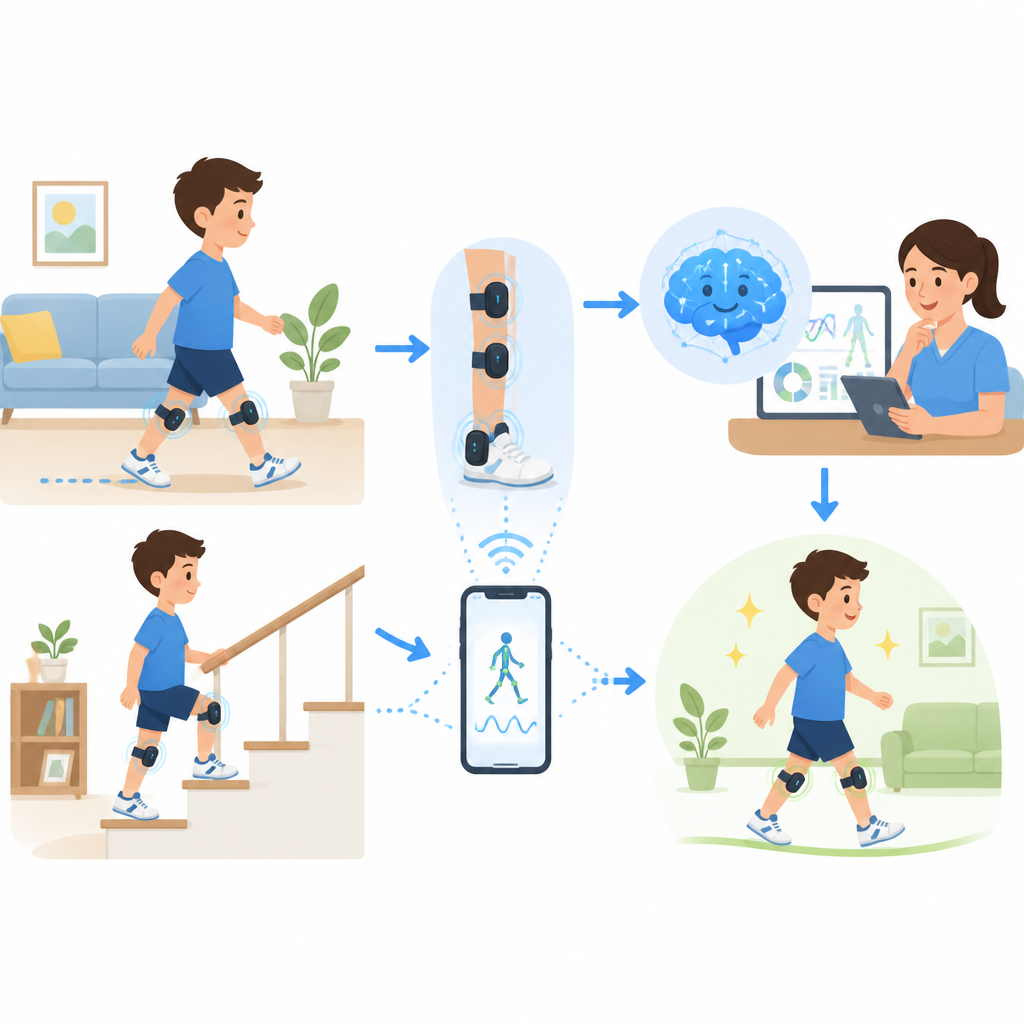
Why Children Need Smarter Rehab Support
Stroke is among the top causes of serious disability in children, and up to seven in ten young patients are left with lasting movement problems. Children usually respond well to training and are highly motivated, but traditional rehabilitation relies on repeated in-person sessions with trained therapists. Families may live far from clinics, have limited time, or lack the funds for long-term, intensive care. Existing artificial intelligence tools could help, yet many work like a black box, giving a result without explaining how it was reached. This makes it hard for physiotherapists and parents to trust or safely use them in everyday life.
A Digital Partner That Watches How Kids Move
RehabMate is designed as a three-layer system that observes how a child moves, combines different kinds of motion data, and then analyzes it to support training. Small wireless sensors placed on the knees and ankles record how the legs accelerate and change direction, while a smartphone captures video and estimates the skeleton of the child’s body frame by frame. These signals are fused into a single picture of the child’s movement. Before each session, information such as the child’s age, pain level, and mobility is entered into an app, so the system can adapt its guidance to the child’s condition.
How the System Understands Walking and Stairs
At the heart of RehabMate is a specialized action recognition model that studies how the child walks, stands, and climbs up and down stairs. Instead of looking only at joint positions, the model also considers the bones between joints and how joint angles change over time. It represents the body as a network of connected points and uses advanced graph-based processing and attention mechanisms to focus on the most important joints and moments in a movement sequence. By carefully mixing sensor data and skeleton data, the model recognizes four key rehab actions and rates the quality of the child’s performance, reaching over 93 percent accuracy when tested across different camera views on a new pediatric stroke dataset called PSP2.
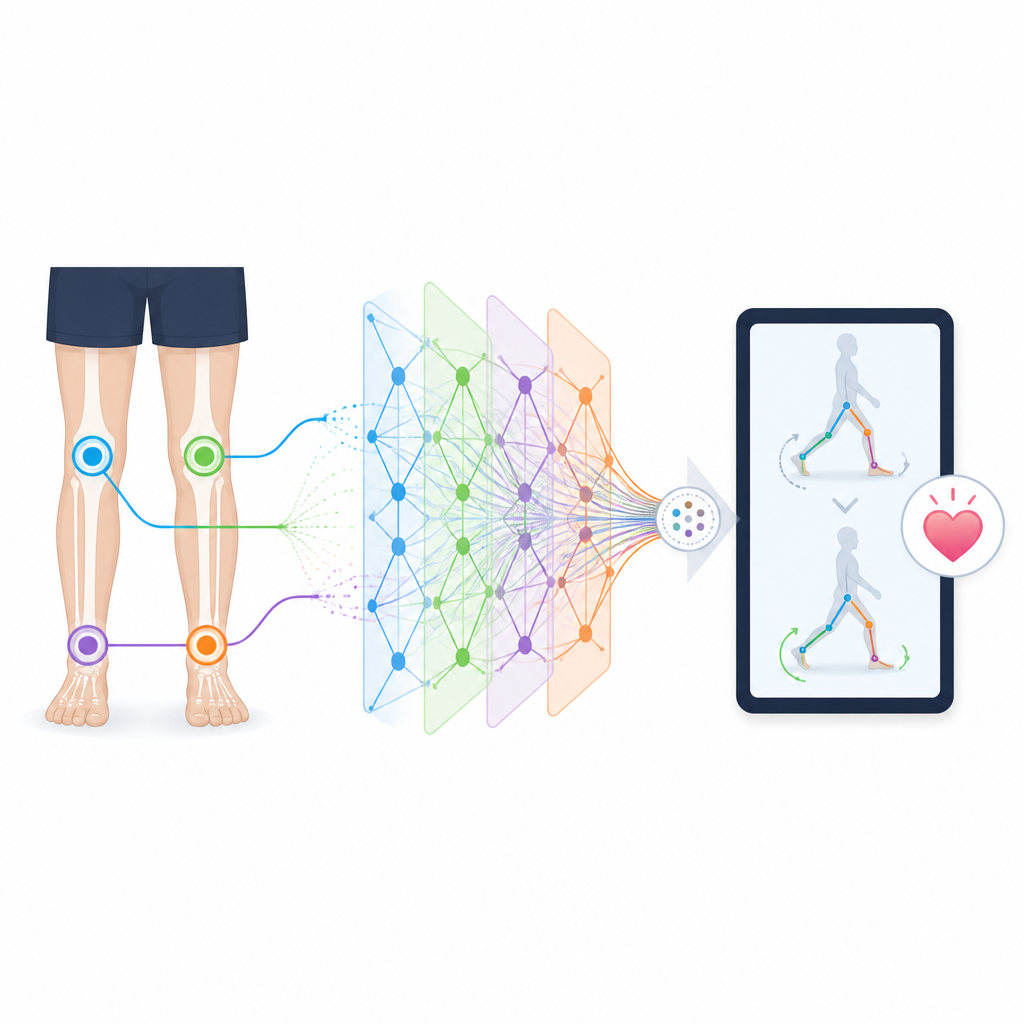
Turning Movement Analysis into Human-Friendly Guidance
RehabMate does more than classify movements; it turns technical results into understandable, tailored feedback. The authors built a professional text library with detailed descriptions of rehab exercises and common mistakes, written by physiotherapists. A language model first retrieves and lightly edits suitable descriptions, then passes them to a larger model that crafts clear corrective suggestions and encouraging messages, adjusted to the child’s pain and mobility levels. For example, instead of always demanding a perfect step, the system may suggest using a stair handrail when pain or limited strength makes full correction unsafe. Therapists can trace each piece of advice back to the underlying motion data and to entries in the knowledge base, making the process auditable and clinically meaningful.
Making AI Transparent and Trustworthy for Rehab
The study shows that RehabMate can accurately identify lower limb rehab actions in children, explain which body parts and time points influenced its decisions, and generate feedback that aligns with professional judgment. Expert reviews confirm that the model’s attention often highlights the same critical joints therapists focus on, and that most generated suggestions can be traced to known rules in the knowledge base. While the current system concentrates on walking and stair activities and uses a moderate-sized dataset, the authors argue that the same explainable approach could be extended to arm and whole-body training. For families and clinicians, this means AI that not only measures movement but also clearly shows how it reaches its conclusions, helping make home-based pediatric stroke rehabilitation safer, more consistent, and more personalized.
Citation: Huang, S., Chen, Z. & Liu, Y. RehabMate: an explainable framework for action detection and corrective feedback in pediatric stroke rehabilitation. Sci Rep 16, 15565 (2026). https://doi.org/10.1038/s41598-026-46093-w
Keywords: pediatric stroke, rehabilitation, explainable AI, action recognition, wearable sensors