Clear Sky Science · en
Study on coal wall spalling mechanism of large mining height working face based on folding mutation theory
Why sudden coal wall failures matter
In modern underground coal mines, ever taller extraction faces allow more coal to be removed in a single pass, boosting output but also raising the risk of sudden sidewall collapses known as rib spalling. These abrupt failures can hurl coal into work areas, damage heavy machinery, and threaten miners’ lives. This study digs into why such failures occur so suddenly, using a mix of mathematical modeling, energy analysis, and computer simulation to show how the coal wall quietly stores energy until it reaches a tipping point and breaks without warning. 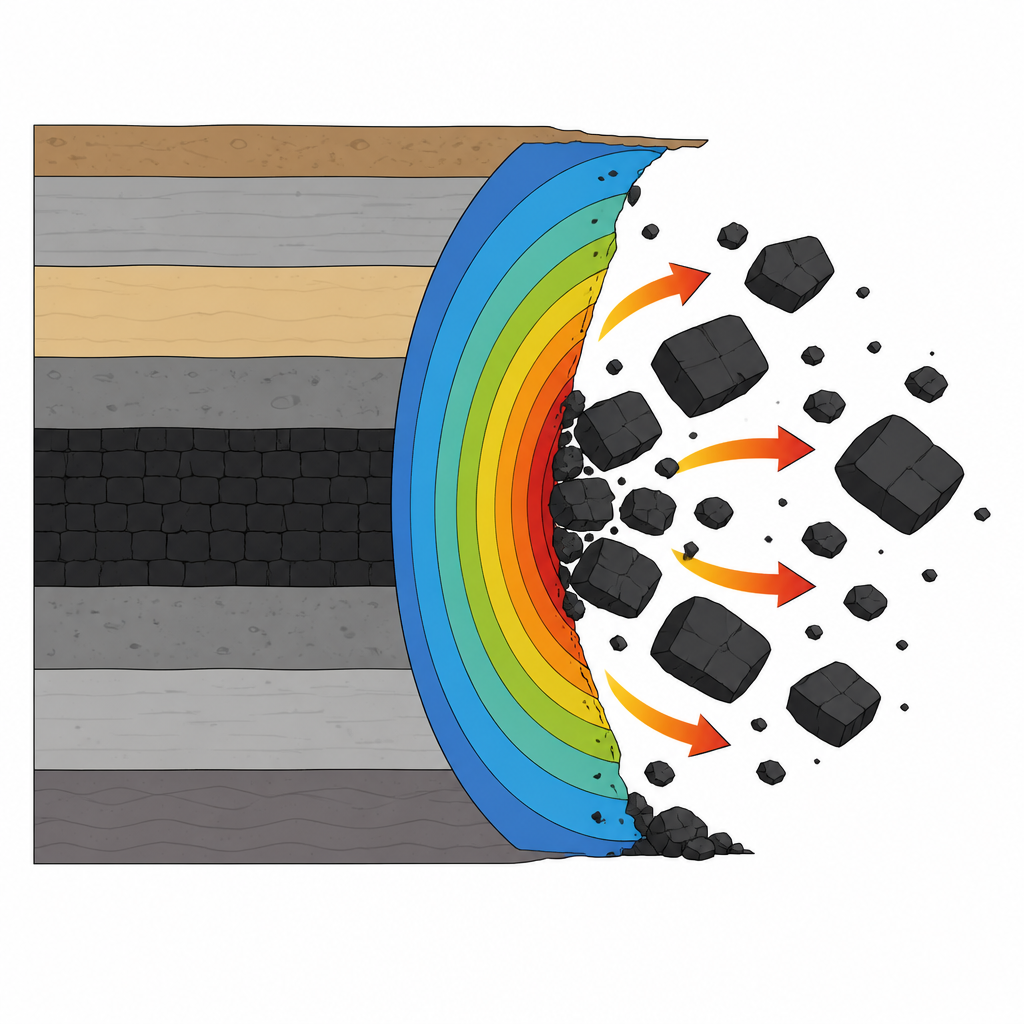
Hidden shell around the mining tunnel
The authors argue that the coal beside a large mining face behaves not like a solid block but like a thin shell wrapped around the opening. As the roof and floor squeeze the exposed wall, this shell gradually bulges toward the tunnel, especially in the middle height of the seam. Field observations in a Chinese mine showed that fractures and breakouts tend to cluster in this midsection, supporting the idea that the coal around the face fails in a roughly spherical pattern rather than as a flat slab. Thinking of the coal as a shell makes it easier to describe how stresses from all directions focus into a limited zone that is primed for instability.
Energy builds up before the break
Instead of focusing only on how hard the coal is pushed, the study tracks how different kinds of energy accumulate inside the coal shell. Part of the coal deforms elastically, like a compressed spring that can release energy, while other parts deform plastically, permanently changing shape and soaking up energy. As small cracks form and spread, more of the shell becomes a plastic zone that absorbs energy, while the surrounding elastic zone holds a growing stock of strain energy. The researchers show mathematically that, once the energy stored in the elastic region reaches a certain threshold, it can suddenly flood into the cracked zone. At that moment, the shell can no longer maintain its shape, and rib spalling occurs in a rapid burst.
A tipping point described by a folding model
To capture this sudden shift, the team uses a mathematical framework called a folding catastrophe model. In plain terms, the coal wall’s behavior is described as a system that can follow two different paths: a stable one where deformation grows slowly, and an unstable one where a small extra push causes a jump to a new, badly deformed state. The key control factor is the rate at which energy is fed into the coal from mining stresses and gas pressure. As long as outside forces must still supply extra energy, the wall deforms gradually. But when the energy released from the elastic parts of the coal is just enough to drive further cracking on its own, the system reaches a critical balance. At this tipping point, even a minor disturbance, such as a new cut by the shearer, can trigger a jump from stability to sudden collapse. 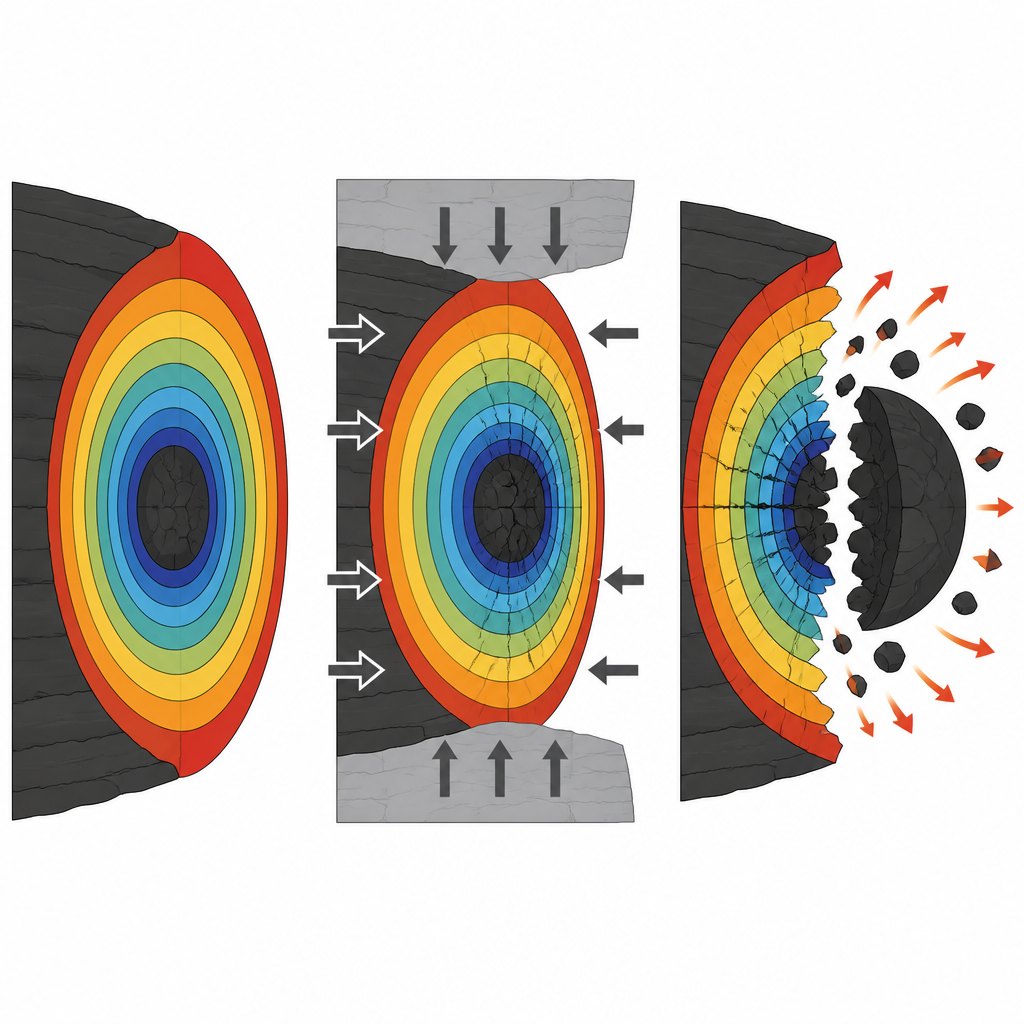
Support from numerical experiments
The researchers tested their ideas with detailed computer simulations of a longwall face in a thick coal seam that includes a weaker dirt band. Using a distinct element model, they simulated stepwise mining and tracked how the coal in front of the face moved and where stresses concentrated. The results showed that horizontal movement and damage concentrate around the middle of the seam, forming a bulging zone that expands outward in an approximately hemispherical pattern. This pattern matches the shell and spherical failure concepts from the theory, indicating that the coal wall indeed accumulates deformation and energy in the central region until it becomes unstable. The presence of the dirt band shifts and intensifies this failure zone, highlighting how thin weak layers can focus damage.
What this means for safer mining
By linking rib spalling to an energy threshold, the study moves from describing visible damage after the fact to predicting when the coal wall approaches a dangerous state. The model suggests that monitoring indicators of energy build up, such as mining-induced stresses and gas pressure, can help identify when the system is close to its tipping point. In practice, engineers can adjust support stiffness, change mining height, or use pressure relief measures to reduce energy input and move the coal wall away from the critical region. In simple terms, the work shows that sudden coal wall collapses are not random events, but the result of a quiet energy pileup inside a fragile shell that can, and should, be watched and controlled.
Citation: Li, G., Zhang, H., Li, M. et al. Study on coal wall spalling mechanism of large mining height working face based on folding mutation theory. Sci Rep 16, 15277 (2026). https://doi.org/10.1038/s41598-026-46075-y
Keywords: coal wall spalling, rib spalling, energy release, longwall mining, coal mine safety