Clear Sky Science · en
Integrative effects of irrigation and aeration on root morphology, yield, and quality of tomatoes cultivated in coastal saline-alkali lands
Why tomatoes on salty coasts matter
As good farmland becomes scarcer, many countries are looking to salty coastal soils as new places to grow food. These lands are tough on crops, especially sensitive ones like tomatoes, because the soil is salty, compact, and low in air. This study explores a simple idea: can adding tiny air bubbles to drip irrigation water help tomato roots breathe better, grow stronger, and produce more tasty fruit in these harsh coastal fields? 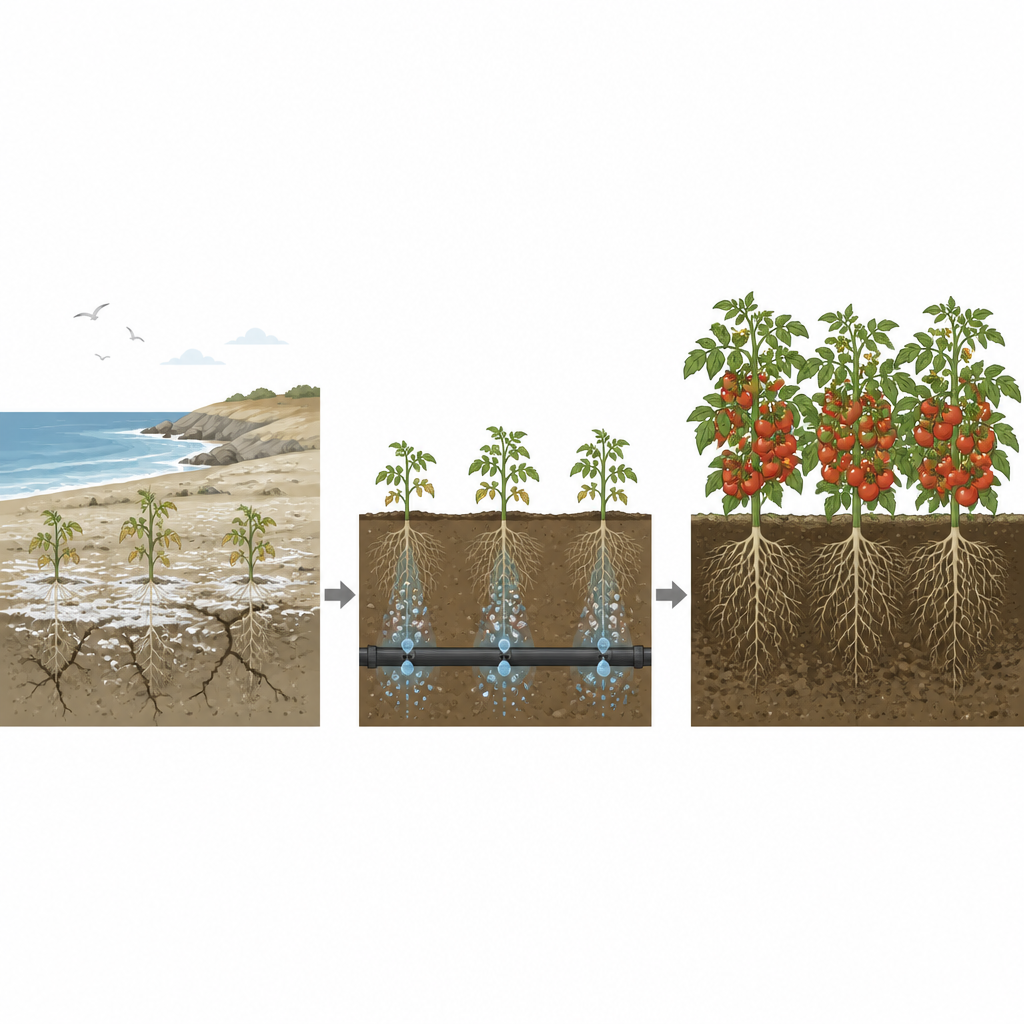
Salty soils and struggling plants
Coastal saline-alkali soils are shaped by seawater intrusion, high groundwater, and tides, which load the ground with salts and sodium. The sodium makes soil particles stick together, closing the pores that normally hold air and water. Plants growing there face several problems at once: salt stress, poor drainage, and a lack of oxygen around their roots. Tomatoes respond by growing poorly, with small leaves, weak roots, and lower yields. Traditional fixes like spreading chemicals or organic matter can be costly or slow, so improving how water and air reach the roots is an attractive alternative.
Testing air-enriched drip water
The researchers worked in a greenhouse on China’s coast, using a tomato variety common in northern China. They compared normal subsurface drip irrigation to a version where a device mixed air into the water as it flowed through buried drip lines. At the same time, they tested three water amounts, from severe shortage to full irrigation. This produced six treatment combinations, all managed with the same fertilizer, plant spacing, and care. By carefully measuring plant height, leaf area, root size and shape, photosynthesis, yield, and fruit quality, they could see how the mix of water and air changed plant performance.
Roots, leaves, and photosynthesis respond
Aerated water clearly helped tomato roots in the salty soil. Across all water levels, plants receiving air-enriched irrigation grew thicker, longer roots with greater surface area and volume than plants with normal water. The best root systems formed when aeration was combined with full irrigation, which also gave the highest leaf area. Bigger root systems supplied more water and nutrients to the canopy, and this showed up in the leaves: plants with aerated irrigation had a higher net photosynthetic rate, meaning they converted sunlight into sugars more efficiently. These gains in root and leaf health were tightly linked to higher yields. 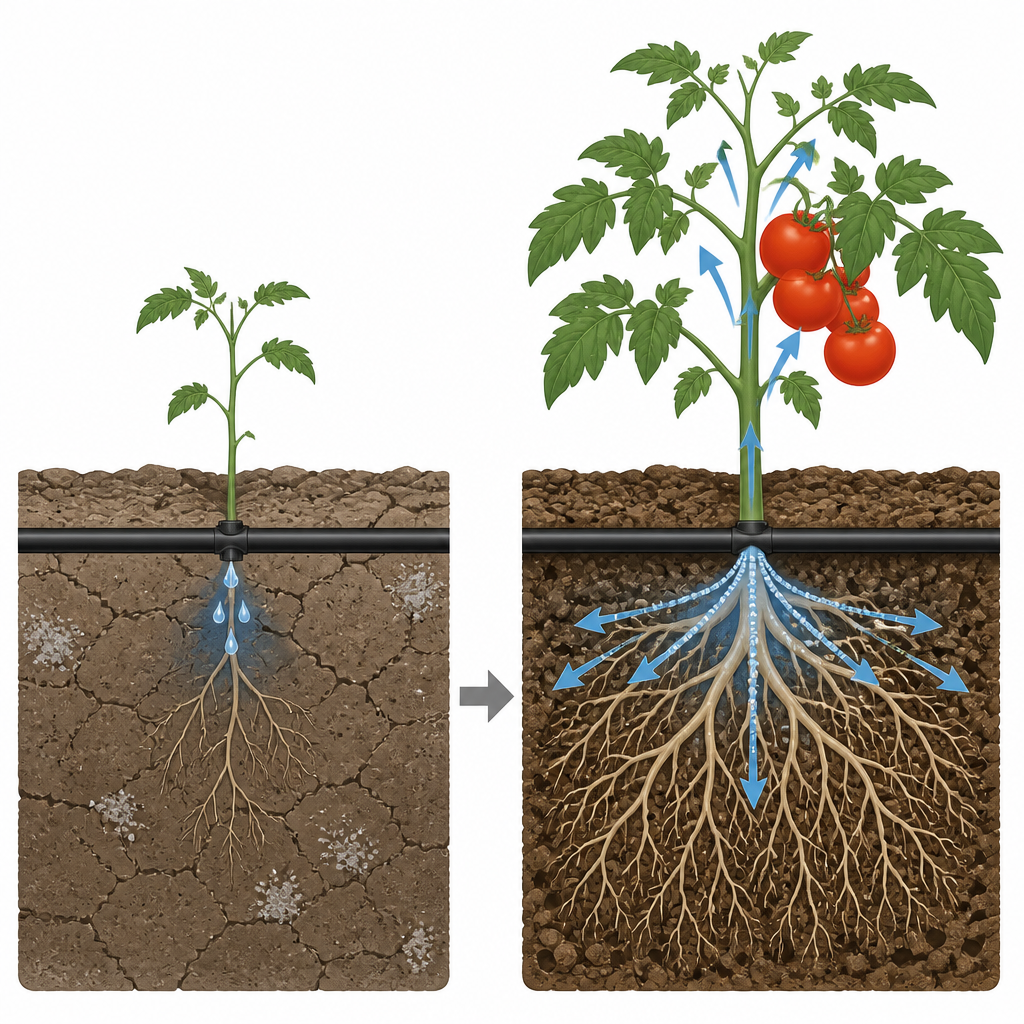
Balancing yield and fruit taste
Aerated irrigation increased tomato yield at every water level, with the strongest effect under full irrigation, where fruit weight per plant rose by about one fifth compared to the standard treatment. At the same time, aeration improved important quality traits. On average, fruits from aerated plots contained far more lycopene, vitamin C, and soluble sugars than those from non-aerated plots. Water amount had mixed effects: more water boosted yield and sugar content but tended to dilute lycopene and vitamin C, likely because fruits held more water. To weigh all these factors at once, the team used a statistical tool that combines many measurements into a single score.
Finding the best irrigation recipe
When the researchers combined growth, yield, and quality into an overall rating, the clear winner was aerated drip irrigation with the highest water level. This mix produced the strongest roots and leaves, the highest photosynthesis, the greatest yield, and very good fruit quality. All aerated treatments scored better than their non-aerated counterparts, showing that adding air to irrigation water can offset some of the damage caused by salty, compact coastal soils.
What this means for future tomato fields
For non-specialists, the message is straightforward: giving tomato roots more air through bubble-rich drip irrigation helps them cope with salty coastal ground. Stronger roots support bigger plants, better use of water, and more nutritious fruit. While the trials were done in one greenhouse season with a single variety, the approach offers a practical way to turn difficult coastal soils into productive tomato fields, supporting food production where land and fresh water are limited.
Citation: Meng, L., Zheng, Y., Ren, H. et al. Integrative effects of irrigation and aeration on root morphology, yield, and quality of tomatoes cultivated in coastal saline-alkali lands. Sci Rep 16, 16182 (2026). https://doi.org/10.1038/s41598-026-46058-z
Keywords: aerated drip irrigation, saline coastal soils, tomato yield, root growth, fruit quality