Clear Sky Science · en
Early-age strength evolution and brittle-to-ductile transition mechanism of basalt-fiber-reinforced cemented gangue backfill
Stronger underground supports from rock waste
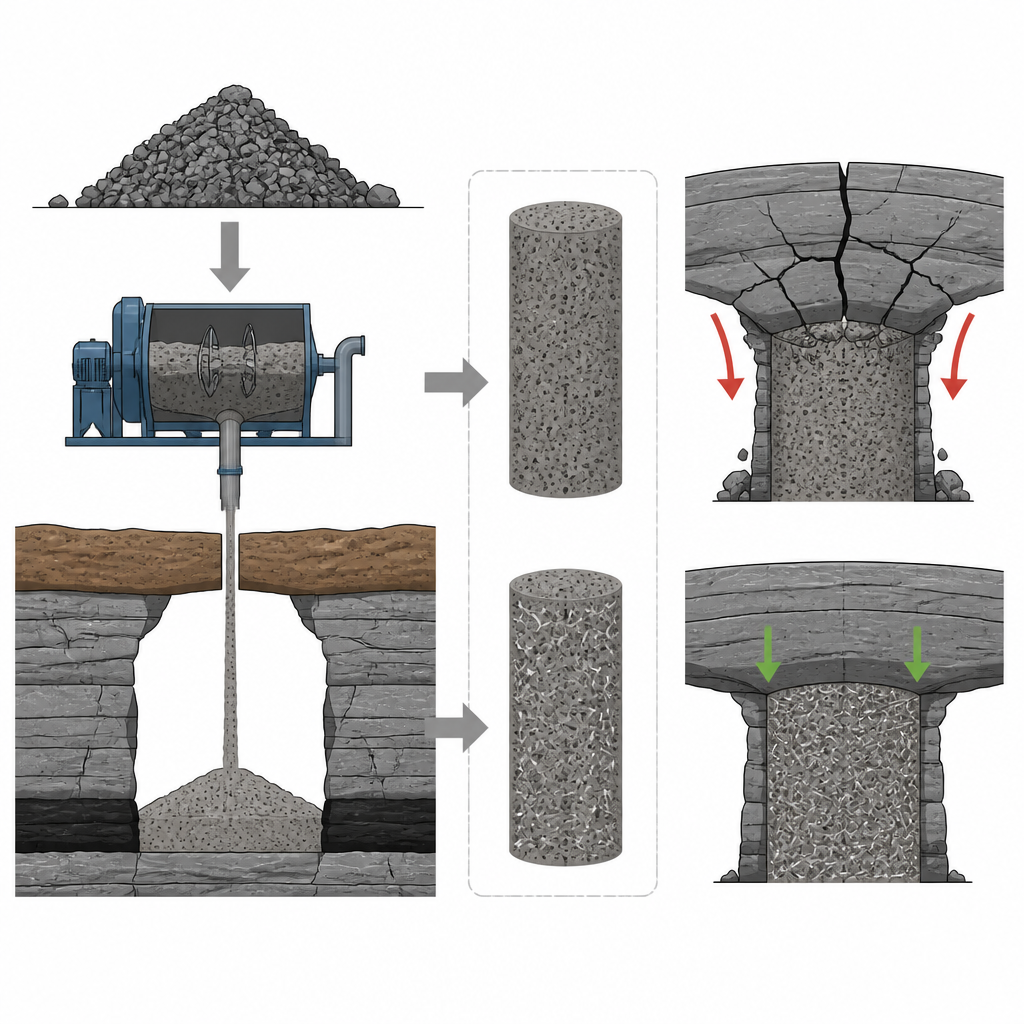
Modern mines often pump mixtures of crushed rock and cement into empty tunnels to hold up the roof and limit ground sinking at the surface. But these man-made pillars can crack suddenly, which threatens worker safety. This study explores how adding tiny basalt fibers to such fill can make it both stronger and less brittle during the crucial first weeks after placement.
Why mine backfill needs a makeover
The fill studied here is called cemented gangue backfill, made mostly from waste rock, fly ash, and a small amount of cement mixed with water. Once it hardens, it helps carry the weight of the overlying rock. Conventional mixtures, however, tend to behave like brittle stone: they resist compression up to a point, then lose strength very quickly once a main crack forms. The researchers wanted the backfill to behave more like a tough, slightly flexible material that can deform and spread damage instead of failing all at once.
Tiny fibers with a big job
The team mixed short chopped basalt fibers into the backfill at different weight fractions, from none up to 0.60 percent of the solid mass, and cured samples for 3 to 60 days. They then squeezed the cylinders in a testing machine to record how much load they could carry and how much they could strain before failure. A fiber content of 0.30 percent stood out: after 28 days, the compressive strength was about two thirds higher and the peak strain about one third higher than in fiber-free samples. Even more important for real mines, between day 3 and day 7 the strength of this mix jumped more than fourfold, reaching a level that can realistically support early mining near the backfilled area.
From sudden cracking to controlled damage
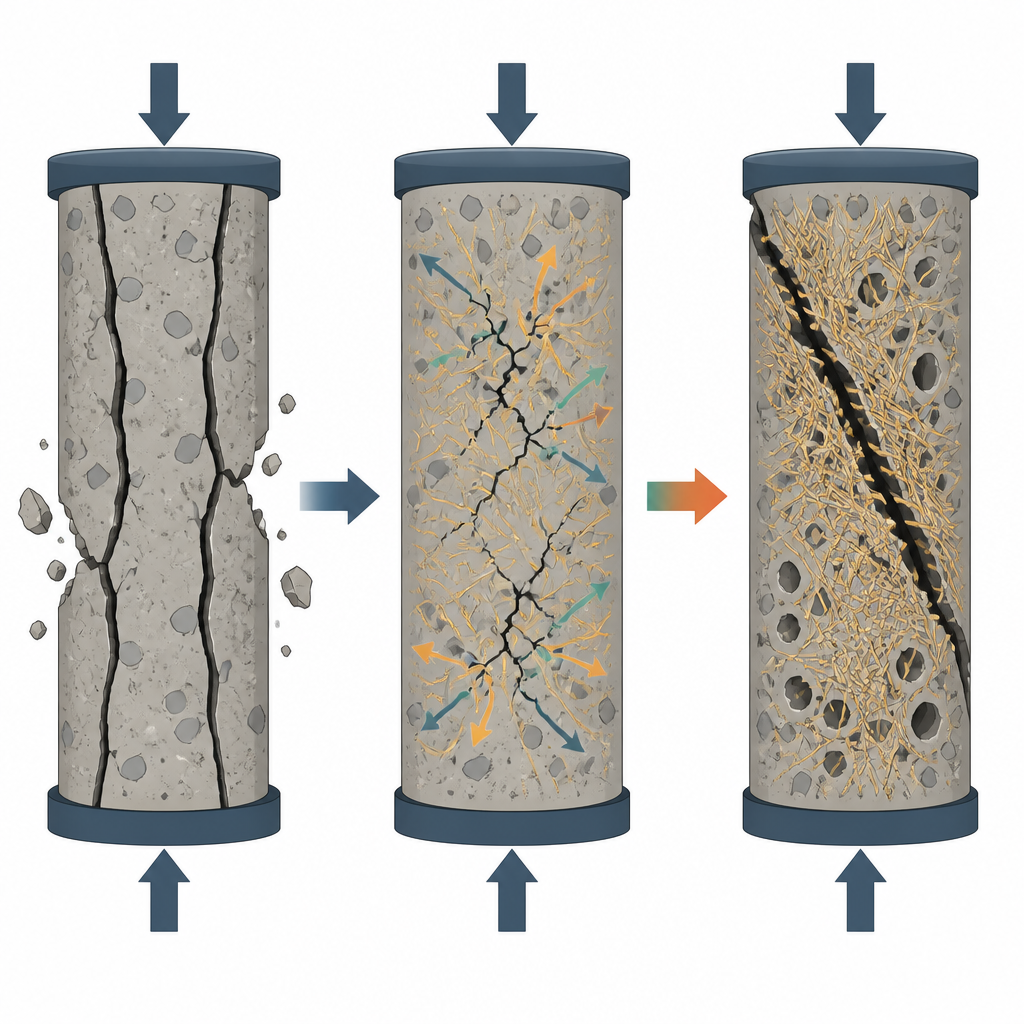
To see how the material broke apart, the researchers listened for tiny sound signals made by growing cracks and watched surfaces with cameras and digital image tools. In plain backfill, cracking was dominated by straight tensile splits that quickly cut through the sample, leading to abrupt loss of capacity. With fibers, cracks were diverted, branched, and sometimes forced into sliding paths, producing a more complex web of smaller cracks. At the optimal fiber content, damage spread in an oblique, mixed pattern instead of along a single vertical split, and the post-peak drop in strength became less steep. Computer simulations of many bonded particles backed up this picture, showing more numerous but smaller fracture segments and more shear-type contact failures when fibers were present.
What happens inside at the microscopic level
Electron microscope images revealed why fibers matter so much. In plain backfill, the hardened cement gel and crystals left many pores and weak spots where cracks could start. In fiber-reinforced samples, the basalt fibers were wrapped in a dense layer of hydration products that bonded them tightly to the surrounding matrix. This three-part interface of fiber, cement products, and rock particles acted like tiny anchors and bridges. When a crack approached a fiber, it tended to bend, split, or slow down rather than cutting straight through. However, when too many fibers were added, they clumped together and created new voids and weak bands, which could again guide rapid cracking and reduce the benefit.
Implications for safer and cleaner mining
For the conditions tested, a basalt fiber content near 0.30 percent offered the best balance of early strength, ductility, and resistance to sudden collapse. The improved backfill can be made largely from mine waste yet provide steadier roof support during the first week and beyond. Although further work is needed under the higher stresses found underground, these results suggest that carefully dosed fibers can turn brittle mine backfill into a tougher, more reliable support that also helps recycle waste rock.
Citation: Mao, J., Shi, X., Feng, J. et al. Early-age strength evolution and brittle-to-ductile transition mechanism of basalt-fiber-reinforced cemented gangue backfill. Sci Rep 16, 15141 (2026). https://doi.org/10.1038/s41598-026-46049-0
Keywords: basalt fiber, cemented gangue backfill, early age strength, mine roof support, crack evolution