Clear Sky Science · en
snRNA sequencing-based skeletal muscle analysis of Jiangquan black pigs with different average daily growth rates
Why pig muscle growth matters
Pork is one of the world’s most important sources of meat, so even small gains in how efficiently pigs grow can have big effects on food supply and farming costs. The Jiangquan black pig, a Chinese breed valued for both rich flavor and fast growth, offers a natural test bed for studying why some animals gain weight more quickly than others. In this study, researchers zoomed in on muscle at the level of individual cell nuclei to see how tiny differences in cell types and activity add up to big differences in growth and meat quality.
Two groups of pigs, one key muscle
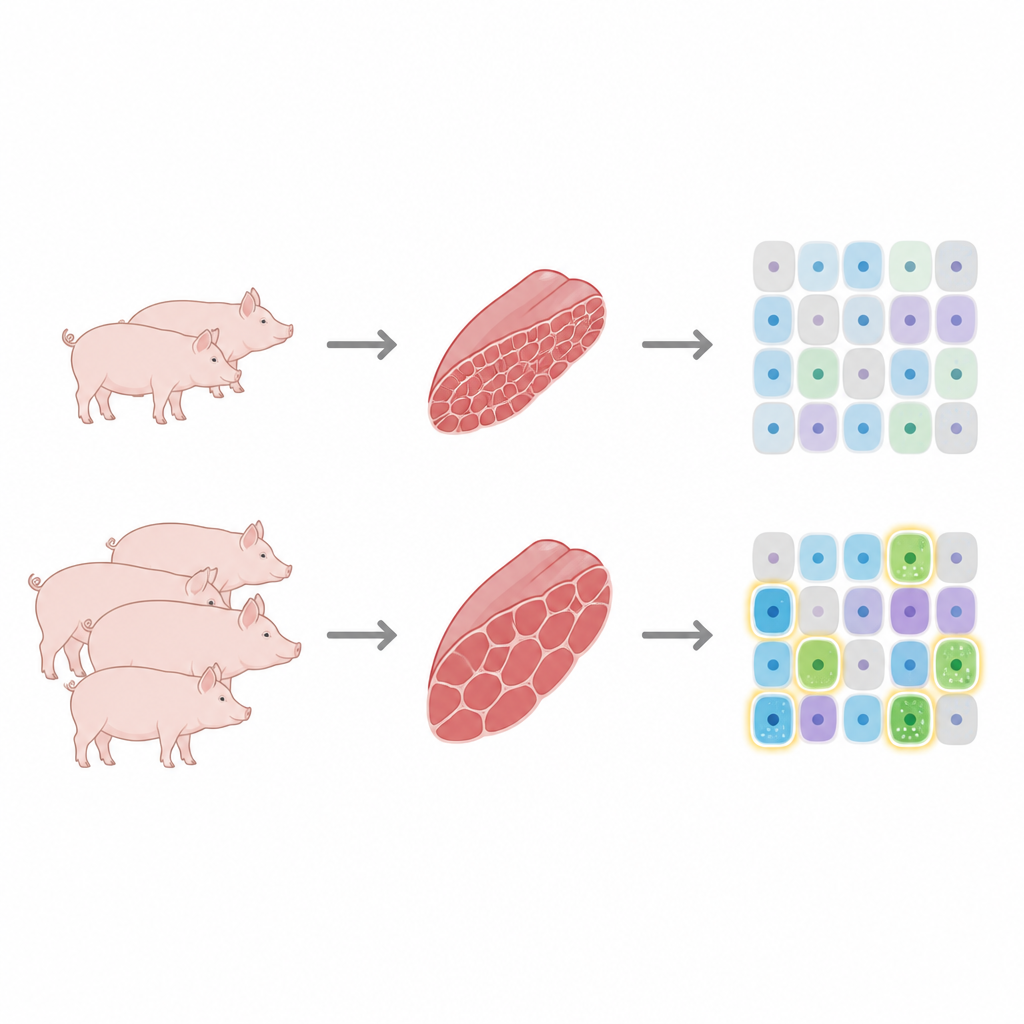
The team focused on the longissimus dorsi, a major muscle along the pig’s back that strongly influences meat yield and texture. They compared two sets of Jiangquan black pigs: one that reached market weight faster and one that grew more slowly, even though the animals shared similar genetic backgrounds and lived under the same conditions. By measuring daily weight gain, examining tissue slices under the microscope, and analyzing gene activity, they built a detailed picture of how muscle structure and growth differed between the fast and slow groups.
Zooming in on muscle cell diversity
To uncover what was happening inside the muscle, the researchers used single-nucleus RNA sequencing, a technique that reads which genes are active in thousands of individual cell nuclei at once. They identified 13 distinct cell types in the muscle, including mature muscle fibers, stem-like cells, satellite cells that help repair and build muscle, connective tissue cells, blood vessel cells, immune cells, and fat cells. This cell-by-cell view revealed that the fast-growing pigs had higher proportions of muscle stem cells, satellite cells, and certain fat cells, while the slow-growing pigs had more mixed or intermediate muscle cell types. In simple terms, the faster pigs carried more “builder” cells ready to expand and remodel muscle.
From stem cells to thicker fibers
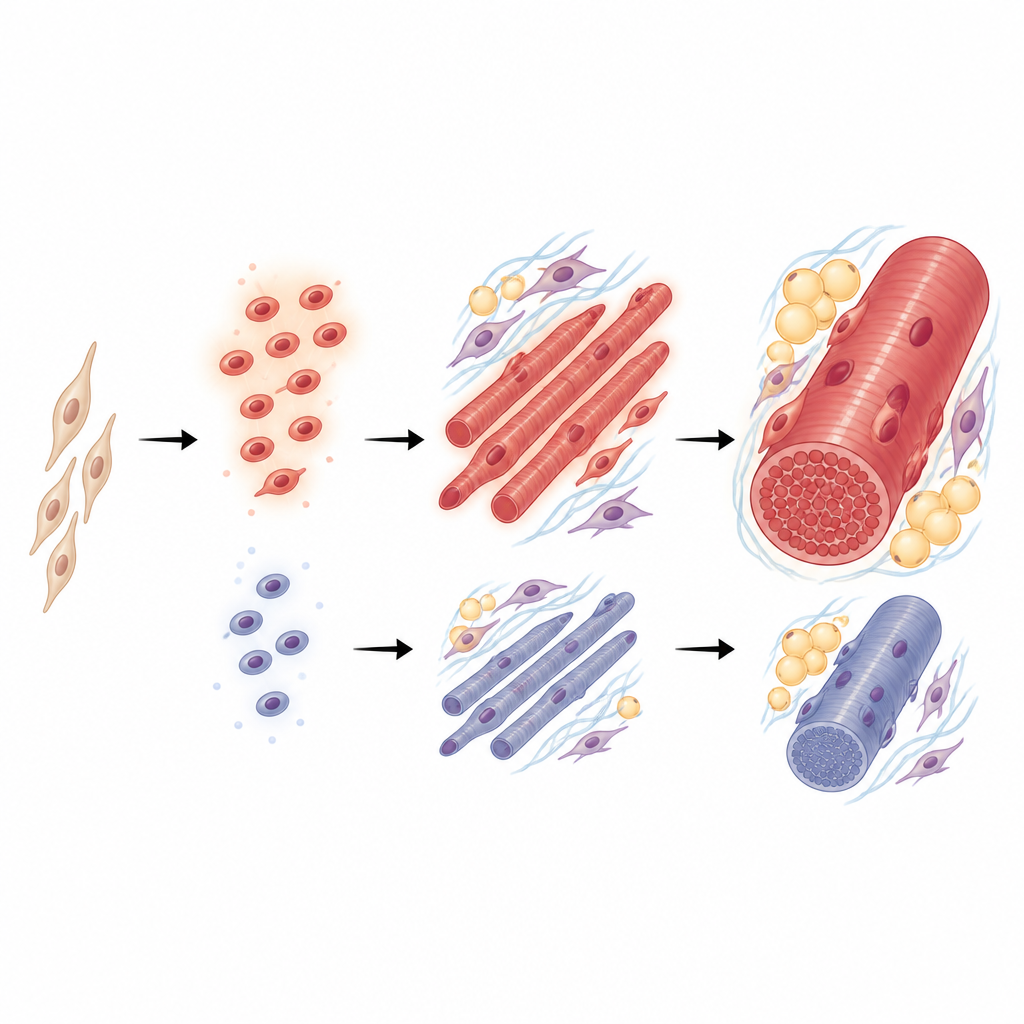
By arranging cells along virtual timelines based on their gene activity, the team traced how immature cells progress into fully formed muscle fibers. Key genes known to guide muscle formation switched on in a clear order: early markers appeared first in stem-like cells, followed by genes tied to active growth and fiber formation. In fast-growing pigs, these growth-related genes were more strongly expressed and stayed active in both early and later cell stages. Microscopy confirmed that their muscle fibers had larger cross-sectional areas, and molecular tests showed more of the gene variants linked with quick, powerful, glycolytic fibers, which favor rapid growth over endurance.
Cell-to-cell conversations in growing muscle
Muscle does not develop in isolation, so the researchers also examined how different cell types “talk” to one another using chemical signals. By matching gene activity in potential signal senders and receivers, they mapped hundreds of likely communication pairs between muscle cells and their neighbors, especially fibroblasts (connective tissue cells), fat cells, blood vessel cells, and immune cells. Certain signal pairs involving a receptor called ERBB4 stood out in links between muscle and fat cells, hinting that cross-talk between these tissues may help tune growth and tissue composition. Many of the genes that differed between fast and slow growers were also connected to pathways involved in energy use and disease, suggesting that growth rate is intertwined with broader health-related processes.
What this means for pigs and pork
For a non-specialist, the key message is that faster-growing Jiangquan black pigs owe their advantage not just to bigger muscles, but to a richer pool of muscle-building cells, more active growth genes, and busy communication networks among muscle, fat, blood vessels, and connective tissue. This work provides a detailed cellular map of pig muscle that breeders and geneticists can use to identify markers linked to desirable traits such as growth rate and meat quality. While further experiments are needed to test cause and effect, the study lays the groundwork for more precise, science-guided breeding of pigs that grow efficiently while maintaining high-quality meat.
Citation: Cao, H., Wang, J., Wang, Y. et al. snRNA sequencing-based skeletal muscle analysis of Jiangquan black pigs with different average daily growth rates. Sci Rep 16, 15443 (2026). https://doi.org/10.1038/s41598-026-46048-1
Keywords: pig muscle, single cell RNA sequencing, muscle stem cells, growth rate, meat quality