Clear Sky Science · en
Optimizing efficiency and sustainability: ANN-controlled bi-directional EV battery charger with solar PV integration
Cars that can power your home
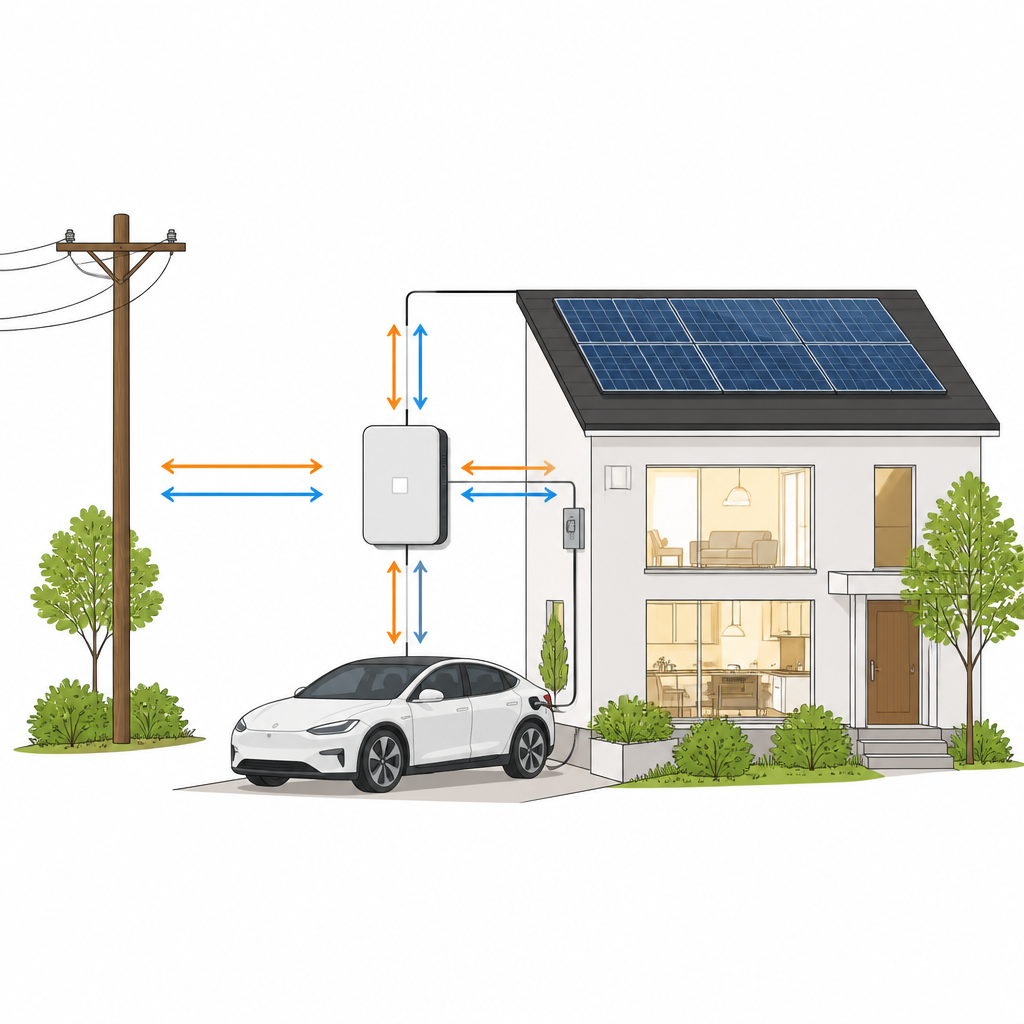
Imagine your electric car not only sipping clean solar power from your roof, but also acting as a backup battery for your home when the lights go out. This study explores how to make that vision practical and efficient by combining rooftop solar, smart electronics, and a learning computer program that keeps electricity flowing smoothly in both directions.
Why smarter charging matters
Electric vehicles are spreading quickly, and so are solar panels. Yet most chargers today only move power one way, from the grid into the car, and they use simple control methods that struggle when sunshine and grid conditions change. The authors argue that to get the most out of clean energy, we need charging systems that can share power among the grid, the car, and the home, while reacting intelligently to clouds, changing household demand, and the car battery’s state of charge.
A two way power bridge
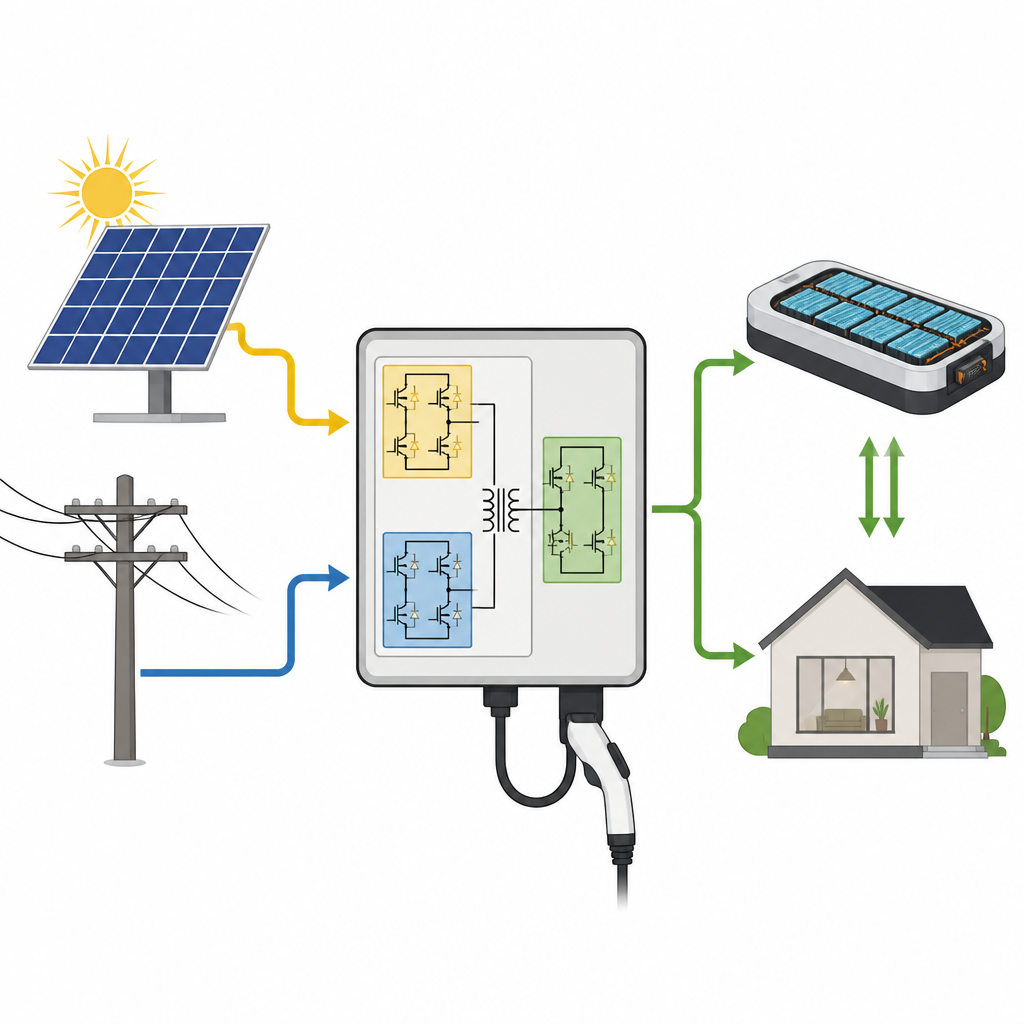
The researchers design a charging setup that links three players: a solar panel array, the public grid, and an electric vehicle battery. At its heart is a special power converter that can boost or reduce voltage and, crucially, send energy in both directions. In “grid to vehicle” mode, it channels electricity from solar and, if needed, the grid into the battery. In “vehicle to home” mode, it reverses the path so the car can run household appliances. The same hardware handles small batteries used in two wheelers and larger packs in family cars, showing that one design can serve different types of vehicles.
A charger that learns as it works
Instead of relying on a traditional rule based controller, the team uses an artificial neural network, a computer model inspired by how the brain learns from examples. In computer simulations, this network looks at how much current is flowing into or out of the battery and how much should be flowing. It then adjusts the tiny on off pulses that drive the electronic switches inside the converter. Because it has been trained on many different scenarios, it can react quickly when solar power dips, when grid voltage wobbles, or when the operating mode shifts between charging the car and powering the home. Compared with standard proportional–integral controllers, it settles into stable operation faster and keeps the current closer to the desired value.
Making the most of sunshine
The system is set up to favor solar energy whenever it is available. During sunny periods, most of the charging power comes from the panels, trimming the draw from the grid and cutting indirect emissions. When clouds roll in or evening falls, the controller smoothly increases support from the grid so the driver still gets a reliable charge. In home supply mode, the car’s battery can feed a household load while the control system maintains a steady output, even as the load changes. Across a wide range of test cases and for both low and high voltage batteries, the simulated charger reaches efficiencies above 90 percent and keeps voltages and currents within safe limits.
What this means for everyday users
For drivers and homeowners, the work points toward chargers that are more than simple plugs. A car connected through this kind of intelligent, solar aware, two way system could charge quickly and efficiently on sunny days, lean less on the grid at peak times, and step in as a quiet backup power source during outages. While the results so far come from detailed computer models rather than physical hardware, they suggest that combining solar panels, a bidirectional converter, and a learning based controller can turn electric vehicles into flexible energy partners for cleaner, more resilient homes.
Citation: Poojary, R., Perumal, R. & Sachidananda, H.K. Optimizing efficiency and sustainability: ANN-controlled bi-directional EV battery charger with solar PV integration. Sci Rep 16, 15094 (2026). https://doi.org/10.1038/s41598-026-46047-2
Keywords: electric vehicle charging, solar PV, bidirectional charger, neural network control, vehicle to home